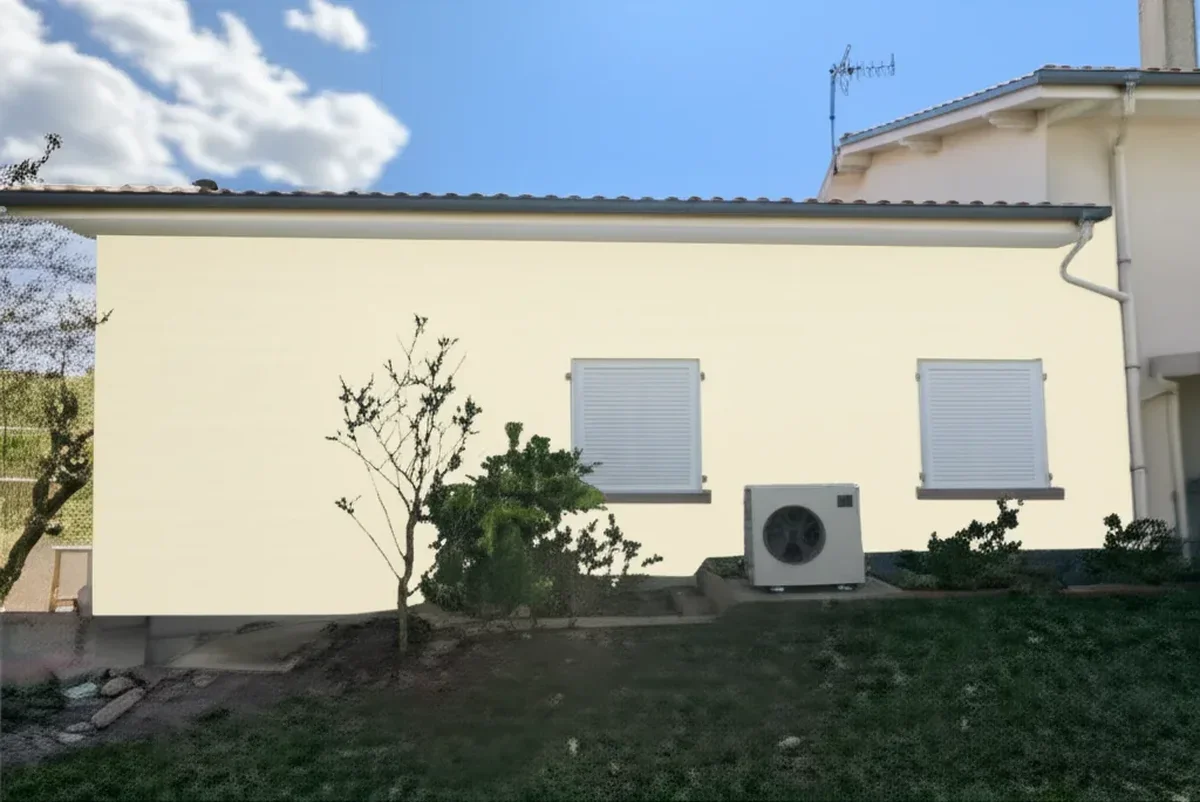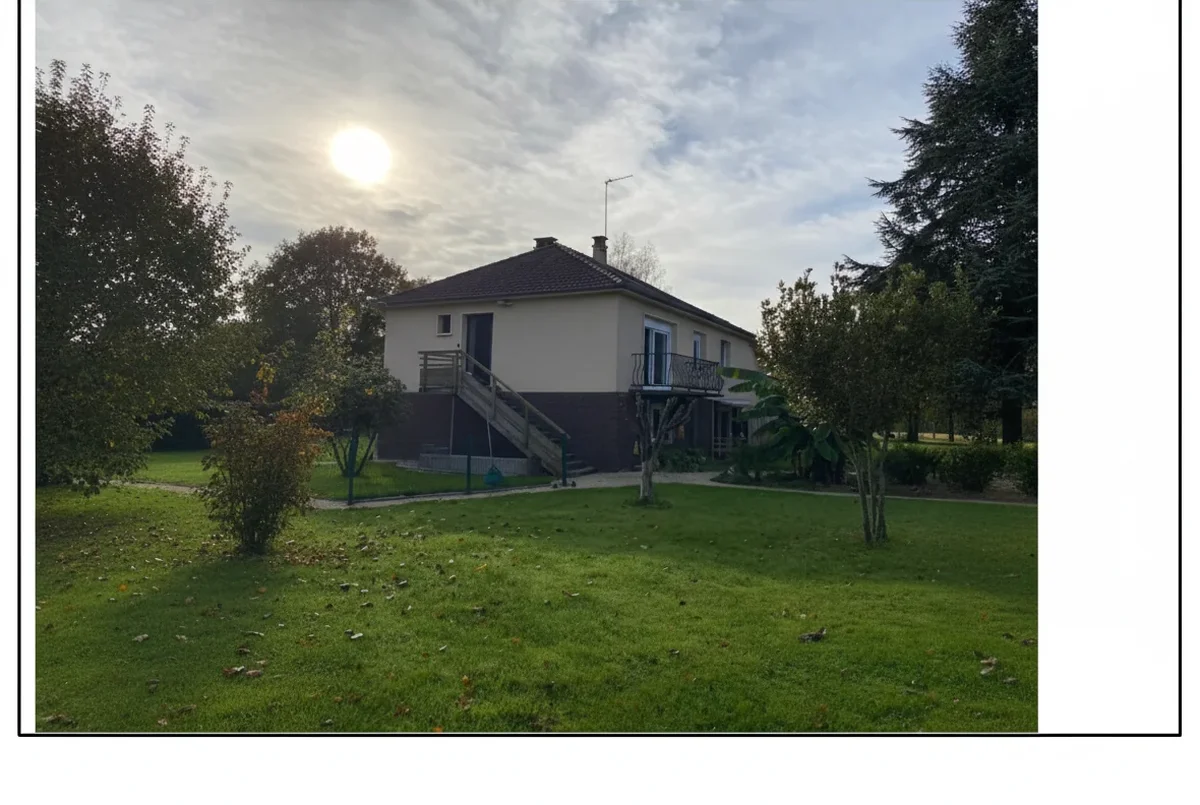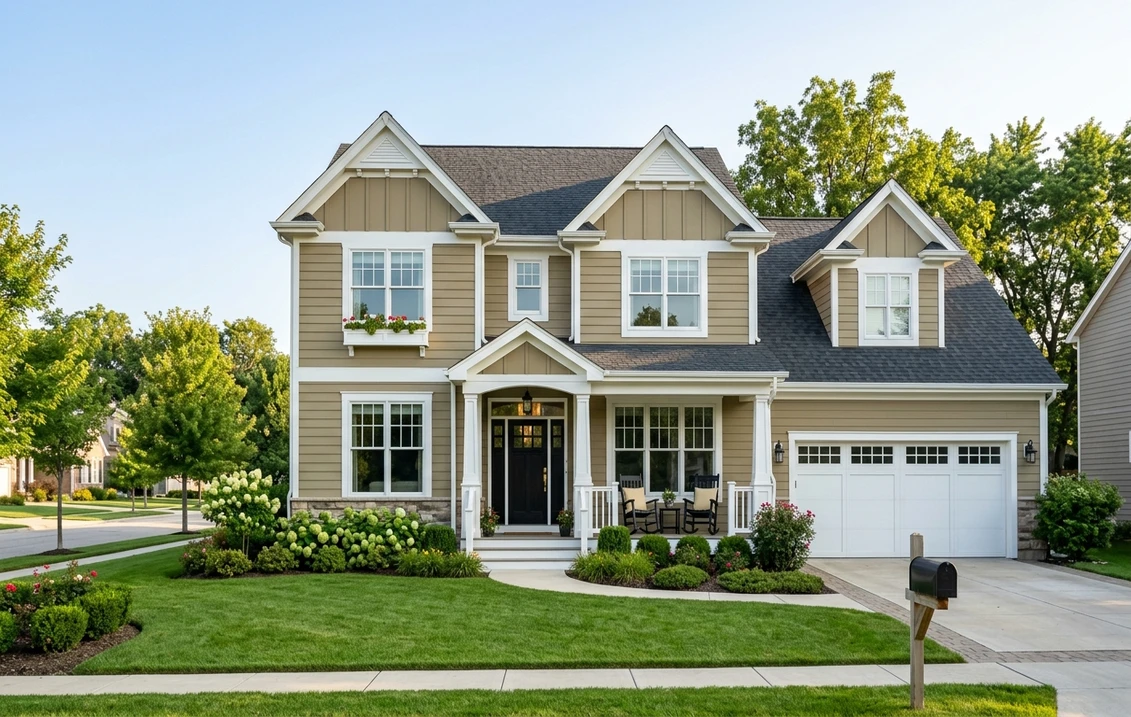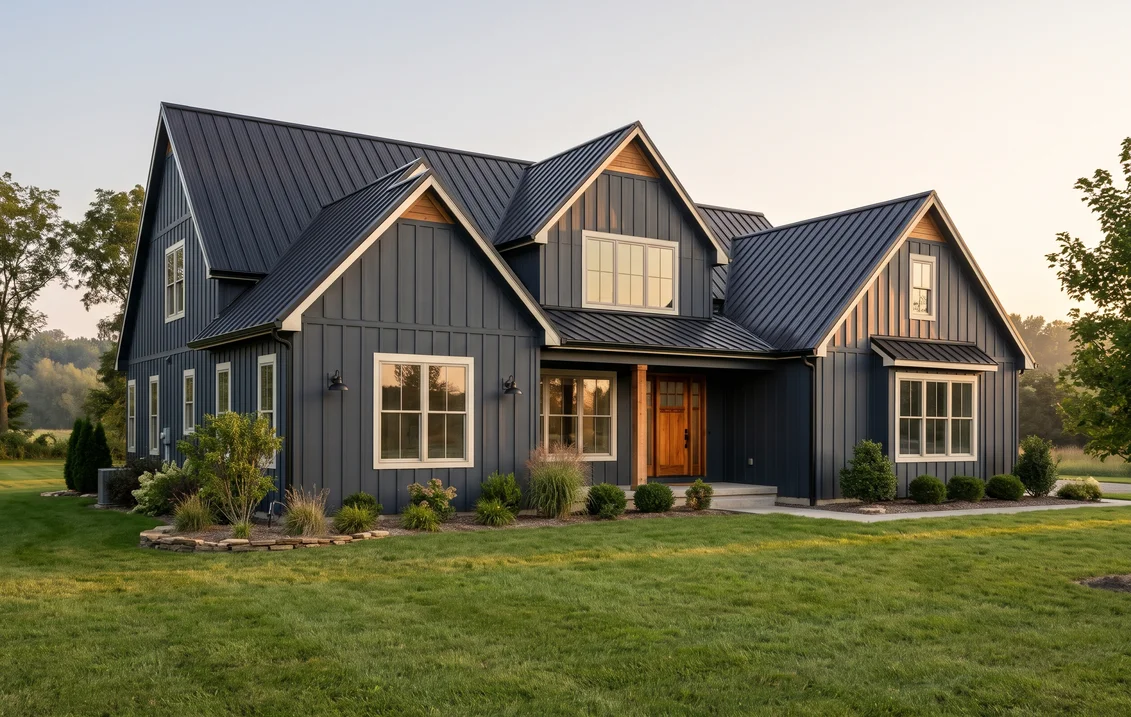

Sherwin-Williams Charcoal Blue (SW 2739) is a very dark slate navy: a charcoal that has been pushed toward blue, or a navy that has been muted with gray, depending on the light. Its Light Reflectance Value (LRV) is about 5.7 and its screen rendering is #3D4450 (RGB 61, 68, 80). On a house it reads as a deep blue-gray in full sun and as a soft charcoal on the shaded side. It is a strong choice for board and batten, cedar-accented modern farmhouses and coastal homes where a classic navy would feel too bright.
The code, LRV, color family, collection, interior and exterior availability and the coordinating colors come from the official Sherwin-Williams Charcoal Blue SW 2739 page and the brand's public color data, read on 25/11/2026. The Delta E 2000 distances to other colors are our own calculations from published screen values, and the exterior advice is our color reasoning, not a manufacturer claim. Dark colors are hard to judge on a screen, so always test a large painted sample on the house itself.
Upload a photo of your home and preview SW 2739 on the siding before buying a gallon. More options on our exterior paint visualizer page.
What Sherwin-Williams publishes for SW 2739
| Attribute | Sherwin-Williams Charcoal Blue SW 2739 |
|---|---|
| Color name and code | Charcoal Blue, SW 2739 |
| Light Reflectance Value | About 5.7 (5.67 in the brand's data) |
| Screen hex and RGB (approximate) | #3D4450 (RGB 61, 68, 80) |
| Color family | Neutral (not Blue, which says a lot about how gray it is) |
| Collection | 2019 Aficionado color forecast |
| Use | Interior and exterior |
| Coordinating colors listed by Sherwin-Williams | Gossamer Veil SW 9165, Moonlit Orchid SW 9153 and, as the white, Creamy SW 7012 |
| Undertone reading (our analysis) | Cool slate blue under a charcoal veil; no green, no violet |
Try it on your house
- 1Your photoPhoto
- 2Your colorColor
- 3HD render in ~30 sHD render in ~30 s
Your photo is used only to create your preview. JPG, PNG, HEIC (iPhone)
LRV is the share of visible light a surface reflects, from 0 for a perfect black to 100 for a perfect white. At about 5.7, Charcoal Blue reflects roughly 6 percent of the light that hits it, which puts it in the same band as most "almost black" exterior colors. On a house this means two things: the color will look rich and saturated only where sunlight falls on it directly, and the siding will absorb a lot of heat. Both points shape how you should use it, and they are covered below.
The coordinating colors are a useful hint about how Sherwin-Williams sees this shade. Instead of a crisp blue-white, the brand pairs it with Creamy, a warm off-white with an LRV of about 81, and with Gossamer Veil, a light warm greige at about 62. The message is that Charcoal Blue is meant to sit in a warm, relaxed palette, not in a nautical red-white-and-blue scheme.
How much blue is in Charcoal Blue?
The screen values answer the question better than the name. Blue is the highest channel at 80, green sits at 68 and red at 61. The gap between blue and red is only 19 points, which is small for a color sold as a blue: a classic navy such as Naval SW 6244 (#2F3D4C) has a gap of 29 points and reads clearly blue. In plain terms, Charcoal Blue is a charcoal with a moderate blue lean. That is why Sherwin-Williams files it in its Neutral family rather than with the blues.
Outside, this balance plays out with the sun. Direct light lifts the blue channel and the siding looks like a dusty slate navy. In open shade under a blue sky, the color turns grayer and flatter. Under an overcast sky it can look close to a dark charcoal, and at dusk most passers-by will read it as near-black. If you want a house that clearly says "blue" from the street at every hour, a brighter navy will serve you better. If you want a dark house that hints at blue without committing to it, Charcoal Blue is exactly in that zone.
Sun, shade and orientation
| Facade exposure | How Charcoal Blue tends to look | What to plan for |
|---|---|---|
| South-facing front | The bluest version: slate navy for most of the day | Most heat on the siding; use a premium exterior paint and check vinyl rules |
| North-facing front | Steady charcoal with only a faint blue cast | Brighten the entry with a warm white trim and a lit front door |
| East-facing front | Blue and crisp in the morning, charcoal from midday | Judge your sample in the afternoon, when most visitors arrive |
| West-facing front | Gray during the day, warm and deep in evening sun | Late sun heats the walls; avoid painting in the afternoon |
| Deep porch or heavy tree shade | Almost black | Consider a slightly lighter blue-gray if you want the color to show |
Materials change the result too. On smooth fiber cement or painted smooth panels, the color looks uniform and modern. On rough-sawn cedar or textured siding, the small shadows inside the grain make it look darker and grayer than the chip. On brick, a very dark color tends to look heavy, so most owners keep brick for a base or chimney and paint only the siding.
Charcoal Blue next to Naval, Cyberspace, Sea Serpent and Hale Navy
Charcoal Blue sits in a crowded corner of the fan deck, between the navies and the charcoals. We calculated the Delta E 2000 distance from published screen values for the colors it is most often compared with. As a rule of thumb, below about 1 two colors are very hard to tell apart; between 1 and 2 the difference shows side by side; between 2 and 5 it is visible on a wall; above 5 most people see a different color.
| Color | Screen hex | LRV | Delta E 2000 to SW 2739 (our calc.) | How it differs |
|---|---|---|---|---|
| SW 2739 Charcoal Blue (reference) | #3D4450 | about 5.7 | 0 | Slate navy, charcoal in shade |
| SW 9640 Sea Mariner | #434A54 | about 6.7 | 2.30 | The closest Sherwin-Williams color: a little lighter and grayer |
| SW 6244 Naval | #2F3D4C | about 4.5 | 3.85 | Deeper and clearly bluer; a true navy |
| SW 7076 Cyberspace | #44484D | about 6.4 | 4.00 | Grayer, almost a neutral charcoal with a faint blue |
| SW 7615 Sea Serpent | #3E4B54 | about 6.7 | 4.46 | A touch lighter with a slight teal lean |
| SW 7605 Gale Force | #35454E | about 5.6 | 5.20 | Same depth, more teal-blue |
| SW 9178 In the Navy | #283849 | about 3.7 | 5.55 | Darker and bluer, a deep classic navy |
| SW 7069 Iron Ore | #434341 | about 5.6 | 8.28 | Same depth with no blue at all: a soft black |
| BM HC-154 Hale Navy | #434B56 | luminance about 6.9 (calc.) | 2.47 | The usual Benjamin Moore counterpart: a hair lighter and grayer |
| Behr PPU14-20 Starless Night | #3E4855 | luminance about 6.3 (calc.) | 1.77 | The closest of the three brands by our calculation |
Three lessons come out of this table. First, nothing in the Sherwin-Williams deck is a near twin: Sea Mariner, from the Designer Color Collection, is the nearest at 2.3, close enough to be a real alternative if Charcoal Blue looks a shade too dark on your house. Second, Naval and Cyberspace sit on either side of it, one bluer and one grayer, which makes Charcoal Blue a good compromise when a couple disagrees between "navy" and "charcoal". Our Naval exterior guide shows the bluer side, and the Hale Navy vs Cyberspace comparison covers the same navy-or-charcoal question between two brands. Third, if you shop at The Home Depot, Behr Starless Night is the closest match we measured; Behr's own description calls it a deep navy that tips toward black.
If you liked Sea Serpent but want less teal, Charcoal Blue is the logical next sample; our Sea Serpent exterior guide covers that slightly lighter blue-charcoal. For the whole family of deep blues in the brand's range, see our guide to Sherwin-Williams dark blue paint colors.
Trim, door and roof pairings
| Element | Pairing with SW 2739 | Result |
|---|---|---|
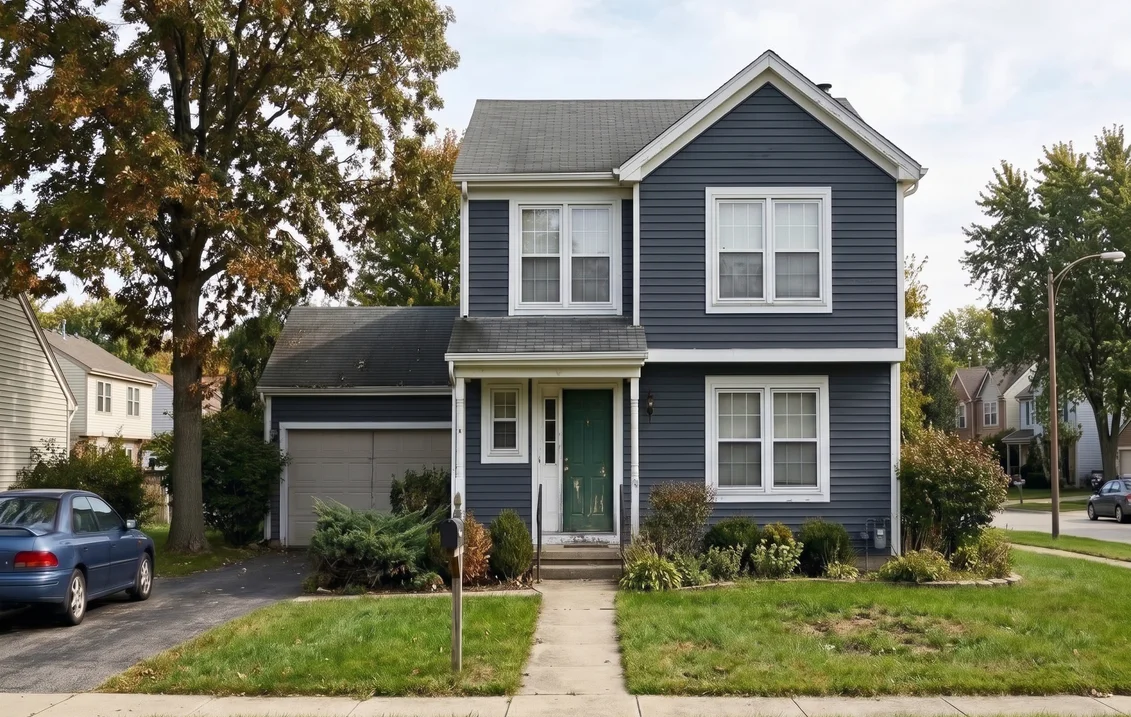
| Trim (soft) | Creamy SW 7012 | The brand's coordinating white: warm, relaxed contrast that keeps the house from looking stark |
| Trim (crisp) | Pure White SW 7005 or Extra White SW 7006 | Sharper outlines; Extra White is the brightest and suits modern lines |
| Second body color or gables | Gossamer Veil SW 9165 | Light warm greige for an upper story, porch ceiling or a garage in a two-tone scheme |
| Front door | Natural cedar or walnut stain, or a warm brick red | Warm wood is the easiest win; a red door reads traditional |
| Roof | Black or charcoal shingles, dark bronze or black metal | A dark roof keeps the house calm; a light gray roof can look washed out above this body |
| Stone and hardscape | Gray fieldstone, bluestone, light concrete | Cool stones echo the blue; very yellow stone fights it |
| Lights and hardware | Black, aged brass or copper | Brass and copper glow against the dark body at night |
Window frames deserve a separate thought. Black frames on a Charcoal Blue body almost disappear, which works on minimalist houses but can make older houses look as if they have no windows from the street. White or cream frames outline each window and give a more traditional look. If your windows are vinyl in an almond or tan color, test the trim white against them: Creamy usually bridges a tan frame better than a blue-white.
Heat, fading and siding: the price of a dark body color
With about 94 percent of sunlight absorbed, a Charcoal Blue wall in direct summer sun gets much hotter than a light wall. Wood and fiber cement tolerate that, but the paint film works harder: expect the sunniest wall to fade or chalk first, and plan a touch-up there before the rest of the house needs it. Vinyl is the real concern, because it softens with heat. Many vinyl siding manufacturers restrict dark colors in their warranties unless the paint is specifically formulated for vinyl, so read your siding warranty and ask your store whether this color can be tinted in a vinyl-safe formula before painting vinyl.
- Pick a premium exterior line. Sherwin-Williams presents Emerald Exterior Acrylic Latex as its top exterior paint; its product page and data sheet list coverage, sheens and application conditions.
- Choose satin rather than flat on siding. A low sheen sheds rain and dirt better, and dark flat paint shows rub marks and chalking sooner.
- Follow the shade around the house. Paint each wall when it is out of direct sun, so the film does not dry too fast and leave lap marks.
- Budget two full coats. Deep colors are mixed in a deep base and rarely cover evenly in one coat, especially over a light previous color.
- Keep a labeled can. Repairs show more on dark colors, so keep touch-up paint from the same batch.
Older houses need one more check. If your home was built before 1978, the existing paint may contain lead. The US Environmental Protection Agency's Renovation, Repair and Painting program requires contractors who disturb paint in pre-1978 homes to be certified and to use lead-safe work practices. Scraping and sanding are the critical steps, so ask about certification before you sign a quote. For more on what dark colors ask of a house over the years, read our pros and cons of dark exterior paint colors.
House styles that suit Charcoal Blue
- Modern farmhouse with board and batten: the vertical lines catch light and shadow, so the color looks rich and textured. Pair with Creamy trim and a cedar porch.
- Craftsman bungalow: a dark slate body with cream trim and a stained door is a natural update of the traditional deep blues of the style.
- Cape Cod and coastal cottages: softer than a navy, it suits gray shingles, white fences and weathered wood.
- Contemporary houses: on smooth panels with large windows and warm wood soffits, it reads as a sophisticated near-black with a blue glint in the sun.
- Accent only: on a white or light gray house, use it for shutters, the front door or the garage doors; at door scale its blue side shows more clearly.
Neighborhood context matters too. In a street of white and beige houses, a dark slate house stands out strongly, which is the point for many owners but can feel heavy on a small lot. Planting helps: green lawns, boxwoods and grasses look especially vivid against a blue-charcoal body. If your HOA has a color list, check it before you buy, because some associations limit very dark body colors.
Three complete exterior schemes with Charcoal Blue
| Scheme | Body | Trim | Door and accents | Roof |
|---|---|---|---|---|
| Warm coastal | Charcoal Blue SW 2739 | Creamy SW 7012 | Natural cedar door, aged brass lights | Charcoal shingles |
| Crisp modern | Charcoal Blue SW 2739 | Extra White SW 7006 | Black door, black lights, warm wood soffits | Black standing seam metal |
| Soft two-tone | Gossamer Veil SW 9165 upper, Charcoal Blue lower | Creamy SW 7012 | Charcoal Blue door, copper lantern | Weathered wood or dark gray shingles |
For a broader overview of the brand's exterior palette and how its dark colors compare, start with our Sherwin-Williams exterior paint guide. If you are still deciding between a blue and a black house, our navy and dark blue siding guide lines up the main options side by side.
How to test Charcoal Blue outside
- Use big samples. Paint two coats on a board at least 2 by 2 feet. A small chip shows almost nothing of how a dark color behaves outdoors.
- Place them on two sides. One on the sunniest wall, one on the shadiest. The difference between the two will surprise you.
- Look from the street. Step back 30 to 50 feet. Dark colors read darker at a distance, and the blue becomes harder to see.
- Check morning, noon and evening. Include a cloudy day if you can: that is the version you will see most in winter.
- Hold the trim white against it. Compare Creamy and Extra White in place; the right white often decides whether the scheme feels warm or sharp.
- Compare with one neighbor. Put Naval or Sea Mariner next to it. One glance tells you whether you want bluer, lighter or exactly this.
Preview Charcoal Blue on your own house
An LRV and a hex code describe the color, not your house. Your roof, your windows, your trees and the direction your facade faces will decide how SW 2739 really looks. Upload a photo of your home and the visualizer shows Charcoal Blue on the siding, so you can compare it with Naval or Sea Mariner before buying sample pots.
Sources and references
- Sherwin-Williams, Charcoal Blue SW 2739: code, LRV, screen rendering, color family, collection, interior and exterior use, coordinating colors (read 25/11/2026).
- Sherwin-Williams, Emerald Exterior Acrylic Latex: product page and data sheet of the brand's premium exterior line.
- Benjamin Moore, Hale Navy HC-154: official page of the Benjamin Moore color most often compared with Charcoal Blue.
- US Environmental Protection Agency, Lead Renovation, Repair and Painting Program: rules for disturbing paint in homes built before 1978.
Frequently asked questions
What color is Sherwin-Williams Charcoal Blue SW 2739?
Is Charcoal Blue more blue or more gray?
What is the difference between Charcoal Blue and Naval?
What trim color goes with Charcoal Blue on a house?
What is the Benjamin Moore equivalent of Charcoal Blue?
Can you paint vinyl siding Charcoal Blue?
Trademarks mentioned (Sherwin-Williams, Benjamin Moore, Behr, Caparol, Brillux, Sto, Alpina, Valspar, PPG, Glidden, Dulux, Crown Trade, Sandtex, Farrow & Ball, Johnstone's, Leyland) are property of their respective owners. FacadeColorizer is independent and not affiliated with any of them. Nominative fair use under Lanham Act §1125.