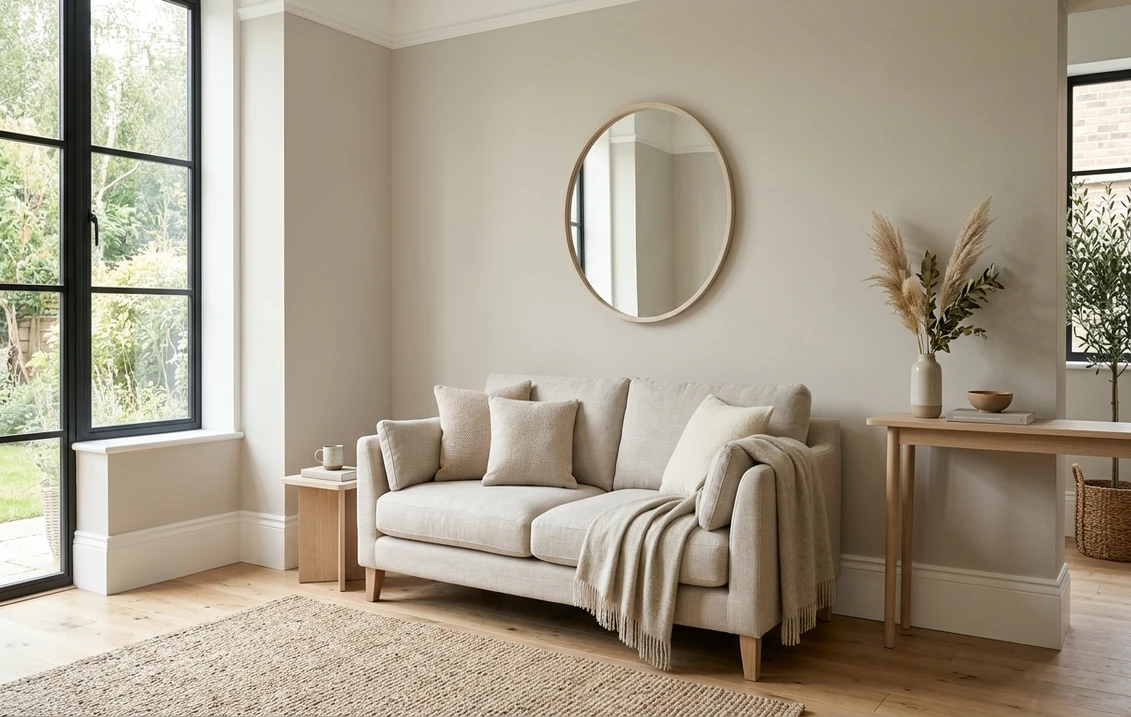
Try it on your room

Benjamin Moore Collingwood (OC-28) is the greige homeowners reach for when they want the whole house to feel calm, current, and hard to get wrong. It is one of the most requested neutrals Benjamin Moore makes, and the appeal is easy to explain: it is light enough to keep rooms bright, warm enough to feel inviting, and quiet enough to sit under almost any furniture. The reason people still search it before committing is the fine print. Collingwood is a greige, which means it can lean gray, lean warm, or in the wrong light show a faint violet cast. Here is exactly how it behaves on real interior walls.
Collingwood OC-28 belongs to Benjamin Moore's Off-White collection and has a published LRV of 62, with a hex value of #D4CFC5 (RGB 212, 207, 197). That number places it in soft, light-greige territory: it reflects well over half the light that hits it, so it never reads dark, yet it holds a hair more color than a true off-white, which is what keeps it from looking flat or builder-basic. This profile is one stop in our wider Benjamin Moore interior paint colors guide, which maps the whole family.
Upload a photo of your actual room and preview BM Collingwood under your own light in about 30 seconds, free.
Collingwood at a glance: the numbers that matter
Before opinions, the verifiable specs. These are the values you can take to a paint counter:
| Spec | Collingwood OC-28 |
|---|---|
| Color number | OC-28 (Off-White collection) |
| LRV (Light Reflectance Value) | 62: a soft light greige that keeps rooms bright |
| Hex / RGB | #D4CFC5 / 212, 207, 197 |
| Color family | Warm light greige (gray plus beige) |
| Primary undertone | Warm greige; a subtle violet-gray can surface in cool north light |
| Best base / finish | Eggshell or matte on walls, satin on doors and trim |
Try it on your house
No photo? Try a sample
The takeaway from those numbers: Collingwood is a light, easygoing neutral, not a bold statement color. An LRV of 62 means it bounces plenty of light and reads friendly in most rooms, which is exactly why it has a reputation for working anywhere. But the same greige recipe that makes it flexible also makes it responsive to light: it can look warmer, grayer, or faintly cool depending on your windows and bulbs. Knowing which read you are going to get is the whole game.
Is Collingwood warm or cool? The undertone, decoded
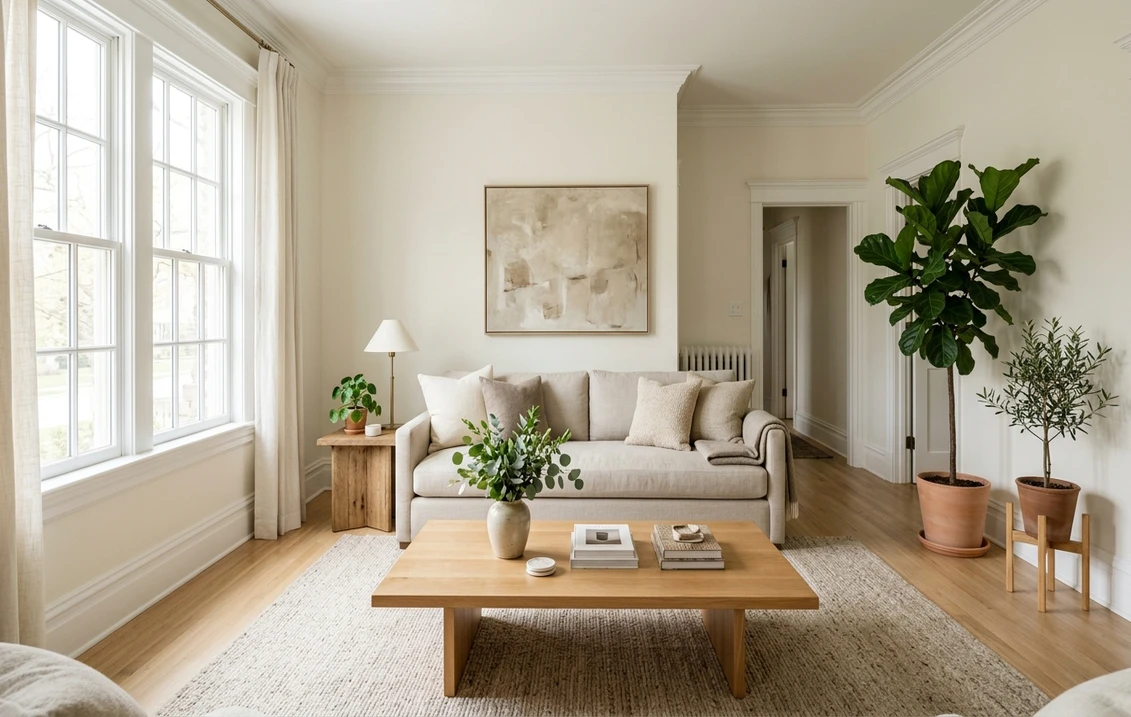
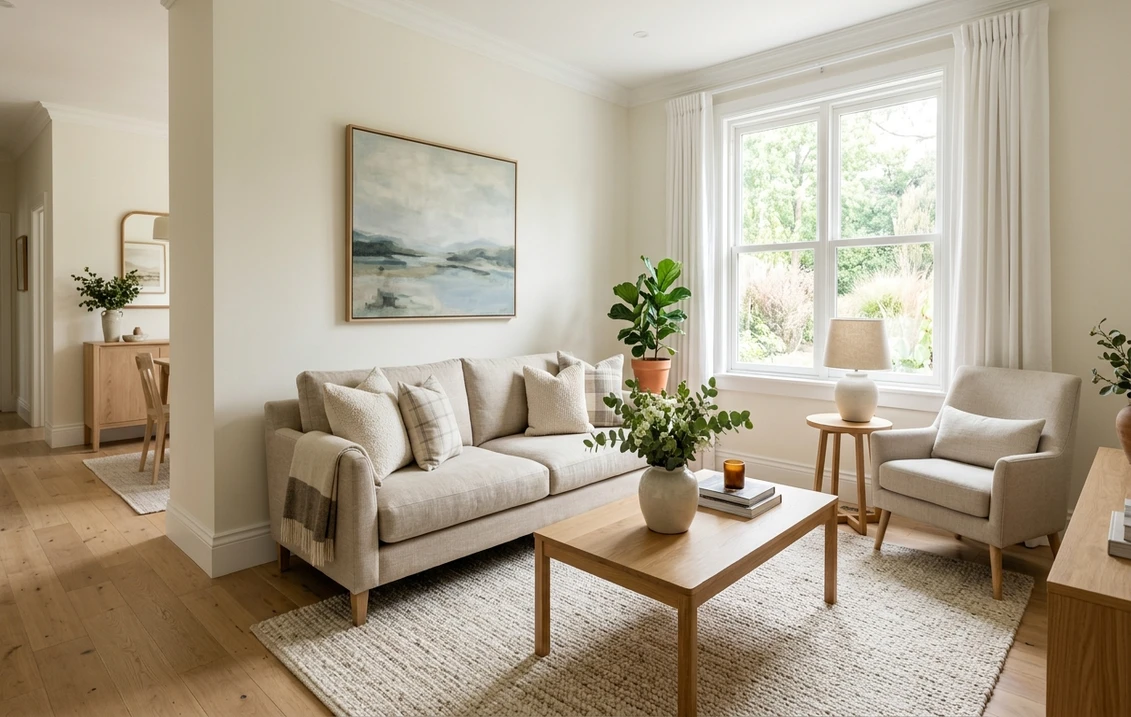
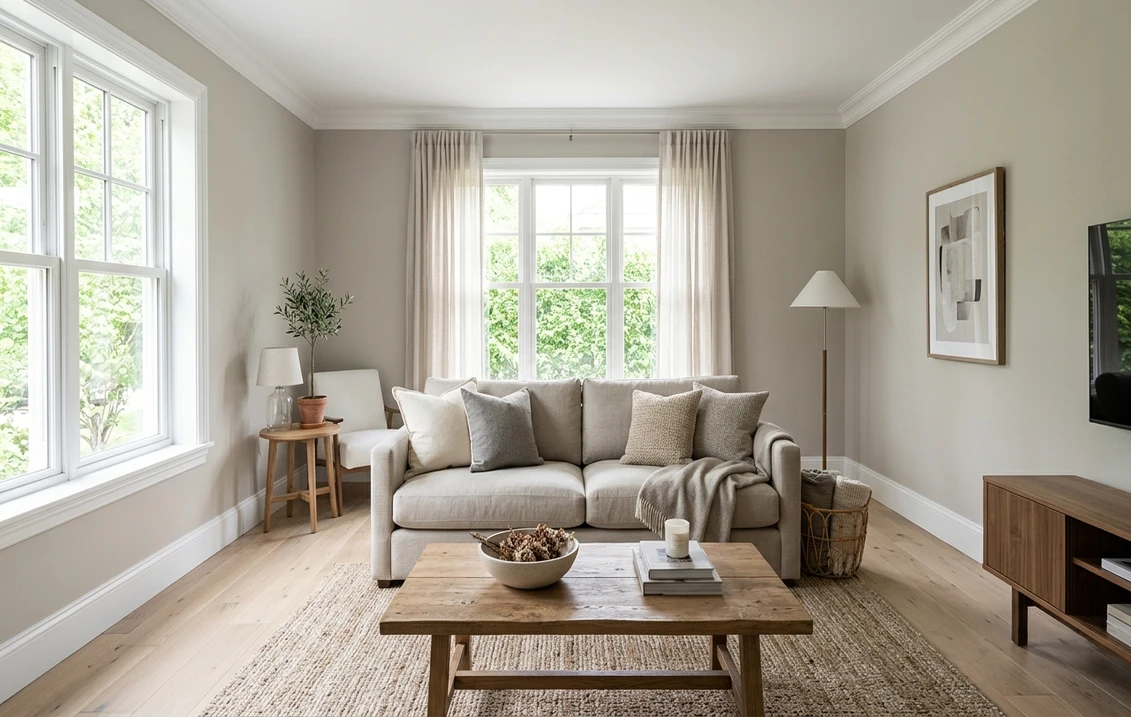
Collingwood is a warm greige at heart, but it is a gentle warmth, not a beige-you-can-name warmth. Most of the day, in most rooms, it reads as a soft, put-together light greige that plays warm against cool furnishings and neutral against warm ones. That balance is the source of its popularity: it flatters more schemes than a committed beige or a committed gray ever could.
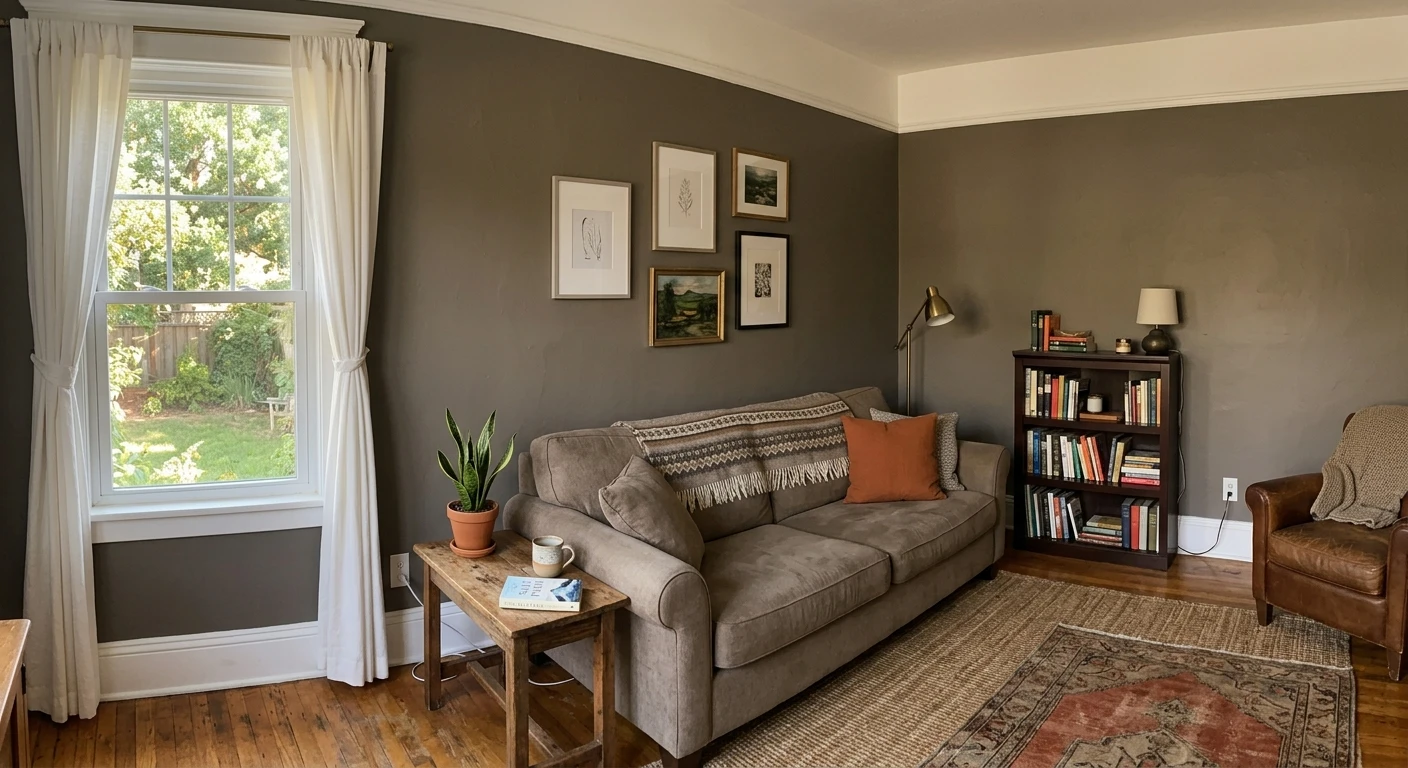
The one caveat every Collingwood shopper should know: in cool, indirect light, and especially in north-facing rooms, the gray side of the greige can pick up a faint violet cast. It is subtle and it is not a defect, but it is real, and it is the single most-discussed thing about this color. The fix is easy once you know it: feed Collingwood warm light and warm whites and the violet stays hidden, and it reads as the clean warm greige you fell for on the chip.
| Indoor light | How Collingwood reads |
|---|---|
| South-facing (bright, warm) | Its cleanest, warmest greige read; the violet stays out of sight |
| West-facing (warm afternoon) | Neutral greige in the morning, warm and creamy by late day |
| East-facing (cool after noon) | Fresh warm greige at breakfast, cooler and grayer in the afternoon |
| North-facing (cool, indirect) | Where the faint violet-gray is most likely to appear; lean on warm whites and warm bulbs |
| Artificial light at night | Warm 2700K bulbs keep it warm and creamy; cool bulbs can pull it gray or faintly violet |
Sources: Benjamin Moore OC-28 color data 2026; designer field reports compiled by FacadeColorizer.
Best rooms for Collingwood
A light warm greige is a genuine whole-house color, and Collingwood is one of the best at the job. Here is where it consistently earns its keep:
Open-plan living, dining, and hallways
This is Collingwood's signature assignment. At LRV 62 it carries light down a hallway and across a great room without any wall ever feeling heavy, and because it is a greige rather than a stark gray or a yellow beige, it transitions cleanly from a sunlit front room to a dimmer interior wall. It is the classic choice for people who want one color to flow through the whole main floor.
Bedrooms and primary suites
In a bedroom Collingwood reads soft and restful without going cold. Its light warmth wraps the room in calm, white bedding keeps it crisp, and natural wood or brass warms it further. It is an easy backdrop for changing bedding and art, which is exactly what most people want from a bedroom neutral.
Kitchens and bright bathrooms
Collingwood is a favorite on kitchen walls and cabinetry alike, where its greige warmth softens white counters and stainless without competing with them. In a bright bathroom it gives a spa-like calm that a pure white can miss. For a lighter, near-white take in the same family, our Classic Gray OC-23 review covers the softer sibling: pick Classic Gray when you want barely-there color, Collingwood when you want a touch more presence.
Where to think twice
A small, dim, north-facing room is the one place Collingwood asks for attention. That is where the greige can slip toward its cool, faintly violet read, and where a light color can still feel flat if the light is poor. There, commit to warm 2700K bulbs and warm-white trim, or consider a slightly warmer neutral if the room never gets real daylight.
Free AI visualizer. Test Collingwood on your real walls before buying a single sample pot.
Trim, ceiling, and decor pairings
Greiges live or die on their whites. What works with Collingwood:
- Soft warm trim (most reliable): BM White Dove (OC-17) is the default answer, and for good reason. Its gentle warmth echoes Collingwood's own and keeps the greige from ever tipping cool or violet, while still reading clearly as trim against the walls.
- Crisp trim (cleaner, more modern): BM Chantilly Lace (OC-65) sharpens the contrast for a fresher, more contemporary look. Use it deliberately: the cooler white can nudge Collingwood's cool side forward, so it pairs best in bright, warm-lit rooms.
- Avoid: stark blue-white trim in a north-facing room. It is the surest way to coax the violet-gray out of the walls and make Collingwood look colder than it is.
- Ceilings: a clean soft white keeps the room bright; there is no need to color-match the ceiling to the walls with a light greige like this.
- Floors and decor: warm white oak, natural linen, rattan, brass, and walnut all flatter Collingwood's warm side. Cooler chrome and marble work too and simply pull the scheme a shade more neutral.
A light greige on all four walls also invites the obvious follow-up question, which is what to put on the fifth surface or the one wall behind the bed. The rule that keeps it from looking bolted on: go two to four steps darker or more saturated, and stay in a related undertone so the two read as one family rather than a collision, which with Collingwood means the warm side of navy, green, or charcoal rather than a cold primary. Our directory of accent wall colors by color works through those families one at a time, with the LRV and the failure mode for each.
Collingwood vs the colors people cross-shop
Almost every Collingwood shortlist includes one or two of the same names:
- vs BM Balboa Mist (OC-27): the big one, and its literal code neighbor. Balboa Mist is the cooler, grayer greige of the pair; Collingwood is the warmer, cozier one. In a bright room they can look almost like twins, but in cool light Balboa Mist stays composed and gray while Collingwood shows its warmth (and, sometimes, that whisper of violet). Our Benjamin Moore Balboa Mist OC-27 profile covers the cooler neighbor on its own, and Balboa Mist vs Collingwood: the full comparison settles the head-to-head room by room.
- vs BM Classic Gray (OC-23): Classic Gray is lighter and even softer, closer to an off-white with the faintest warmth. Choose Classic Gray when you want the wall to read almost white; choose Collingwood when you want the greige to actually register as a color.
- vs SW Repose Gray: Collingwood is the Benjamin Moore neutral most often matched to Sherwin-Williams' hugely popular Repose Gray. Collingwood is a touch lighter and softer, Repose a touch grayer, which is why cross-brand shoppers compare them constantly. We line them up in our paint color matching guide.
Spelling note: BM Collingwood, Collingwood Benjamin Moore, and Benjamin Moore Collingwood OC 28 all point to this same OC-28.
How to test Collingwood before you commit
Greiges are the trickiest colors to judge from a 2-inch chip, because the chip cannot show you whether your specific light will pull Collingwood warm, gray, or faintly violet. Two better methods:
- Paint a large swatch: roll at least a 12-by-12-inch sample on two walls, one by the brightest window and one in the room's darkest corner. Look at it mid-morning, late afternoon, and at night under your normal bulbs. The dark-corner swatch is the one that tells the truth about the violet.
- Preview it digitally first: upload a photo of your room and run Collingwood against its greige neighbors before you buy a single pot. Our guide on how to compare paint colors side by side walks through the exact shortlist-then-sample method that avoids the five-sample-pot spiral.
Preview the warm greige and its cooler neighbor side by side on your real walls, free.
Frequently asked questions
Is Benjamin Moore Collingwood warm or cool?
Collingwood (OC-28) is a warm greige, but a gentle one: most of the day it reads as a soft, balanced light greige that plays warm against cool furnishings and neutral against warm ones. The nuance is that in cool, indirect light, and especially in north-facing rooms, its gray side can pick up a faint violet cast. Warm 2700K bulbs and warm-white trim keep it reading as the clean warm greige most people expect.
What is the LRV of Collingwood OC-28?
Collingwood has a published Light Reflectance Value of 62, with a hex value of #D4CFC5 (RGB 212, 207, 197). That makes it a soft, light greige: it reflects well over half the light in a room, so it stays bright and friendly, while still holding a touch more color than a true off-white, which is what keeps it from looking flat.
What trim color goes with Collingwood?
BM White Dove (OC-17) is the most reliable trim for Collingwood. Its soft warmth mirrors the greige and keeps it from tipping cool or violet, while still standing apart as trim. For a cleaner, more modern look use BM Chantilly Lace (OC-65) in bright, warm-lit rooms, and avoid stark blue-white trim in north-facing spaces, which can coax the violet out of the walls.
What is the difference between Collingwood and Balboa Mist?
They are code neighbors and the pair people cross-shop most. Balboa Mist (OC-27) is the cooler, grayer greige; Collingwood (OC-28) is the warmer, cozier one. In bright light they can look nearly identical, but in cool light Balboa Mist holds its gray while Collingwood shows more warmth. Choose Balboa Mist for a crisper, more neutral read and Collingwood when you want the softer, warmer greige.
Preview BM Collingwood on your actual walls under your own light before buying a single sample.
Disclaimer: Benjamin Moore, Collingwood (OC-28), Balboa Mist (OC-27), Classic Gray (OC-23), White Dove (OC-17), and Chantilly Lace (OC-65) are trademarks of Benjamin Moore & Co. FacadeColorizer is an independent paint visualization service and is not affiliated with, endorsed by, or sponsored by Benjamin Moore. Color reproduction on screens approximates the manufacturer's chip; always confirm with a manufacturer sample under your own light before purchase. Sources: Benjamin Moore OC-28, OC-27 and OC-23 color data 2026, designer field reports compiled by FacadeColorizer.
Trademarks mentioned (Sherwin-Williams, Benjamin Moore, Behr, Caparol, Brillux, Sto, Alpina, Valspar, PPG, Glidden, Dulux, Crown Trade, Sandtex, Farrow & Ball, Johnstone's, Leyland) are property of their respective owners. FacadeColorizer is independent and not affiliated with any of them. Nominative fair use under Lanham Act §1125.