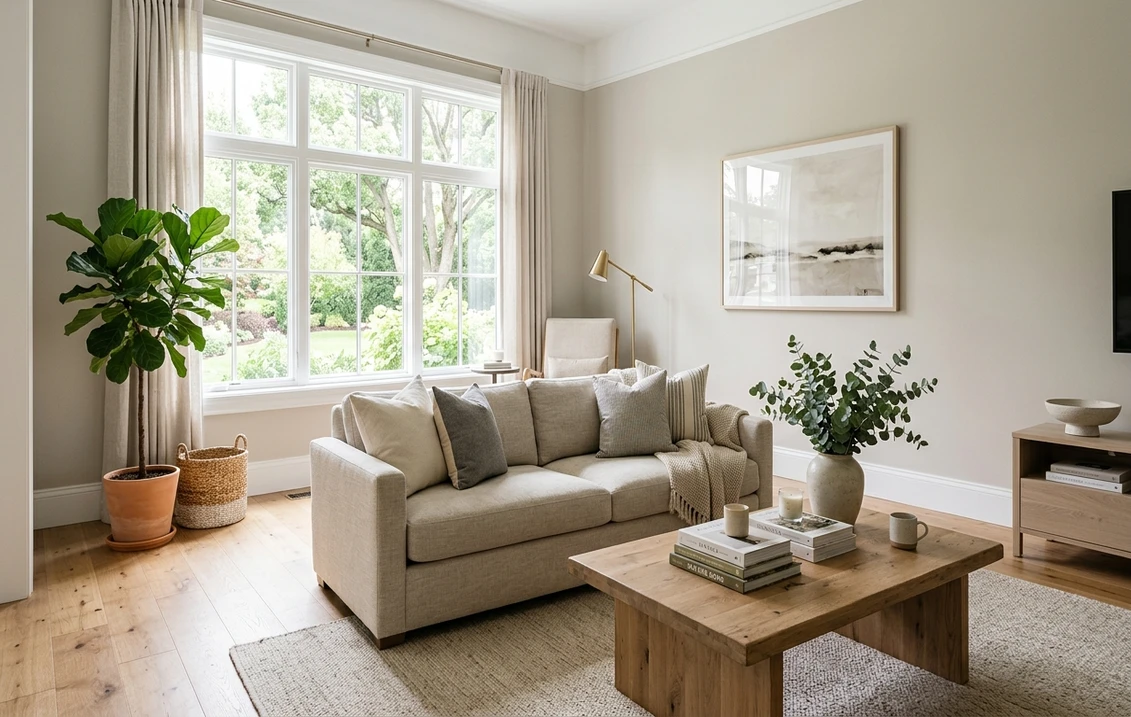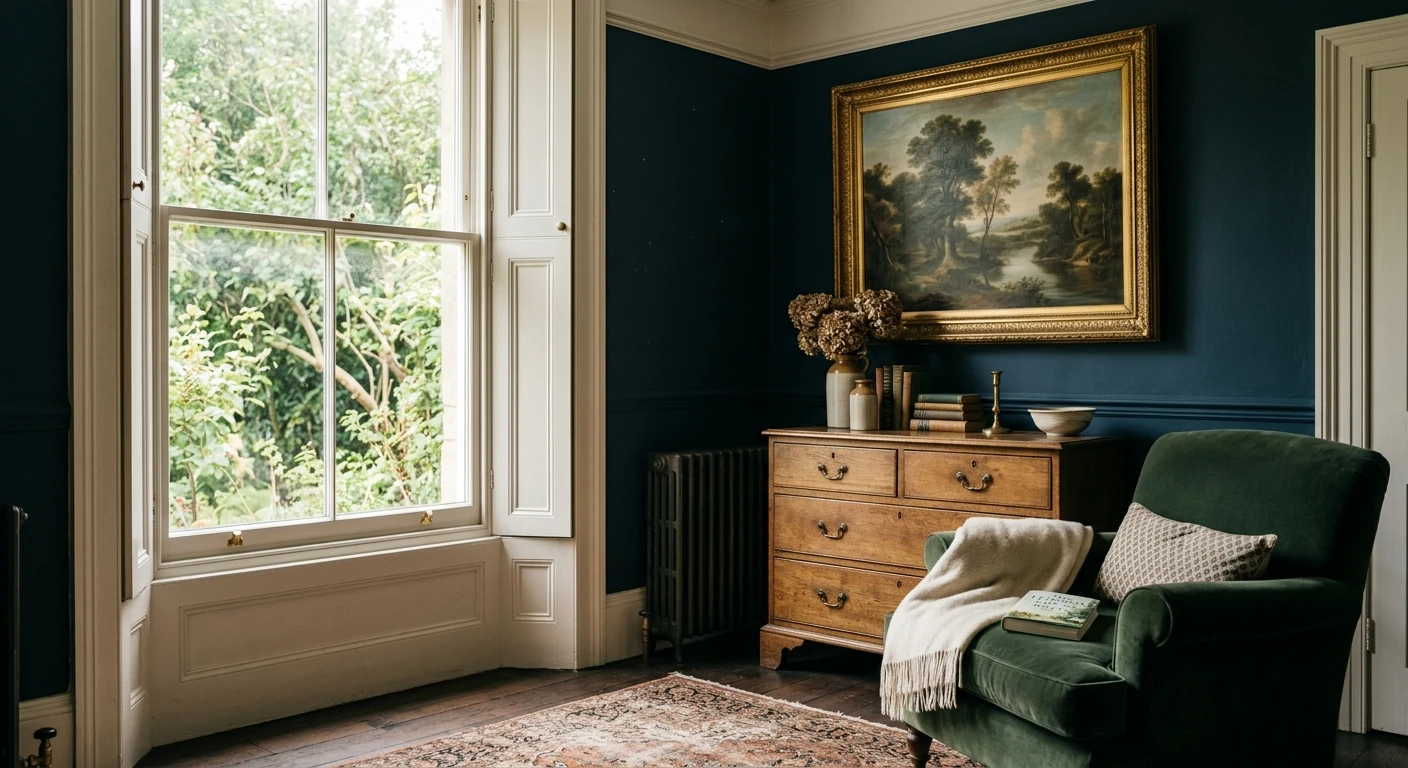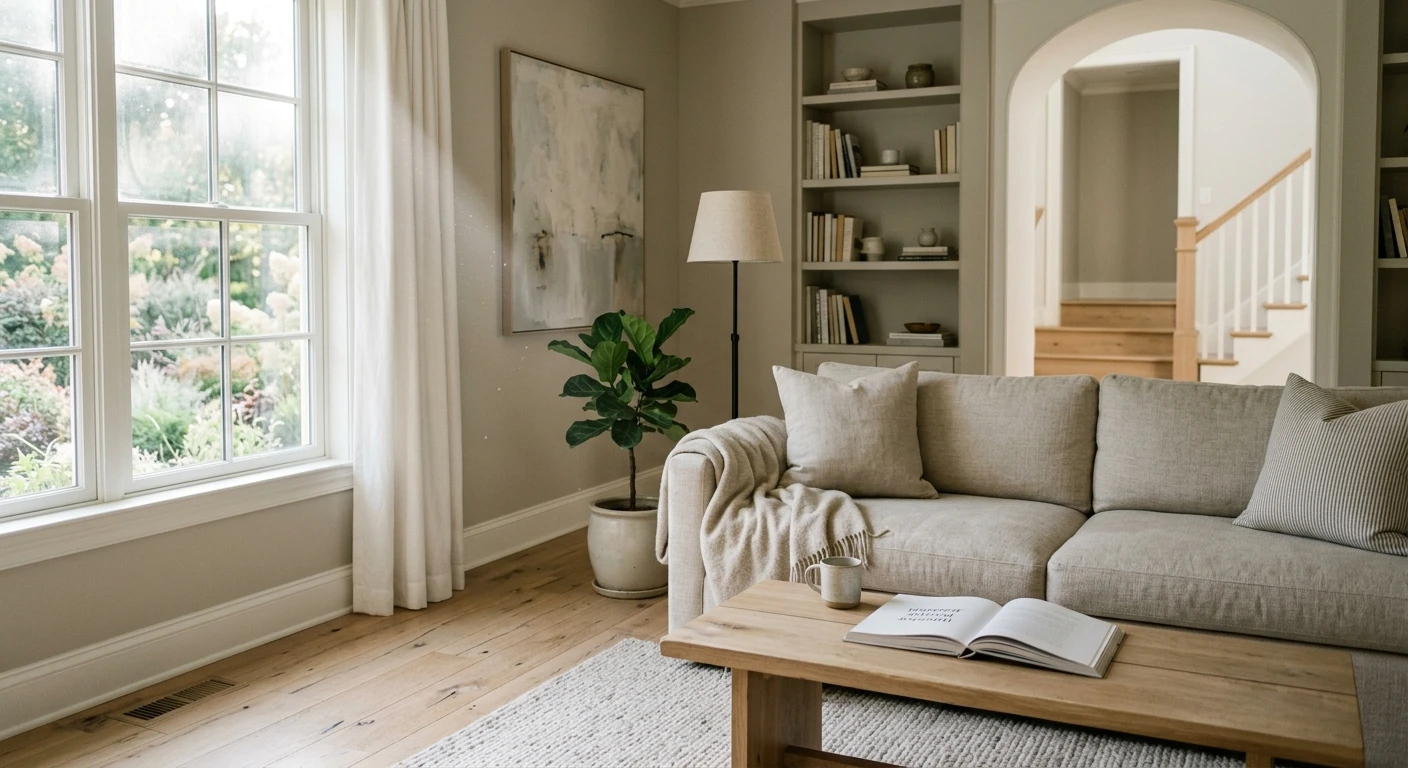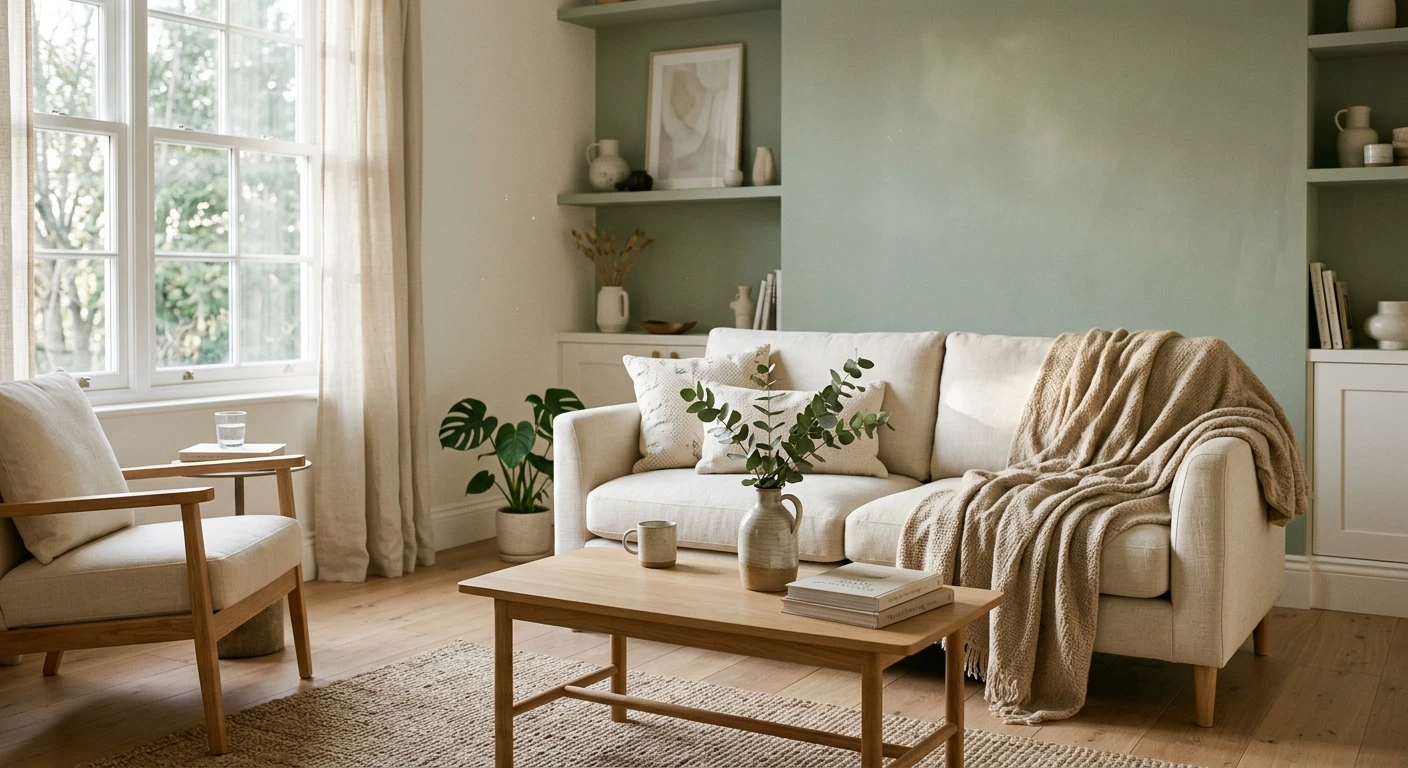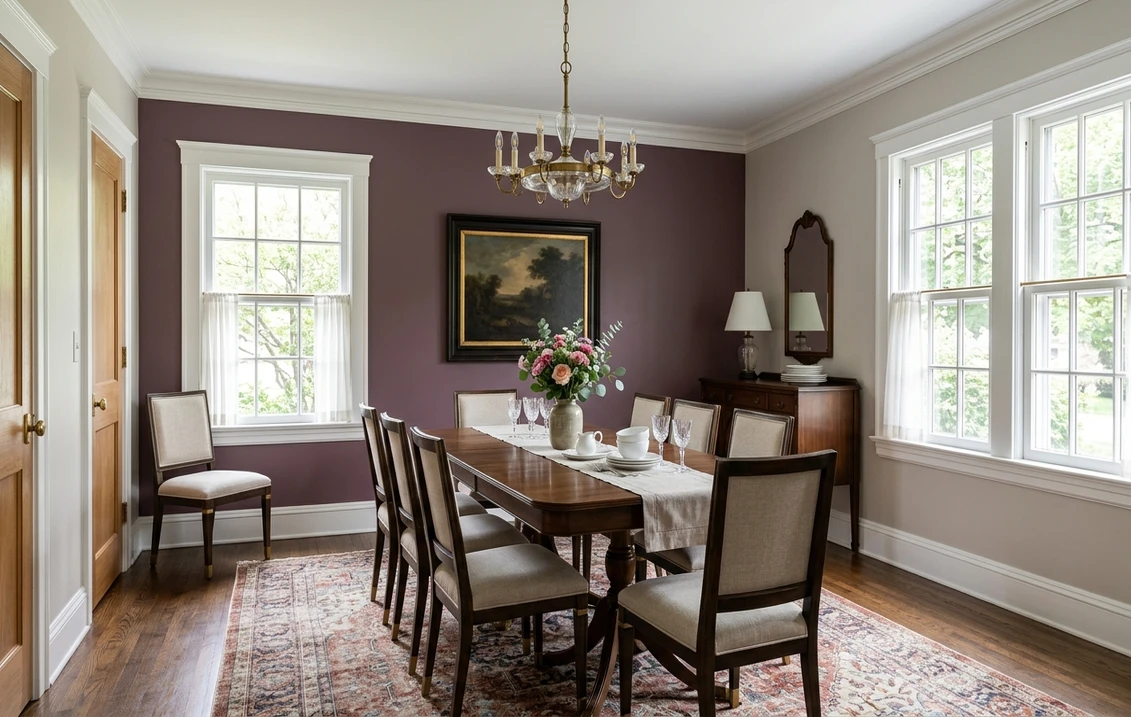

Farrow & Ball Brinjal No. 222 is a deep aubergine, a dark wine color the maker places "somewhere between purple and red". It is named after the shiny skin of the aubergine (the British word for eggplant), which is why the brand calls it "particularly magnificent in Full Gloss". Its complementary white is Skimming Stone No. 241. No LRV is published: calculated from the swatch on the brand's website (#5E4449), our lightness index is about 7 out of 100. On the US store on November 17, 2026, a gallon cost $160 (Estate or Modern Emulsion) or $168 (Dead Flat, eggshells, Full Gloss), and a sample pot $9. The closest colors on screen are Benjamin Moore Dark Walnut 1358 (LRV 9.56) and Sherwin-Williams Deep Maroon SW 0072 (LRV 6.603): our comparison, not official equivalents.
The Farrow & Ball color page gives no LRV, no RGB values and no cross-brand equivalent. The lightness index, hue readings and brand comparisons below are our calculations from published data, labeled as such. Prices can change.
Upload a room photo and compare the closest Benjamin Moore and Sherwin-Williams colors before you order samples.
What Farrow & Ball publishes for Brinjal No. 222
The Brinjal page on Farrow & Ball's US site is headed "A sophisticated aubergine". It says the color works on all four walls but is more often used as a feature wall in a neutral Skimming Stone scheme, or on the underside of a bath or a kitchen island. The brand's article Spotlight on Brinjal (March 6, 2026) adds that it was first introduced more than two decades ago and likens its tone to a ripe Pinot Noir.
| Item | Brinjal No. 222 | Source |
|---|---|---|
| Brand description | A sophisticated aubergine | Color page |
| Complementary white | Skimming Stone No. 241 | Color page |
| Recommended primer | Dark Tones Primer & Undercoat (wall and ceiling, wood or metal) | Color page |
| Swatch color on the site | #5E4449 (RGB 94, 68, 73), a screen value | Color page data |
| LRV | Not published (our index: about 7) | Our calculation |
| Archive color? | No made-to-order notice, unlike Pelt and Potted Shrimp | Color pages |
Try it on your room
- 1Your photoPhoto
- 2Your colorColor
- 3HD render in ~30 sHD render in ~30 s
Your photo is used only to create your preview. JPG, PNG, HEIC (iPhone)
On primer the page is direct: "When it comes to using dark colours, the deeper the better." For the brand as a whole, start with our Farrow & Ball paint colors guide; this page stays on one color.
Is Brinjal purple, violet or red? The hue in numbers
The Chromologist calls Brinjal a purple, then says it sits between purple and red. Both hold. In paint language "violet" usually means a bluer purple, and Brinjal is not that: it is a red-purple, the family of wine, plum and aubergine. Converted to CIELAB, which separates lightness (L*) from red against green (a*) and yellow against blue (b*), #5E4449 gives L* 31.8, a* 12.1 and b* 1.4 by our calculation: a hue angle of about 7 degrees and a chroma (colorfulness) of about 12.
For reference, a screen's pure red sits at about 40 degrees and pure magenta at about 328. Among Farrow & Ball's own darks, Brinjal lands between Pelt, "a deep and luxurious purple", and Preference Red, "the deepest of our reds":
| Color | Swatch hex | Lightness index (ours) | a* / b* (ours) | Hue angle (ours) |
|---|---|---|---|---|
| Paean Black No. 294 | 484348 | 5.9 | 3.2 / -2.3 | 325° (very low chroma) |
| Pelt No. 254 | 53454F | 6.7 | 8.0 / -3.8 | 335° |
| Brinjal No. 222 | 5E4449 | 7.0 | 12.1 / 1.4 | 7° |
| Preference Red No. 297 | 6F4449 | 8.0 | 19.3 / 4.8 | 14° |
By hue, Brinjal is closer to Preference Red than to Pelt, which is why it can pass for a dark red in warm light. But it carries almost no yellow (b* 1.4) and much less color than Preference Red (chroma 12 against 20), so in our reading it does not read as brick or burgundy, and beside a true red it looks purple. The Chromologist describes the same double behavior: red undertones in golden afternoon sun, a richer purple on cloudy days. For the wider family, see our guide to purple paint colors for interiors.
How dark is it? Our lightness index of 7, not an LRV
An LRV (light reflectance value) is measured on the paint by its manufacturer, and Farrow & Ball does not publish one. What can be computed is the relative luminance of the swatch color the site displays, from 0 (black) to 100 (white): 7.0 for #5E4449. Checked on dark colors with a published LRV, the method lands within 0.05 points of Sherwin-Williams (Deep Maroon 6.58 against 6.603, Cordovan 6.13 against 6.114) and 0.9 to 1.7 points under Benjamin Moore (Dark Walnut 8.33 against 9.56). Read Brinjal's 7 as "roughly 7 to 9", not a laboratory value.
That puts Brinjal among the true darks: Skimming Stone reflects about nine and a half times as much light by the same index (66.9). In our reading, it looks close to black in a dim corner at night and clearly colored where daylight hits it. Hence the dark primer: the Dark Tones undercoat is based on the color of Down Pipe, a dark gray, and the page presents it as the foundation for a rich, even and longer lasting finish.
Brinjal in north, south, east and west light
The Chromologist gives a rule for each orientation and advises embracing a room's light rather than fighting it (the brand's rules, then our reading):
- North-facing: its red undertones bring welcome warmth, and the brand recommends it for rooms with limited daylight. Expect the purple side to dominate.
- South-facing: it "positively glows" in strong natural light; the red comes forward at midday.
- West-facing: especially cozy in afternoon and evening light, a good fit for a dining room used at dinner time.
- East-facing: morning light can make it feel cooler. A bedroom here is seen mostly by lamp light, so judge the sample at night.
The article adds that candlelight, wall sconces and layered lamps make Brinjal especially atmospheric. The U.S. Department of Energy's guide to purchasing energy-efficient light bulbs lists 2,700 K (warm), 3,000 K (soft), 3,500 K (neutral) and 4,100 K (cool), and says ENERGY STAR bulbs must have a color rendering index of 80 or more. In our reading, 2,700 K pushes Brinjal toward red wine and 4,100 K toward a cool, grayed plum. For deep colors in bedrooms, see our dark and moody bedroom paint ideas.
Brinjal room by room
Dining room. Both uses on the color page, four walls or one feature wall in a Skimming Stone scheme, fit a US dining room; a drench of walls, trim and ceiling in Dead Flat gives the enveloping effect the Chromologist describes. Our guide to elegant dining room paint colors compares other deep options.
Bathroom and powder room. They head the article's list, and one of its photos pairs Brinjal on the wall and radiator with Potted Shrimp on the ceiling and trim. For walls that see steam, the Modern Emulsion page describes a washable finish protected against mold, and the Dead Flat page says it is also mold protected and suited to bathrooms. Paint does not fix damp: the EPA's brief guide to mold, moisture and your home says not to paint moldy surfaces, to run the fan or open the window when showering, and to keep humidity below 60 percent, ideally 30 to 50. See also our dark and moody bathroom paint ideas.
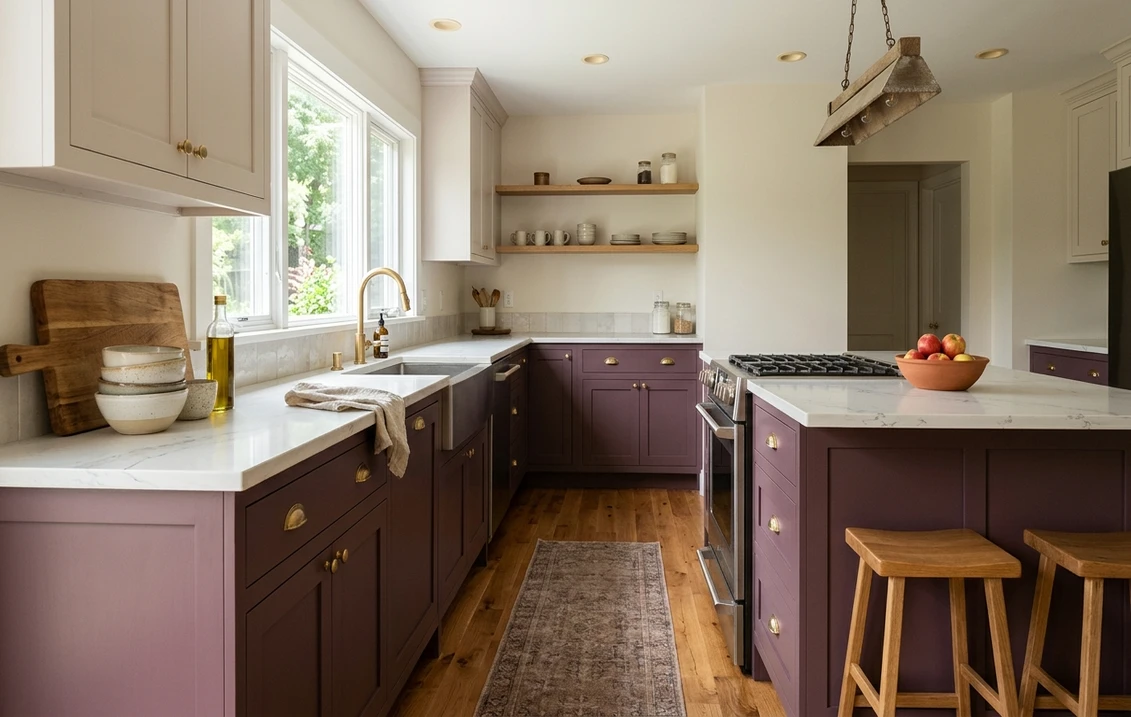
Kitchen cabinets and islands. The article finds "plum tones like Brinjal" surprisingly versatile in kitchens, especially on cabinetry, island bases and pantry cupboards, with a softer neutral such as Skimming Stone on the walls. One of its kitchens sets Brinjal cabinets against School House White walls, and it names unlacquered brass hardware as a natural partner. More options are in our colorful kitchen cabinet ideas.
Bedroom. The article finds Brinjal "dramatic yet grounding" here and advises painting the woodwork the same color, in a finish such as Flat Eggshell, to avoid harsh contrast. If four dark walls feel like too much, our purple bedroom paint ideas keep a deep shade to the wall behind the bed.
Doors, trim and furniture. This is where Full Gloss earns the brand's praise: a door, window frame or painted chest at 95% sheen catches light the way the vegetable's skin does. The article also shows a Brinjal window frame against Oxford Stone walls. In a house built before 1978, sanding old trim can disturb lead paint: the EPA's Renovation, Repair and Painting Program page says its rule does not apply to homeowners working on their own pre-1978 home (renting it out is an exception), but asks them to use lead-safe work practices.
Which finish to order in the US, and what it costs
The US store offers Brinjal in eight finishes, two of them for exteriors. Below are the interior ones, with the prices and coverage the Brinjal page listed on November 17, 2026; sheen and uses come from the finish pages.
| Finish | Sheen | Brand's stated use | Price (USD) | Coverage listed |
|---|---|---|---|---|
| Estate Emulsion | 2% | Low-traffic walls and ceilings; chalky; gently wipeable, not washable | $160 per US gallon; $9 per 100 ml sample | 570 sq ft per gallon |
| Modern Emulsion | 7% | Washable walls and ceilings, kitchens and bathrooms; mold protected | $160 per US gallon | 480 sq ft per gallon |
| Dead Flat | 2% | Walls, woodwork and metal; washable; mold protected | $56 per 750 ml; $168 per gallon | 95 sq ft per 750 ml; 480 per gallon |
| Flat Eggshell | 20% | Wood, metal and concrete, including floors and kitchen cabinets; scrubbable | $56 per 750 ml; $168 per gallon | 95 sq ft per 750 ml; 480 per gallon |
| Modern Eggshell | 40% | Woodwork, furniture, kitchen cabinets, floors | $56 per 750 ml; $168 per gallon | 95 sq ft per 750 ml; 480 per gallon |
| Full Gloss | 95% | Wood and metal inside and out, also walls and ceilings; scrubbable | $56 per 750 ml; $168 per gallon | 95 sq ft per 750 ml; 480 per gallon |
Why Full Gloss suits Brinjal. The Full Gloss page gives a 95% sheen, scrubbable Class 1, dry in 2 hours and recoat in 4. The Estate Emulsion page notes that the same shade in gloss can look very different in matt, and that the very matt Estate finish minimizes imperfections. A 95% gloss does the opposite, so fill and sand doors and trim with care (our note).
No longer sold. Older guides recommend Estate Eggshell for woodwork, but its range update page says it is no longer available and names Flat Eggshell the closest equivalent. The 100 ml sample is listed only in Estate Emulsion, so a sample shows Brinjal at 2% sheen: a gloss door will look richer and shinier (our note).
How much paint for a dining room: a worked example
Take a 12 by 14 foot dining room with an 8-foot ceiling, two coats as the store's calculator assumes, primer not included (our arithmetic):
- One 14-foot feature wall: 112 square feet, 224 for two coats. One gallon of Estate Emulsion (570 listed) is enough, $160. In Dead Flat, two 750 ml cans (190) fall short; three cost $168, the price of a gallon.
- All four walls: 2 x (12 + 14) x 8 = 416 square feet, minus a door (about 21) and two windows (about 15 each), leaves 365; 730 for two coats. That is 2 gallons of Estate Emulsion ($320) or of Dead Flat ($336).
- Interior door in Full Gloss: a 30 by 80 inch door is about 33 square feet for both faces, 67 for two coats: one 750 ml can ($56, 95 listed) covers it.
Coverage figures are maximums ("up to" on the finish pages). The U.S. Environmental Protection Agency lists paints among household sources of volatile organic compounds and advises increasing ventilation and buying only what you will use right away; Farrow & Ball states its finishes are water based and low in VOCs. A single-wall plan is laid out in our accent wall color strategy.
Is there a Sherwin-Williams or Benjamin Moore match for Brinjal?
No official one, and no close one either. The brand's color matching page says less than 8% of a can is color, that it uses twelve exclusive pigments, and that a match made with other pigments may look similar in daylight but shift under artificial light. Below, the colors whose hex values on each maker's website sit closest to Brinjal's swatch, ranked by CIEDE2000 difference (ΔE, our calculation). Our working scale: under 1, hard to tell apart on screen; around 2, visible side by side; above 3, clearly different. LRVs are the brands' own.
| Color | LRV (published) | Hex | ΔE (ours) | Against Brinjal (our reading) |
|---|---|---|---|---|
| Dark Walnut 1358 (BM) | 9.56 | 674A4E | 2.5 | Closest overall; a little lighter and warmer |
| Deep Maroon SW 0072 | 6.603 | 623F45 | 3.3 | Redder and more saturated, about as dark |
| Carnelian SW 7580 | 5.783 | 573E3E | 3.4 | Browner and slightly darker |
| Cordovan SW 6027 | 6.114 | 5F3D3F | 3.7 | Redder and warmer |
| Townsend Harbor Brown HC-64 (BM) | 8.22 | 634543 | 3.8 | Browner (more yellow) |
| Chambourd AF-645 (BM) | 8.61 | 56464E | 4.3 | Grayer and more violet |
| Mature Grape SW 6286 | 6.655 | 5F3F54 | 6.8 | Clearly more purple |
Benjamin Moore. The Dark Walnut 1358 page describes "a deep, wine-like red" with strong violet undertones, files it under purple and lists it for interiors only: the nearest in spirit as well as on screen. Townsend Harbor Brown HC-64 is "a grounded burgundy", and Chambourd AF-645 "a rich mahogany that nods to violet and brown".
Sherwin-Williams. The Deep Maroon SW 0072 page lists RGB 98, 63, 69 and files it as a Historic Color for interior use only. Carnelian SW 7580 (strip 276-C6) and Cordovan SW 6027 (191-C7) are rated for interior and exterior. If you like Brinjal for its purple side, Mature Grape SW 6286 (190-C7) is the bluer direction. Any substitute is a different paint: compare it beside a Brinjal sample.
Colors that go with Brinjal: the three official schemes
The color page shows three schemes, each pairing Brinjal with an accent and a trim color. The pairings are Farrow & Ball's; the scheme names and comments are ours.
| Scheme | Accent | Trim | Effect (our reading) |
|---|---|---|---|
| Crisp | All White No. 2005 | Strong White No. 2001 | Strongest contrast; the aubergine looks darkest |
| Soft | Elephant's Breath No. 229 | Skimming Stone No. 241 | Warm grays; a softer, tonal contrast |
| Deep | Charleston Gray No. 243 | Dove Tale No. 267 | Mid-tone neutrals, less contrast, more enveloping |
Per their pages, All White contains no pigment other than white, Strong White is a cool white, Elephant's Breath a mid gray that can turn almost lilac in cooler light, Charleston Gray has brown undertones and Dove Tale lilac ones. Skimming Stone is a warm light gray; our Skimming Stone No. 241 guide gives its US prices and closest US swatches.
The Chromologist's photos add School House White No. 291 behind Brinjal cabinets, Oxford Stone No. 264, a dark taupe, around a Brinjal window frame, and Potted Shrimp No. 9906, a blush, on a bathroom ceiling and trim. The Potted Shrimp page says it is an Archive color, made to order and non-returnable: sample it first. The article also suggests burnt orange or a lively green, and warns that darker greens can tip the scheme into something overly gothic. For another dark from the same maker, see our Hague Blue No. 30 guide. School House White is also the complementary white Farrow & Ball names for Setting Plaster No. 231; if the next room needs a light, warm color rather than another dark, our Setting Plaster No. 231 guide covers that dusty plaster pink.
The pairing also works the other way round: on the Dead Salmon color page, one of the three schemes uses Brinjal as the accent with London Clay trim, and the brand's Lessons In Colour episode pairs Brinjal and Green Smoke, the flesh and stalk of an aubergine, with Dead Salmon as their foil. Our Dead Salmon No. 28 guide covers that softer, mid-tone partner.
Where to buy Brinjal in the US and how to sample a dark color
The US website sells online; its showrooms page lists showrooms in Berkeley, Los Angeles, Pasadena, Santa Monica, Greenwich, Bethesda, Chicago, Boston, Paramus, Dallas and three New York locations, with in-store color advice and a stockist finder.
- Order a 100 ml sample pot of Brinjal, plus one of your trim color if it is a Farrow & Ball shade.
- Paint two coats on a white board about 2 by 2 feet, so you can move it (our method).
- Check it on the darkest wall and by the window, morning to night, under your own bulbs.
- Hold it next to your trim and floor, and beside a Dark Walnut or Deep Maroon board if you are weighing a substitute.
Preview Brinjal's closest matches in your own room
The US version of our interior paint visualizer does not carry the Farrow & Ball palette but carries Benjamin Moore and Sherwin-Williams: upload a photo and preview Dark Walnut, Deep Maroon or Cordovan on your walls before ordering the sample.
One photo of your room, the walls recolored, floor and furniture unchanged.
Sources and references
- Farrow & Ball, Brinjal No. 222 color page (US): description, complementary white, primer, schemes, finishes, US prices and coverage read on November 17, 2026, swatch hex.
- Farrow & Ball, The Chromologist, Spotlight on Brinjal (March 6, 2026): hue, light by orientation, rooms, finishes, pairings.
- Farrow & Ball color pages, such as Skimming Stone, Pelt and Preference Red: descriptions, Archive notices, swatch hex.
- Farrow & Ball finish pages, such as Full Gloss, the Estate Eggshell range update and color matching: sheen, uses, drying times, why a match differs.
- Benjamin Moore and Sherwin-Williams color pages, such as Dark Walnut 1358 and Deep Maroon SW 0072: published LRV, hex, description, store strip.
- U.S. Department of Energy, Purchasing Energy-Efficient Light Bulbs: color temperature and color rendering index.
- U.S. Environmental Protection Agency: mold and moisture, VOCs and indoor air, lead-safe renovation.
- Lightness index, CIELAB values, hue angles and CIEDE2000 differences: FacadeColorizer calculation from the hex values on each maker's website, November 17, 2026.
Frequently asked questions
What color is Farrow and Ball Brinjal?
Is Brinjal violet or purple?
What colors go with Brinjal?
What is the LRV of Farrow and Ball Brinjal?
Is there a Sherwin-Williams or Benjamin Moore color match for Brinjal?
How much does Farrow and Ball Brinjal cost in the US?
What finish is best for Brinjal?
Is Brinjal good for a north-facing room?
Trademarks mentioned (Sherwin-Williams, Benjamin Moore, Behr, Caparol, Brillux, Sto, Alpina, Valspar, PPG, Glidden, Dulux, Crown Trade, Sandtex, Farrow & Ball, Johnstone's, Leyland) are property of their respective owners. FacadeColorizer is independent and not affiliated with any of them. Nominative fair use under Lanham Act §1125.