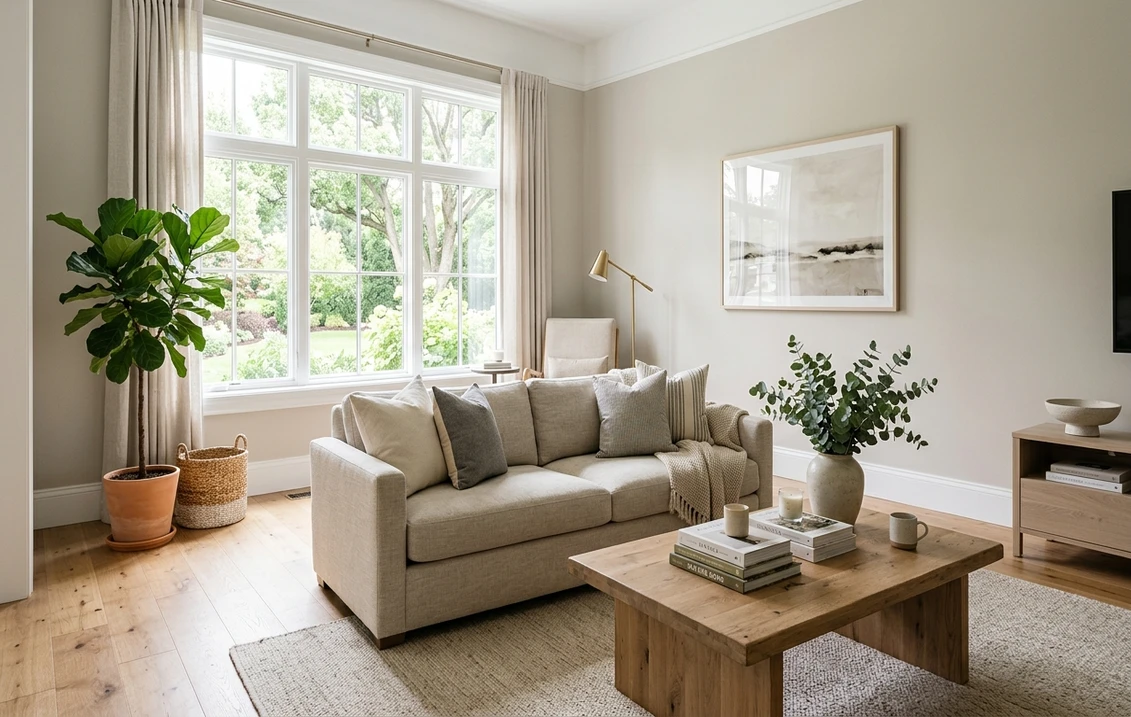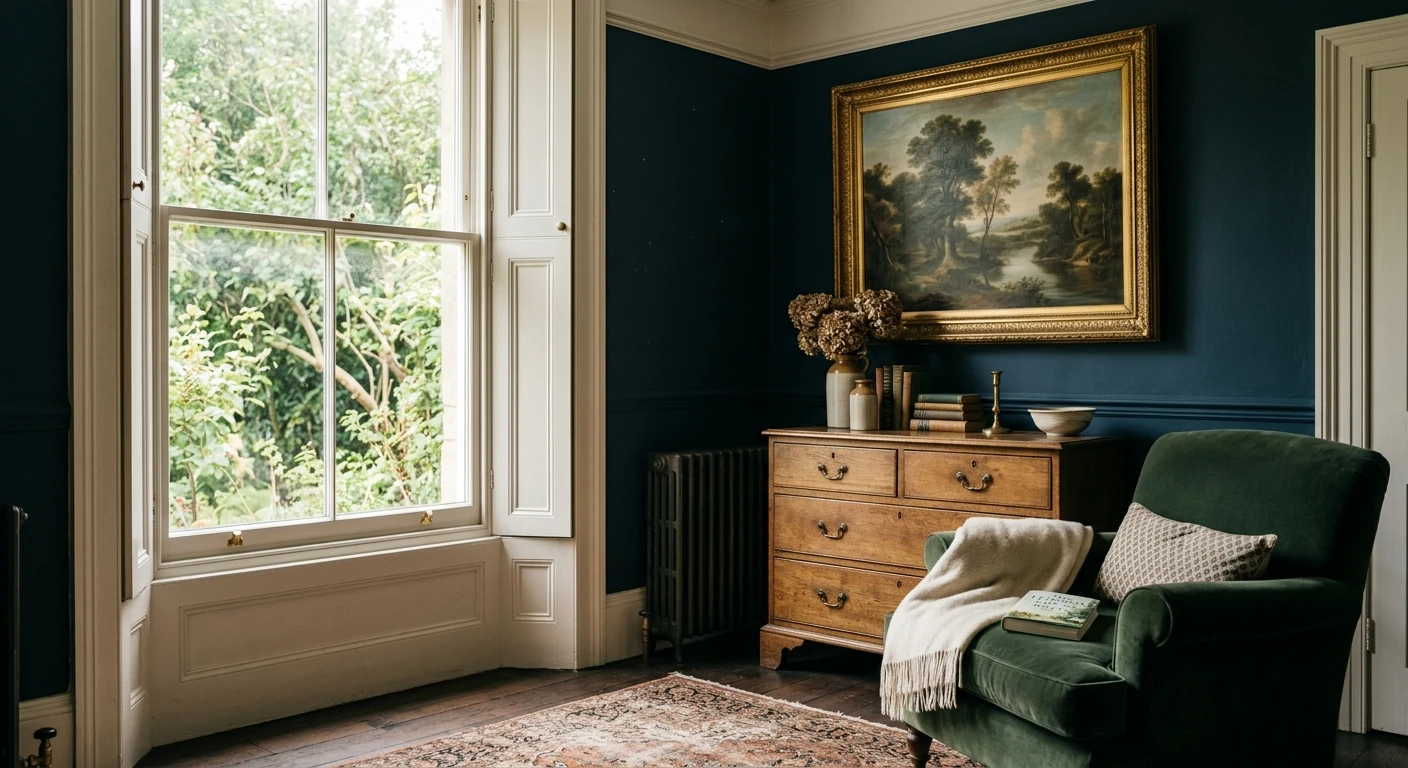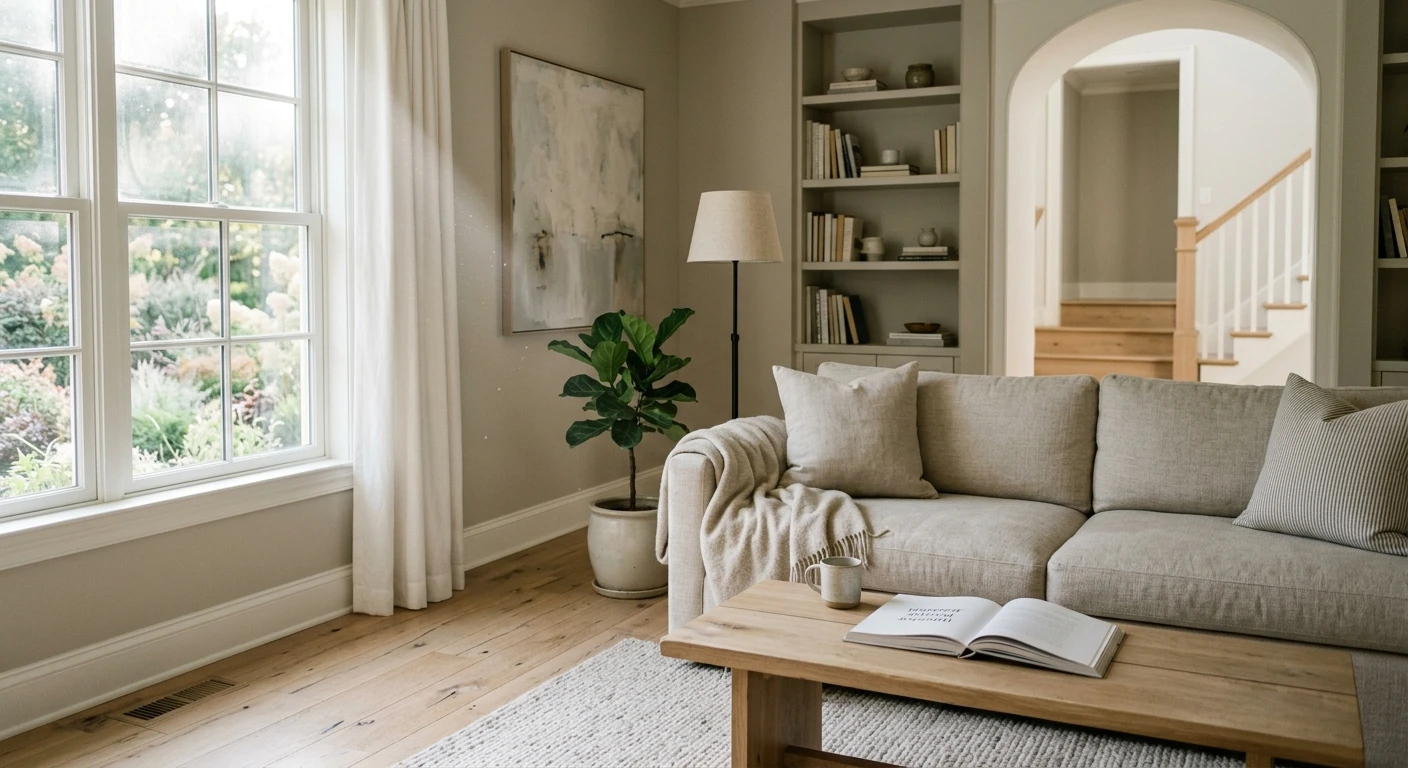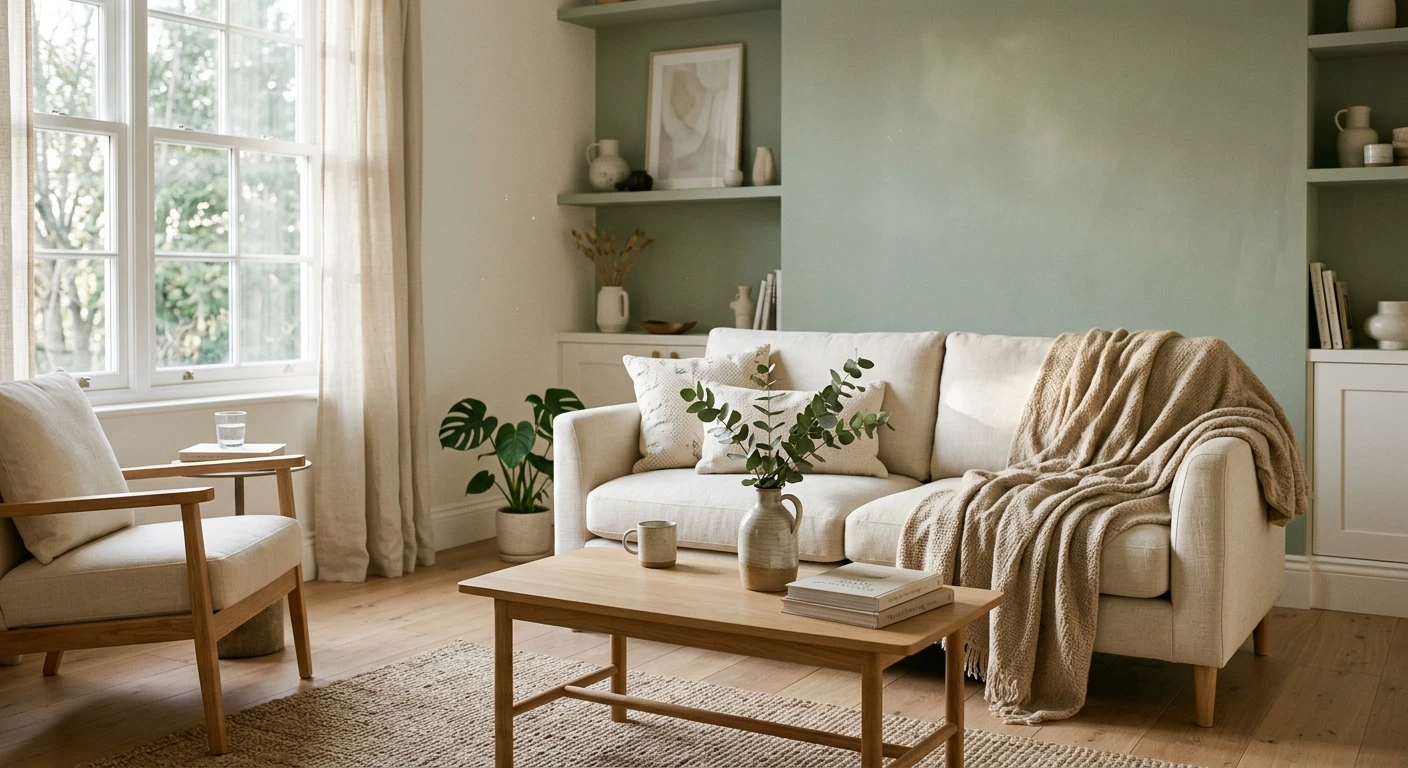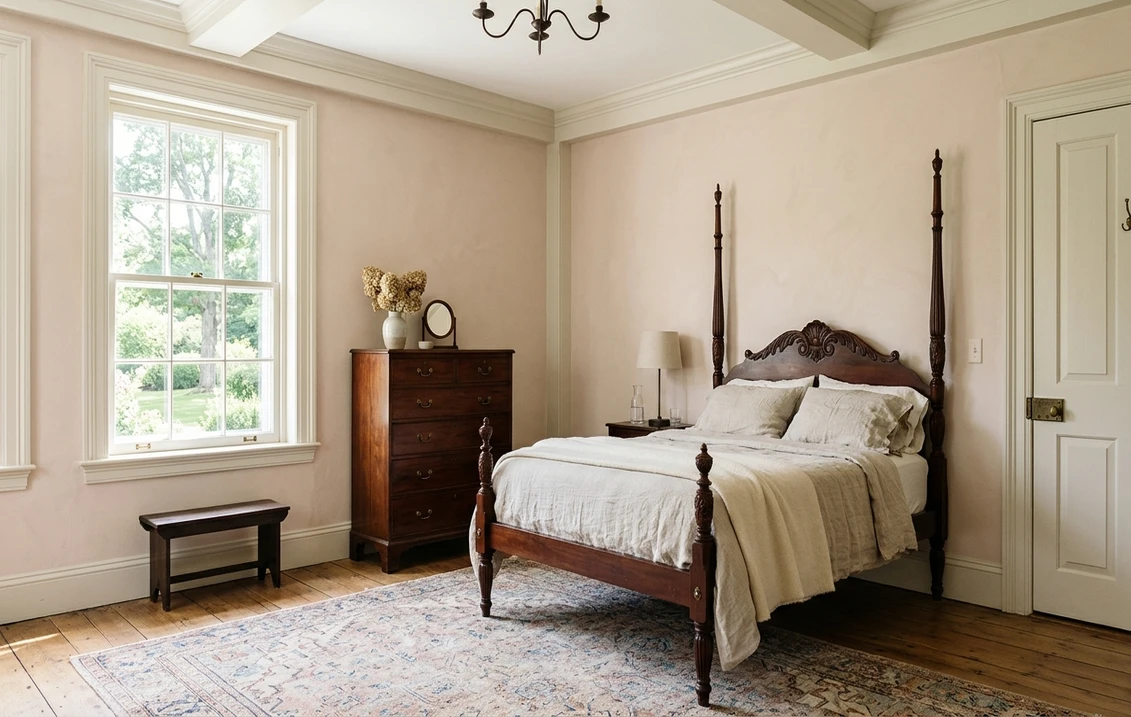

Farrow & Ball Setting Plaster No. 231 is a dusty plaster pink, named after the blush of freshly plastered walls. The maker calls it "definitely a pink in historic terms", softened by yellow pigment, and its creator says it is perfect in north-facing rooms because it warms them up. Its complementary white is School House White No. 291. No LRV is published: from the swatch on the brand's website (#D9C0AE), our lightness index is about 55 out of 100, close to twice Sulking Room Pink's. On the US store on November 18, 2026, a gallon cost $160 (Estate or Modern Emulsion) or $168 (Dead Flat, eggshells, Full Gloss), and a sample pot $9. The nearest colors on screen are Sherwin-Williams Classic Sand SW 0056 (LRV 53.201) and Benjamin Moore Boudoir AF-190 (LRV 54.99): our comparison, not official equivalents.
Farrow & Ball gives no LRV, RGB values or cross-brand equivalent. The lightness index, CIELAB readings and brand comparisons below are our calculations from each maker's hex values. Prices can change.
Upload a room photo and compare Classic Sand, Boudoir and other close US colors before you order samples.
What Farrow & Ball publishes for Setting Plaster No. 231
The Setting Plaster page on Farrow & Ball's US site is headed "A dusty plaster pink". It calls the color a wonderful backdrop to antique furniture that also works with Mahogany in a more contemporary home. The brand's article Lessons in Colour: Setting Plaster (November 25, 2024) gives the origin: Joa Studholme, who created the shade, wanted to keep the bare walls of a freshly re-plastered TV room, found them whitewashed by a painter, and recreated the plaster color that night.
| Item | Setting Plaster No. 231 | Source |
|---|---|---|
| Brand description | A dusty plaster pink | Color page |
| Complementary white | School House White No. 291 | Color page |
| Recommended primer | White & Light Tones Primer & Undercoat (based on All White) | Color page |
| Swatch color on the site | #D9C0AE (RGB 217, 192, 174), a screen value | Color page data |
| LRV | Not published (our index: about 55.5) | Our calculation |
| Archive color? | No made-to-order notice, unlike Mahogany and London Clay | Color pages |
Try it on your room
- 1Your photoPhoto
- 2Your colorColor
- 3HD render in ~30 sHD render in ~30 s
Your photo is used only to create your preview. JPG, PNG, HEIC (iPhone)
For the brand as a whole, start with our Farrow & Ball paint colors guide; this page stays on one pink.
Pink, peach or beige? Setting Plaster in numbers
In CIELAB, which separates lightness (L*) from red (a*) and yellow (b*), #D9C0AE gives L* 79.3, a* 6.0 and b* 12.3 by our calculation: a hue angle of about 64 degrees. Its yellow component is twice its red one. That is the "inclusion of yellow pigment" in numbers, and why, in our reading, it can pass for a warm beige or pale apricot in some lights. Its creator: "a little yellow undertone in the pink, so it always feels very, very soft." Among four other Farrow & Ball pinks (descriptions the brand's, numbers ours):
| Color | Brand description | Swatch hex | Lightness index | a* / b* | Hue angle |
|---|---|---|---|---|---|
| Pink Ground No. 202 | A dusty blush pink | EAD4C6 | 68.7 | 5.4 / 9.7 | 61° |
| Setting Plaster No. 231 | A dusty plaster pink | D9C0AE | 55.5 | 6.0 / 12.3 | 64° |
| Templeton Pink No. 303 | A warm, welcoming pink | CDB19D | 46.9 | 7.0 / 14.0 | 63° |
| Dead Salmon No. 28 | An aged salmon pink | B19C8D | 35.0 | 5.3 / 10.7 | 64° |
| Sulking Room Pink No. 295 | A romantic and muted rose | AA8D87 | 29.3 | 10.0 / 7.3 | 36° |
Four of the five share almost the same hue and differ mainly in lightness; the brand calls Templeton Pink "a more intense version of Setting Plaster or Pink Ground". Sulking Room Pink, with more red than yellow, is the outlier. For lighter blushes from US brands, see our soft blush pink paint colors.
Setting Plaster vs Sulking Room Pink vs Pink Ground
These three are the brand's own shortlist: the Setting Plaster page sells a set of three sample pots of Pink Ground, Setting Plaster and Sulking Room Pink. Side by side:
| Item | Setting Plaster No. 231 | Sulking Room Pink No. 295 | Pink Ground No. 202 |
|---|---|---|---|
| Lightness index (ours) | 55.5 | 29.3 | 68.7 |
| Hue angle (ours) | 64°, yellow over red | 36°, red over yellow | 61°, yellow over red |
| Difference from Setting Plaster (ΔE, ours) | Reference | 15.5 | 5.0 |
| Recommended primer | White & Light Tones | Mid Tones | White & Light Tones |
| Complementary white | School House White | Skimming Stone | Wimborne White |
| Nearest US color (ours) | Classic Sand SW 0056 | Barberry 1244 (BM) | Coastal Cottage 1164 (BM) |
Setting Plaster vs Sulking Room Pink. By our index, Setting Plaster reflects about 1.9 times as much light, and a CIEDE2000 difference (ΔE) of 15.5 describes two different colors, not two strengths of one. The Sulking Room Pink page calls it "a muted rose with enormous warmth", not overtly pink. In our reading, Setting Plaster suits a light, warm, plaster-like wall, Sulking Room Pink a deeper, rosier, enveloping one. Our Sulking Room Pink No. 295 guide covers the darker of the two.
Setting Plaster vs Pink Ground. Pink Ground is the lighter cousin: about 1.24 times as reflective at nearly the same hue (ΔE 5.0). The Pink Ground page says it carries "a large dose of yellow pigment" for a blush "that doesn't feel sugary", and suggests Great White, a white with the slightest lilac hint, on the woodwork. Joa Studholme pairs the two: Setting Plaster walls, Pink Ground ceiling.
Two more sample sets make Setting Plaster the darkest of a lighter trio (with Dimity and Pink Ground) and the lightest of a darker one (with Templeton Pink and Sulking Room Pink).
How light is Setting Plaster? An index of 55, not an LRV
An LRV (light reflectance value) is measured on the paint by its maker, and Farrow & Ball does not publish one. What can be computed is the relative luminance of the swatch color the site displays, from 0 (black) to 100 (white): 55.5 for #D9C0AE. On similar colors with a published LRV, the method lands within 0.15 point of Sherwin-Williams (Classic Sand 53.16 against 53.201) and within 1.6 points of Benjamin Moore (Boudoir 56.54 against 54.99). Read it as "roughly 54 to 57": a light mid-tone returning a little over half the light.
In our reading, that is light enough for a small or dim room and colored enough to show on all four walls. School House White, its complementary white, scores 73.1 by the same index: a soft step to the trim, not a hard edge. The White & Light Tones undercoat, based on All White, is the one the page recommends for the brand's "softest shades".
Setting Plaster in north, south, east and west light
Joa Studholme's advice covers one orientation: "It's perfect in north facing rooms because it warms it up." For the others, our reading of a warm, yellow-leaning pink:
- North-facing: cool, even light holds back the yellow; a soft, slightly grayed pink. The use its creator recommends.
- South-facing: strong sun brings the yellow forward; a peach cast at midday, closer to beige on the brightest wall.
- East-facing: fresh in the morning, flatter and grayer by late afternoon.
- West-facing: warmest in the evening, when the wall opposite the window can lean apricot.
Bulbs matter too. The U.S. Department of Energy's guide to purchasing energy-efficient light bulbs lists 2,700 K (warm) to 4,100 K (cool) and a color rendering index of 80 or more for ENERGY STAR bulbs. In our reading, 2,700 K pushes Setting Plaster toward apricot and 4,100 K toward a grayer pink. For dim rooms, see also our north-facing room paint colors.
Setting Plaster room by room
Bedroom. One of the color page's schemes pairs Setting Plaster with Skimming Stone (accent) and Elephant's Breath (trim), and the Skimming Stone page calls that warm light gray "particularly suited to soothing bedroom schemes". Our blush pink bedroom paint ideas cover lighter and grayer options.
Living room. Another scheme sets it against Charleston Gray, which its page calls "very popular for use in modern living rooms", with London Clay, a magenta-loaded brown, on the trim. Both Mahogany and London Clay are Archive colors, made to order and non-returnable: sample first. More pairings are in our living room color schemes.
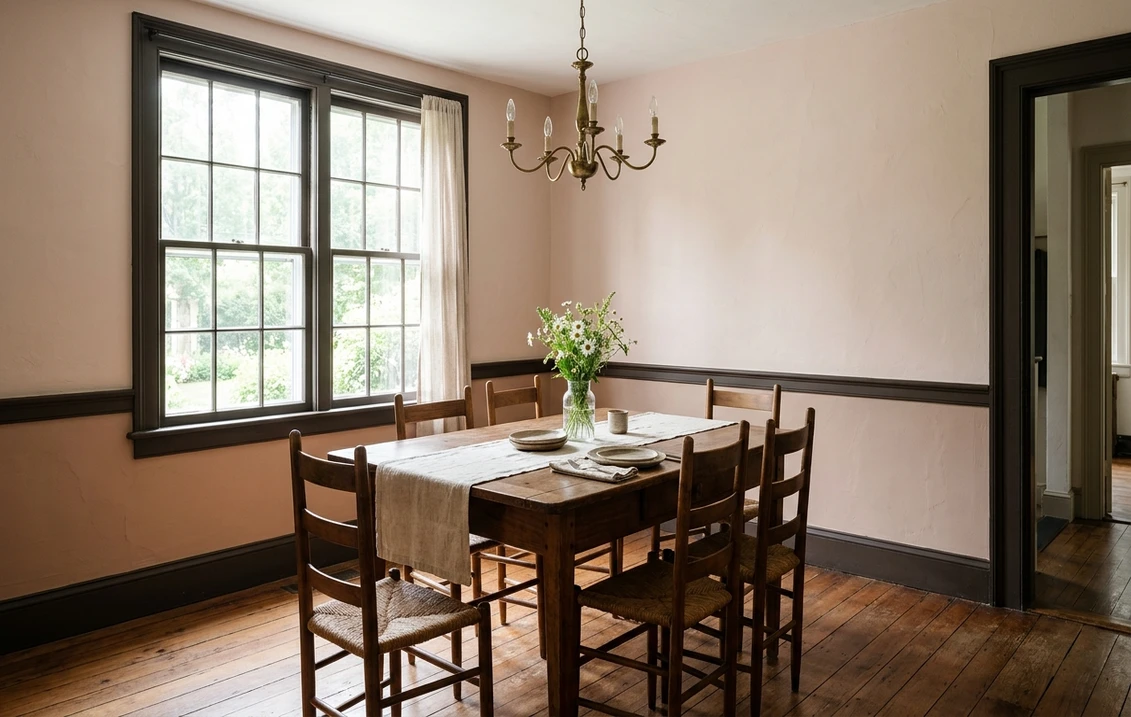
Dining room. Joa Studholme's warm scheme fits here: Dead Salmon below a dado (chair) rail, Setting Plaster above, and Tanner's Brown on the trim, which she calls "the most chic thing on earth". The Dead Salmon page names candlelit dining rooms as a natural setting, and the Tanner's Brown page says that dark brown reads almost black in lower light. Our guide to elegant dining room paint colors compares deeper options.
Nursery and kids' rooms. The first scheme pairs Setting Plaster with Tallow, a light cream its page calls "often very popular in nurseries", and Dimity trim. The Setting Plaster page states the paint is water based, low in VOCs and certified toy-safe to EN 71-3. The U.S. Environmental Protection Agency, which lists paints among VOC sources, still advises to increase ventilation when using products that emit VOCs. In a house built before 1978, its Renovation, Repair and Painting Program page recommends lead-safe practices to homeowners and stresses keeping children from contact with lead. See also our baby-safe nursery paint colors.
Entry and hallway. Dimity, the trim of that scheme, is a very pale taupe its page calls "perfect for elegant and understated hallways". In our reading, Setting Plaster walls with Dimity trim warm a north-facing entry without darkening it.
Bathroom and kitchen. The Modern Emulsion page describes a washable wall finish protected against mold, "particularly perfect for moisture-prone kitchens and bathrooms". More options are in our pink bathroom paint ideas.
Finishes and US prices for Setting Plaster
The US store offers Setting Plaster in eight finishes, two for exteriors. The interior ones, with the prices and coverage the Setting Plaster page listed on November 18, 2026 (sheen, use and drying times from the finish pages):
| Finish | Sheen | Brand's stated use | Price (USD) | Coverage listed | Dry / recoat |
|---|---|---|---|---|---|
| Estate Emulsion | 2% | Chalky; low-traffic walls and ceilings; not washable | $160 per US gallon; $9 per 100 ml sample | 570 sq ft per gallon | 2 h / 2 h |
| Modern Emulsion | 7% | Washable walls and ceilings; protected against mold | $160 per gallon | 480 sq ft per gallon | 2 h / 4 h |
| Dead Flat | 2% | Walls, woodwork and metal; protected against mold | $56 per 750 ml; $168 per gallon | 95 sq ft per 750 ml; 480 per gallon | 2 h / 4 h |
| Flat Eggshell | 20% | Wood, metal, concrete, floors, kitchen cabinets; scrubbable (Class 1) | $56 per 750 ml; $168 per gallon | 95 sq ft per 750 ml; 480 per gallon | 2 h / 4 h |
| Modern Eggshell | 40% | Floors, doors and more; washable | $56 per 750 ml; $168 per gallon | 95 sq ft per 750 ml; 480 per gallon | 2 h / 4 h |
| Full Gloss | 95% | Scrubbable (Class 1) | $56 per 750 ml; $168 per gallon | 95 sq ft per 750 ml; 480 per gallon | 2 h / 4 h |
Which wall finish? The Estate Emulsion page describes a very matt, chalky finish, the closest to the bare-plaster look, but only gently wipeable. In our reading, Modern Emulsion is safer for a hallway, kids' room or kitchen, and Dead Flat lets walls and woodwork share one matte. The 100 ml sample comes only in Estate Emulsion. Older guides recommend Estate Eggshell for trim, but its range update page says it is no longer available and names Flat Eggshell the closest equivalent.
How much paint for a bedroom: a worked example
A 12 by 13 foot bedroom with an 8-foot ceiling in Joa Studholme's lighter scheme (Setting Plaster walls, Pink Ground ceiling), two coats as the store's calculator assumes, primer excluded (our arithmetic):
- Walls: 2 x (12 + 13) x 8 = 400 square feet, minus a door (about 21) and two windows (about 15 each): 349, or 698 for two coats. At 570 (Estate) or 480 (Modern Emulsion) per gallon, 2 gallons ($320).
- Ceiling in Pink Ground: 156 square feet, 312 for two coats: one gallon of Estate Emulsion, also $160 on the Pink Ground page that day.
- Trim: 47 feet of 5-inch baseboard plus one door and two window casings, about 34 square feet (68 for two coats): one 750 ml can of Flat Eggshell ($56).
About $536 before primer, tax and delivery. Coverage figures are maximums ("up to" on the finish pages), and the EPA's VOC guidance says to buy only as much as you will use right away. Our Skimming Stone No. 241 guide runs the same arithmetic for a light gray.
Sherwin-Williams and Benjamin Moore colors closest to Setting Plaster
There is no official equivalent. The brand's color matching page says less than 8% of a can is the color, made with twelve exclusive pigments that matching companies do not use. Below, the colors whose hex values on each maker's website sit closest to the swatch, by CIEDE2000 difference (ΔE, ours: under 1, hard to tell apart on screen; around 2, visible side by side; above 3, clearly different). LRVs are the brands' own.
| Color | LRV (published) | Hex | ΔE (ours) | Against Setting Plaster (our reading) |
|---|---|---|---|---|
| Classic Sand SW 0056 | 53.201 | D6BCAA | 1.1 | Closest; same hue, a shade darker |
| Boudoir AF-190 (BM) | 54.99 | DAC2AE | 1.2 | A touch more yellow |
| Milk Shake 1165 (BM) | 55.57 | DCC0AF | 1.5 | A touch pinker |
| Crossroads 1226 (BM) | 54 | D8BDAD | 1.6 | Pinker and a little darker |
| Georgetown Pink Beige HC-56 (BM) | 55.28 | DFC1AB | 1.9 | More saturated, warmer |
| Likeable Sand SW 6058 | 50.189 | D1B7A8 | 2.7 | Darker |
| Malted Milk SW 6057 | 61.561 | DECABD | 3.3 | Lighter and grayer |
Sherwin-Williams. The Classic Sand SW 0056 page lists RGB 214, 188, 170, files it as a Historic Color and rates it for interior and exterior use. Likeable Sand SW 6058 (195-C2) and Malted Milk SW 6057 (195-C1) share one store strip.
Benjamin Moore. The Boudoir AF-190 page describes "dusty rose undertones" in "this soothing mid-tone" (Affinity collection). Milk Shake 1165 has "touches of pink and orange", Crossroads 1226 is "a cozy blend of orange, pink, and beige", and Georgetown Pink Beige HC-56, from the Historical Colors, has "subtle notes of orange and rosy-brown". Benjamin Moore files all four under orange, a sign of the yellow in Setting Plaster. For the neighbors, Coastal Cottage 1164 (LRV 65.65, ΔE 0.9) sits closest to Pink Ground and Barberry 1244 (LRV 27.66, ΔE 2.7) to Sulking Room Pink. Any substitute is a different paint: compare it beside a Farrow & Ball sample.
Colors that go with Setting Plaster: six schemes
Four schemes come from the color page and two from its creator. Pairings are Farrow & Ball's; effects are our reading.
| Source | With Setting Plaster | Trim | Effect (our reading) |
|---|---|---|---|
| Color page | Tallow No. 203 (accent) | Dimity No. 2008 | Lightest and softest; cream and pale taupe |
| Color page | Skimming Stone No. 241 (accent) | Elephant's Breath No. 229 | Warm grays that calm the pink |
| Color page | Charleston Gray No. 243 (accent) | London Clay No. 244 (Archive) | Earthy, strongest contrast |
| Color page | School House White No. 291 (accent) | Elephant's Breath No. 229 | The complementary white with a mid-gray trim |
| Lessons in Colour | Dead Salmon No. 28 below a dado rail | Tanner's Brown No. 255 | Two warm pinks, near-black trim |
| Lessons in Colour | Pink Ground No. 202 on the ceiling | Card Room Green No. 79 | Pink on pink, gray-green trim |
Per their pages, Elephant's Breath is a warm mid gray that can turn almost lilac in cooler west light, and Card Room Green a dark gray green "unapologetic in its strength". For a much darker room next door, our Brinjal No. 222 guide covers the brand's aubergine.
Preview Setting Plaster's closest matches in your room
The US version of our interior paint visualizer does not carry the Farrow & Ball palette but carries Sherwin-Williams and Benjamin Moore: preview Classic Sand, Boudoir or Milk Shake on a photo of your walls first. Then paint two coats of the 100 ml sample on a 2 by 2 foot board and check it on the darkest wall and by the window, morning to night, under your own bulbs (our method).
One photo of your room, the walls recolored, floor and furniture unchanged.
Sources and references
- Farrow & Ball, Setting Plaster No. 231 color page (US): description, white, primer, schemes, sample sets, US prices and coverage read on November 18, 2026, swatch hex, toy-safe and VOC statements.
- Farrow & Ball, The Chromologist, Lessons in Colour: Setting Plaster (November 25, 2024): origin, north-facing advice, two schemes.
- Farrow & Ball color pages, such as Sulking Room Pink, Pink Ground, Templeton Pink and Dead Salmon: descriptions, primers, whites, swatch hex.
- Farrow & Ball finish pages, such as Estate Emulsion, Modern Emulsion, the Estate Eggshell range update and color matching: sheen, uses, drying times, matching.
- Sherwin-Williams and Benjamin Moore color pages, such as Classic Sand SW 0056 and Boudoir AF-190: published LRV, hex, description, collection, store strip.
- U.S. Department of Energy, Purchasing Energy-Efficient Light Bulbs: color temperature and color rendering index.
- U.S. Environmental Protection Agency: VOCs and indoor air quality, lead-safe renovation.
- Lightness index, CIELAB values and CIEDE2000 differences: FacadeColorizer calculation from each maker's hex values, November 18, 2026.
Frequently asked questions
What color is Setting Plaster by Farrow and Ball?
Is Setting Plaster pink or beige?
What is the difference between Setting Plaster and Sulking Room Pink?
Is Pink Ground lighter than Setting Plaster?
What is the LRV of Farrow and Ball Setting Plaster?
What is the Sherwin-Williams or Benjamin Moore equivalent of Setting Plaster?
Is Setting Plaster good for a north-facing room?
What colors go with Setting Plaster?
How much does Farrow and Ball Setting Plaster cost in the US?
Trademarks mentioned (Sherwin-Williams, Benjamin Moore, Behr, Caparol, Brillux, Sto, Alpina, Valspar, PPG, Glidden, Dulux, Crown Trade, Sandtex, Farrow & Ball, Johnstone's, Leyland) are property of their respective owners. FacadeColorizer is independent and not affiliated with any of them. Nominative fair use under Lanham Act §1125.