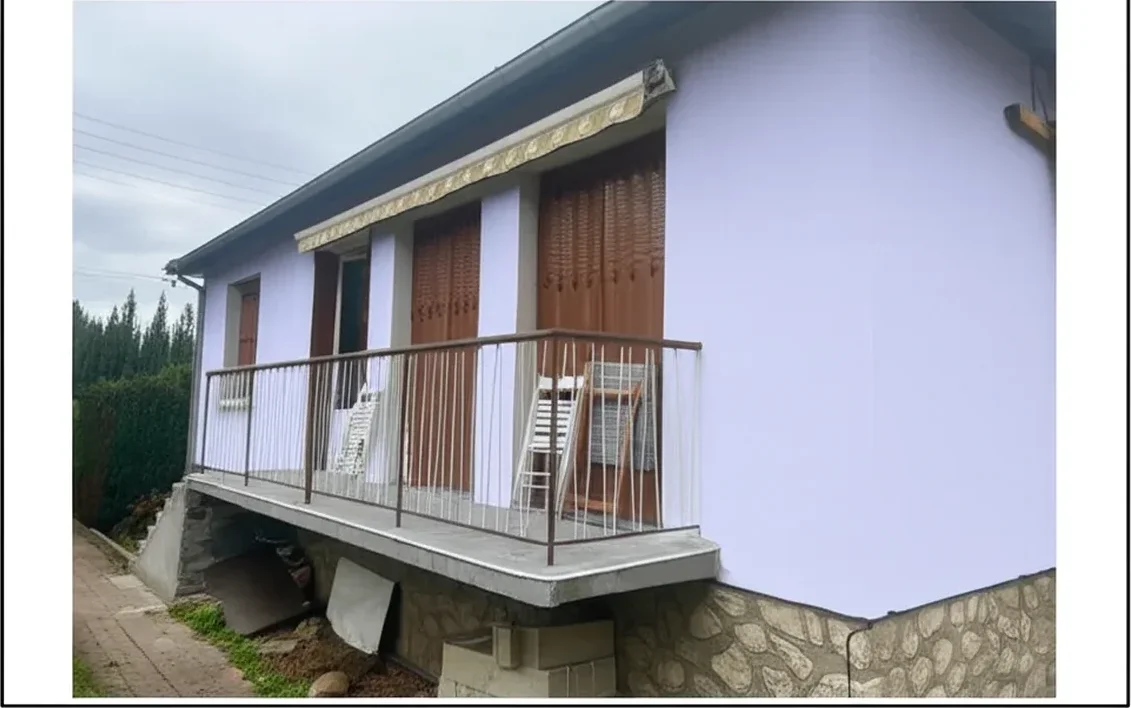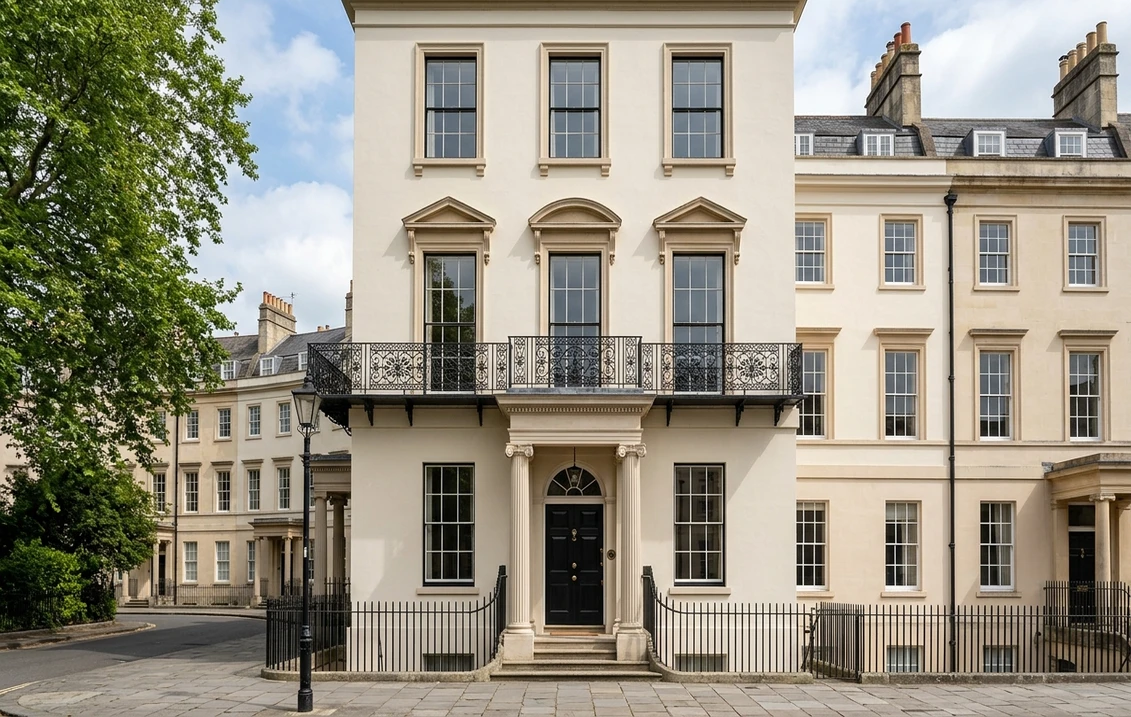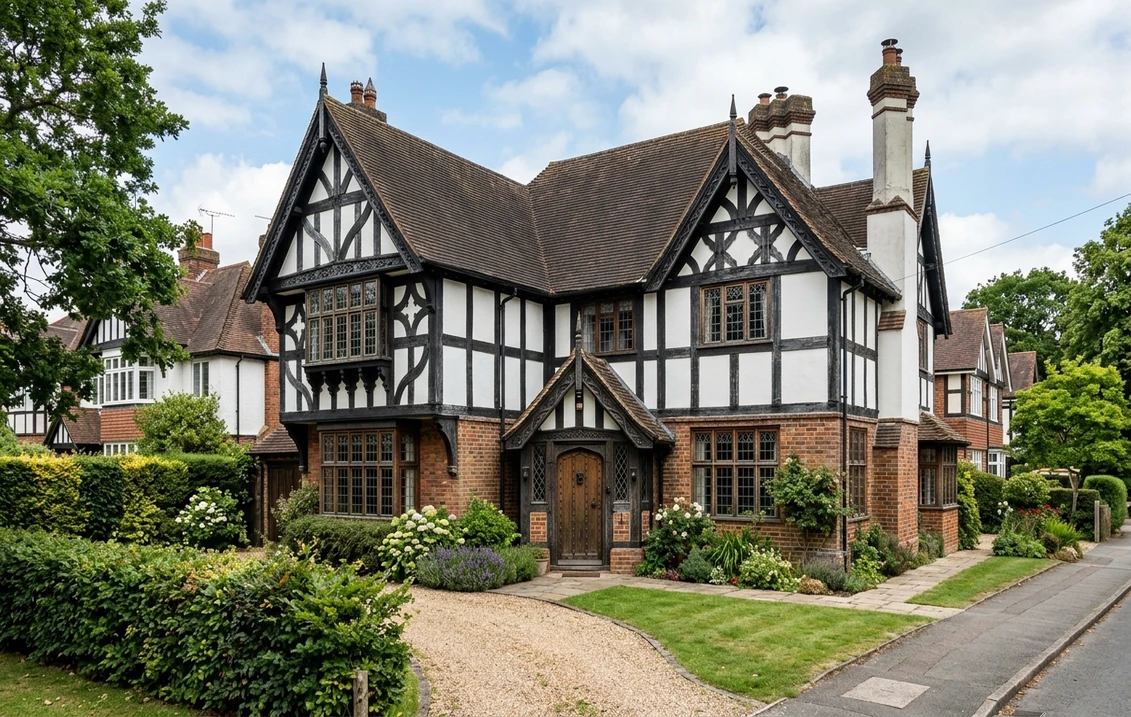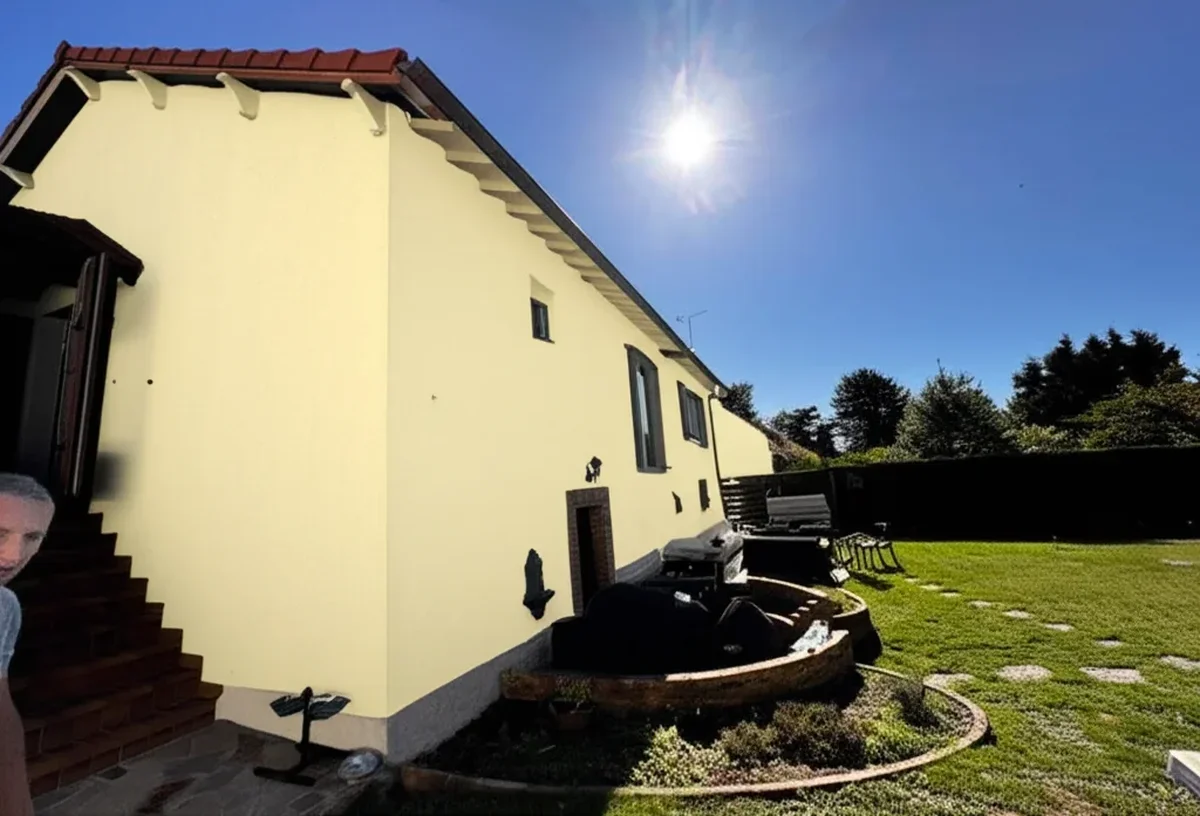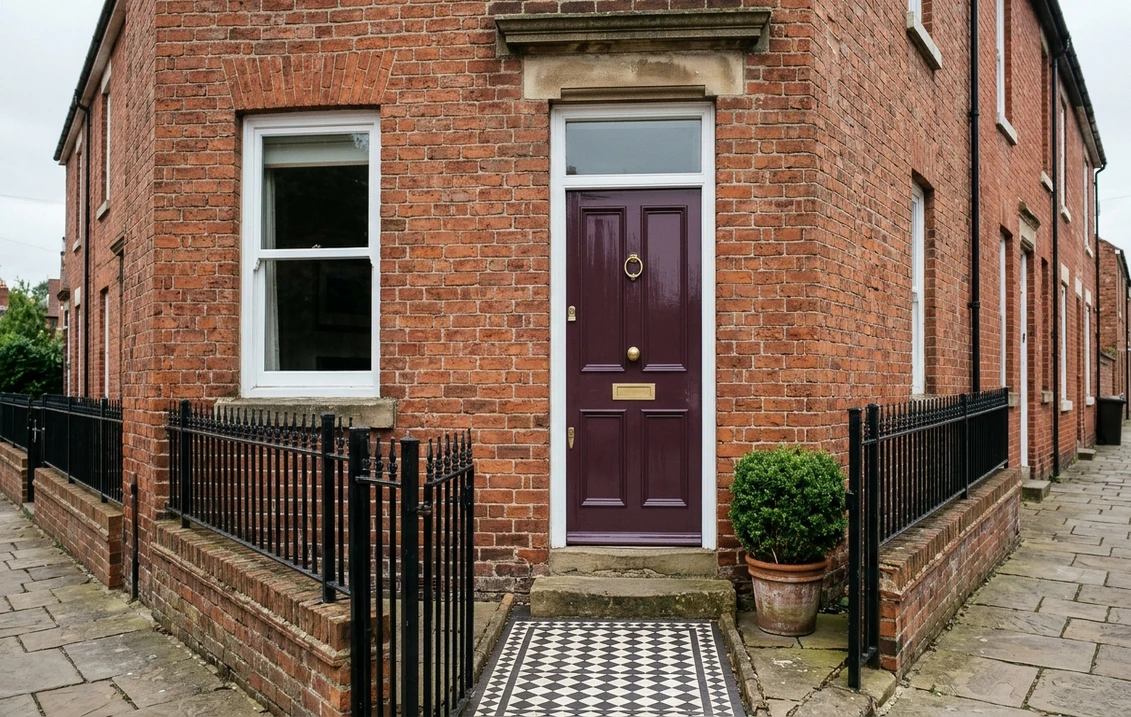
Try it on your house

For a purple front door on a British house, a deep, greyed aubergine usually works better than a bright violet, and Farrow & Ball Brinjal No. 222 ("a sophisticated aubergine", filed in the brand's purple group) is the reference. Paint it in Exterior Eggshell (20% sheen) or Full Gloss (95%): on 29 October 2026 a 750 ml tin of Brinjal cost £38 or £35, enough for the outside face of an ordinary door in three coats. Pelt No. 254 is the bluer version, Brassica No. 271 and Calluna No. 270 the softer ones, and Dulux mixes Deep Aubergine, Plum Compote and Mulberry Burst in its Weathershield Quick Dry exterior gloss and satin. In England, repainting a front door is permitted development, so most houses need no planning permission; a listed building or an Article 4 direction can change that.
Facts below were read on the makers' sites and official pages on 29 October 2026. Neither brand publishes a light reflectance value (LRV) for these colours; any brightness figure here is our estimate from the web swatch.
See a purple front door on your own house first
Upload a photo, repaint the door in Brinjal, Pelt or a Dulux plum, and compare them against your brick or render before buying a sample.
Try our free colour visualiserPurple and the historic British front door
Purple does not appear among the historic door colours described in conservation guidance, which helps explain why it still looks bold on most streets. Tendring District Council's conservation painting booklet lists the exterior colours popular at the end of the eighteenth century (greys, stone, buff, several greens, apricot, yellow, fawn) and notes that by the mid nineteenth century front doors were usually dark Brunswick green, blue or black.
That does not rule purple out on a period house. It means the darker, greyer purples sit more comfortably than a clear violet, because they share the depth of those historic colours, and that on a listed building a purple door is a change the council may want to see first. For door colours by house type, start with our UK front door colour guide.
Brinjal No. 222: what Farrow & Ball says
On its Brinjal colour page, Farrow & Ball says the name comes from the shiny skin of the aubergine and that the colour looks particularly good in Full Gloss. Its other suggestions are indoor ones; on a door, the gloss remark is the one that counts.
| Attribute | Brinjal No. 222 |
|---|---|
| Title and colour group | A sophisticated aubergine; Purple |
| Primer and undercoat tone | Dark Tones (based on the colour of Down Pipe) |
| Complementary white | Skimming Stone No. 241 |
| Web swatch (screen approximation) | #5E4449 (RGB 94, 68, 73) |
| LRV | Not published by Farrow & Ball |
| Exterior prices, 29 October 2026 | Exterior Eggshell £38 (750 ml), £91 (2.5 L); Full Gloss £35 (750 ml), £85 (2.5 L); Exterior Masonry £111 (5 L); sample pot £5.95 |
Try it on your house
No photo? Try a sample
The swatch shows which way Brinjal leans: red (94) is the strongest channel, then blue (73), then green (68), so it is a red-leaning purple, nearer a ripe plum than a violet. That is why our red front door guide lists it with the deep reds. It is also very dark: the relative luminance of the swatch is about 7 on a 0 to 100 scale (our calculation, not an LRV). Expect it to look almost black on a north-facing door and aubergine in sun.
The other Farrow & Ball purples, from lilac to near-black
Farrow & Ball's purple paint colours page groups nine colours; two of them, Peignoir and Titmouse Blue, are filed as pink and blue on their own pages. The seven below are all sold in Exterior Eggshell (£38), Full Gloss (£35) and Exterior Masonry (£111 for 5 litres). Descriptions are summarised from each colour page; the brightness column is our estimate from the swatch.
| Colour | Farrow & Ball (summary) | Swatch | Our brightness estimate |
|---|---|---|---|
| Calluna No. 270 | "A tranquil lilac", named after moorland heather | #C9C7CD | about 58 |
| Sugared Almond No. 9913 | A pale lilac; Archive colour | #D0BFCD | about 55 |
| Brassica No. 271 | "A dark and sophisticated lavender", greyer in shade | #8D838C | about 24 |
| Imperial Purple No. W40 | A deep purple meant for dining rooms; Archive colour | #51516A | about 9 |
| Brinjal No. 222 | "A sophisticated aubergine" | #5E4449 | about 7 |
| Pelt No. 254 | "A deliciously deep purple", much bluer than Brinjal; Archive colour | #53454F | about 7 |
| Paean Black No. 294 | "A chic red based black", said to suit traditional exteriors; filed with the blacks | #484348 | about 6 |
Pelt, Imperial Purple and Sugared Almond are Archive colours: made to order, not returnable, and sampled as 210 x 270 mm paper swatches (£3) rather than pots. How to choose:
- Brinjal or Pelt? Same depth, different lean: Brinjal is red, Pelt is blue (the brand says so, and the swatches agree). Brinjal is warmer on red brick; Pelt looks cooler on grey render or white stucco.
- Black from the street: Paean Black looks black at a distance and plum close up.
- A softer cottage door: Brassica, a greyed lavender deep enough to frame an entrance.
- A pale door: Calluna, best against brick or stone; on white render it can look washed out.
For a softer grey-green, see our guide to Farrow & Ball Pigeon outside; if Paean Black tempts you, the guide to black front door paint covers the true blacks.
Dulux purples you can have mixed for a door
Dulux files its purples under "Violet" and, on its purple paint page, calls aubergine and plum shades dramatic and the grey or brown-tinged ones calmer. On 29 October 2026 its product finder listed the colours below in Weathershield Quick Dry Exterior Gloss and Exterior Satin, both mixed to order in selected stores. Two other deep purples, Royal Berry and Decadent Damson, were not listed in either.
| Dulux colour | Swatch | Our brightness estimate | Our reading |
|---|---|---|---|
| Deep Aubergine | #542840 | about 4 | Redder and more saturated than Brinjal |
| Plum Compote | #484253 | about 6 | A cool, smoky near-black, like Pelt |
| Mulberry Burst | #654657 | about 8 | A berry purple, a little lighter than Brinjal |
| Purple Pout | #594786 | about 8 | A clear violet, brighter than any Farrow & Ball purple |
| Heather Climb | #70677F | about 15 | A greyed heather, between Brinjal and Brassica |
| Lavender Quartz | #B8B9C8 | about 49 | A cool pale lavender, near Calluna |
The last column compares screen colours, not official equivalents: test samples on the door in daylight. Heritage by Dulux, despite its Aubergine and Violet Night, is no help here: its product page lists only Velvet Matt and Eggshell, sold as interior paint. More on Weathershield doors in our Dulux front door colours guide.
Exterior Eggshell, Full Gloss or Weathershield: which finish for a purple door
Figures from the finish and product pages (Exterior Eggshell, Full Gloss, Weathershield Quick Dry Exterior Gloss and Exterior Satin), 29 October 2026.
| Product | Sheen | Coverage per litre | Drying | Durability claimed | Price |
|---|---|---|---|---|---|
| F&B Exterior Eggshell | 20% | Up to 13 m² | 2 h, recoat 4 h | Up to 6 years | £38 (750 ml) |
| F&B Full Gloss | 95% | Up to 12 m² | 2 h, recoat 4 h | Up to 6 years | £35 (750 ml) |
| Dulux Weathershield QD Exterior Gloss (mixed) | Gloss | Up to 13.5 m² | 4 h | 6-year guarantee | £42 (1 L) |
| Dulux Weathershield QD Exterior Satin (mixed) | Mid sheen | Up to 13.5 m² | 6 h | 10-year guarantee | £42 (1 L) |
Gloss suits purple: a deep aubergine in high gloss reflects the sky and shows its undertone, while a low sheen looks flatter and closer to black, hence Farrow & Ball's advice to use Brinjal in Full Gloss. Gloss also shows every dent, so it needs careful preparation; Exterior Eggshell forgives more. Dulux's satin carries the longer guarantee (10 years against 6 for its gloss).
Dark purples need more coats and more patience. The Exterior Eggshell product advice sheet says darker colours may need more than the usual two coats and can take up to 14 days to reach full hardness. Under Brinjal, Pelt and Paean Black use the Dark Tones primer and undercoat, based on the colour of the grey covered in our Down Pipe exterior guide, so a pale undercoat never shows at the panel edges.
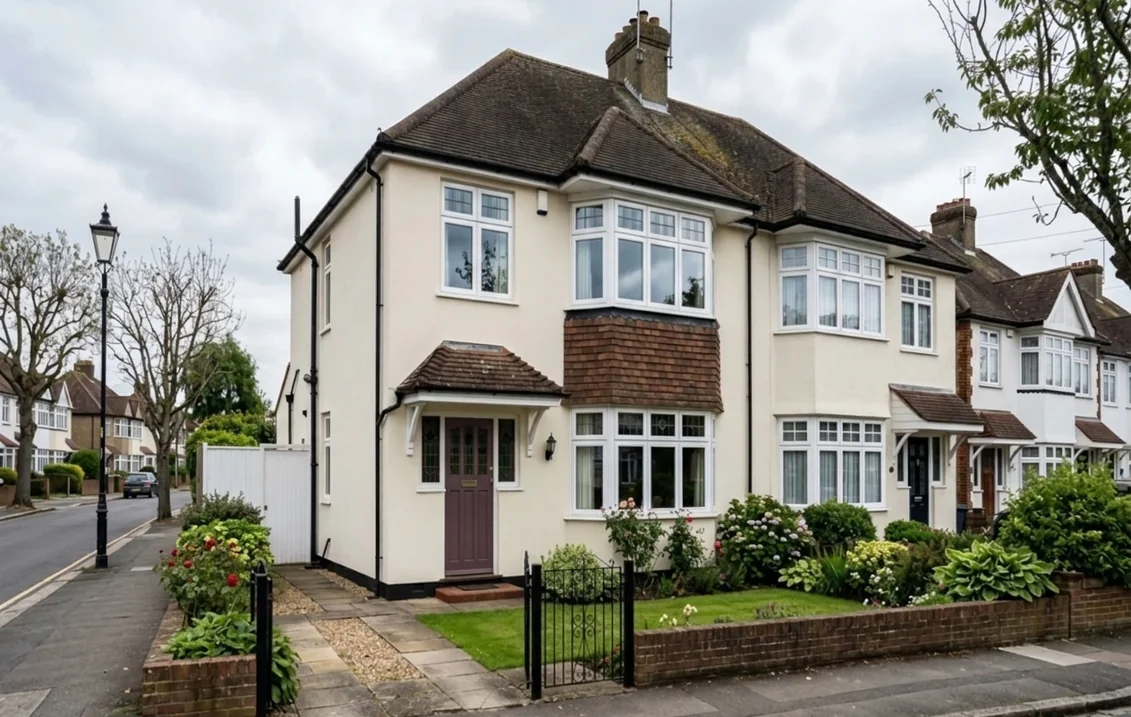
A dark purple on a sunny door: the heat warning from both makers
The same advice sheet warns that changing exterior woodwork from light to dark greatly increases the heat it absorbs, which can draw resin out of the timber and cause blistering, peeling or warping. For a big change on wood in direct sun, Farrow & Ball suggests avoiding its darkest shades in favour of a colour with an LRV above 55, or asking its customer relations team. Dulux's Weathershield gloss page says the same in one line: use only light colours on south-facing resinous wood.
Our swatch estimates put only the lilacs (Calluna, Sugared Almond) around 55, Lavender Quartz just under 50, and every deep purple between 4 and 9. So for a timber door facing south or west in full afternoon sun:
- Choose a light purple and keep the drama for the door furniture; or
- Prepare as the sheet asks: strip old paint to expose knots and resin, treat and patch-prime them, then a full coat of Dark Tones primer; and
- Ask the maker about your door first.
A north or east-facing door, or one under a porch canopy like the semi above, carries much less risk. On a uPVC or composite door, the sheet treats PVC as a difficult surface: degrease, sand lightly, apply a specialist adhesion primer, then Wood Primer and Undercoat and two coats of finish. Check the door maker's warranty first. Dulux recommends its Weathershield Multi-Surface paint for uPVC doors, but its product finder did not list any of the purples above in that product.
Preparing and painting a purple front door
- Pick the day. The Farrow & Ball sheet sets the limits: 10°C to 30°C, no direct sun or rain, humidity under 80%, timber under 15% moisture, and work to Annex C of BS 6150, the British code of practice for painting buildings. Start early so the paint dries before the evening damp.
- Clean, sand and fill. If the door was painted before the early 1990s, assume lead in the lower layers: the UK Health Security Agency notes that the sale of lead paint was banned in the UK from 1992. Wet-sand, never burn it off.
- Prime bare wood: Wood Primer and Undercoat in Dark Tones (Farrow & Ball), or Weathershield Preservative Primer+ and two coats of Weathershield Quick Dry Undercoat (Dulux).
- Topcoats: panels and mouldings first, then the rails and stiles, keeping a wet edge. Two coats, a third if the colour looks patchy; Dulux also warns that some dark colours need a further coat.
- Be gentle for two weeks while the paint hardens.
How much paint? Our calculations from the makers' "up to" coverage, so treat them as a minimum. A door about 2 m tall and 0.8 to 0.9 m wide has roughly 2 m² per face with its edges. The outside face in three coats is 6 m²: about half a litre, so one 750 ml tin of Exterior Eggshell (£38) or Full Gloss (£35), or the 1 litre tin of Weathershield (£42). Both faces in three coats is 12 m²: about a litre, so two 750 ml tins (£76 or £70) rather than a 2.5 litre tin. For the frame and windows around the door, see our guide to repainting exterior window frames; adhesion primers for uPVC are compared in our UK exterior primer guide.
What goes with a purple front door: brick, render, stone and door furniture
Farrow & Ball shows Brinjal with Elephant's Breath No. 229 and Skimming Stone No. 241, with Charleston Gray No. 243 and Dove Tale No. 267, and with All White No. 2005 and Strong White No. 2001, and names Skimming Stone as its complementary white. Outside, with our own reading of each wall material:
- Red brick: Brinjal shares the brick's red base, so it looks rich rather than loud; Paean Black is quieter, Pelt and Imperial Purple stand out more. Frames in Skimming Stone or Strong White.
- London stock or yellow brick: purple sits opposite yellow on the colour wheel, so the contrast is strong. A greyed purple (Brassica, Heather Climb) keeps it elegant; Purple Pout will shout.
- Cream or white render and stucco: the pale wall makes a deep purple look darker and the door the focal point. Brinjal or Plum Compote with white frames is crisp; Calluna may look faded.
- Grey render or pebbledash: warm purples (Brinjal, Mulberry Burst) liven it; Pelt keeps it calm.
- Honey limestone or Cotswold stone: the softer purples, Brassica and Calluna, with Brinjal for a deeper accent.
- Door furniture: brass warms Brinjal, Mulberry Burst and Brassica; black iron sharpens Pelt and Paean Black; chrome or satin nickel suits the blue-leaning purples.
For the walls around the door, see the best exterior paint colours for UK homes and the Edwardian house exterior colours guide.
Do you need permission to paint your front door purple?
For most houses in England, no. Painting the outside of a building is permitted development under Class C of Part 2 of the General Permitted Development Order 2015, unless it is for advertisement, announcement or direction, and "painting" includes any application of colour. The Planning Portal confirms that repainting door and window frames does not usually need permission; its guidance covers England and notes that policy in Wales may differ. Four situations change the answer:
- A listed building. Section 7 of the Planning (Listed Buildings and Conservation Areas) Act 1990 forbids unauthorised works affecting a listed building's character. Tendring's booklet applies this to paint: a new colour on external joinery may need listed building consent (no fee), and unauthorised works risk prosecution.
- An Article 4 direction. What a direction covers varies. Under Tendring's directions, unlisted houses need permission to significantly change the colour of painted surfaces. Worcester's Park Avenue design guide goes the other way for doors: its painting control excludes joinery, and painting doors or windows is listed as a minor change needing no permission.
- A street with a fixed colour scheme. Brighton and Hove told residents in 2021 that under all its Article 4 directions the colour of a front door remains a matter of choice, yet on Lansdowne Square and Lansdowne Place window and door frames must be black gloss and walls Magnolia (BS 4800 08 B15). The door leaf is not mentioned there; a purple frame would break the rule.
- Flats and leasehold houses. The Planning Portal reminds leaseholders that the landlord or management company may need to agree first.
If one of these applies, show the conservation officer a picture of the door in the new colour before buying paint. Our guides to painting in a conservation area and painting a listed building explain how to ask.
Compare Brinjal, Pelt and Brassica on your door
Try three purples on a photo of your house, side by side, and order samples only for the one that works with your brick, render or stone. More about the tool on our paint visualiser page.
Upload a photo of my houseSources and references
- Farrow & Ball, Brinjal No. 222: description, primer, schemes, swatch, prices.
- Farrow & Ball, Purple paint colours and the pages for Pelt, Brassica, Calluna, Paean Black, Imperial Purple and Sugared Almond: descriptions, Archive status, swatches, prices.
- Farrow & Ball, Exterior Eggshell, Full Gloss and the Exterior Eggshell advice sheet (GBEXE): finish data, heat warning, curing, weather limits, PVC.
- Dulux, Purple paint, the six colour pages linked in the table, Weathershield Quick Dry Exterior Gloss, Exterior Satin and The Weathershield Exterior Gloss System: swatches, exterior availability, product data, uPVC.
- Heritage by Dulux, Our products: Velvet Matt and Eggshell interior paint only.
- legislation.gov.uk, GPDO 2015, Schedule 2, Part 2, Class C and Listed Buildings Act 1990, section 7.
- Planning Portal, Doors and windows: planning permission: repainting, Article 4, leaseholders, listed buildings.
- Tendring District Council, Painting booklet: historic door colours, consent for colour changes, Article 4, prosecution, no fee.
- Worcester City Council, Park Avenue Conservation Area Design Guide: joinery excluded, doors as a minor change.
- Brighton and Hove City Council, Queen's Park Article 4, representations (July 2021) and Lansdowne Square and Lansdowne Place: front door colour, black gloss frames.
- UK Health Security Agency, Lead: general information: 1992 ban on the sale of lead paint.
Frequently asked questions
What is the best purple for a front door in the UK?
Which Farrow & Ball finish should I use for a Brinjal front door?
Is a dark purple front door a problem in direct sun?
How much paint do I need for a purple front door?
Do I need planning permission to paint my front door purple?
Does a purple front door go with red brick?
Trademarks mentioned (Sherwin-Williams, Benjamin Moore, Behr, Caparol, Brillux, Sto, Alpina, Valspar, PPG, Glidden, Dulux, Crown Trade, Sandtex, Farrow & Ball, Johnstone's, Leyland) are property of their respective owners. FacadeColorizer is independent and not affiliated with any of them. Nominative fair use under Lanham Act §1125.