Try it on your house

To repaint exterior wooden window frames in the UK, wait for a dry spell above the paint's minimum temperature (10°C for water-based finishes such as Farrow & Ball Exterior Eggshell or Dulux Trade Weathershield Quick Dry, 5°C for solvent-based Weathershield Exterior High Gloss), wash the frames, scrape back to sound paint, cut out rot and fill, prime any bare timber, then apply undercoat and topcoat, letting the last coat lap about 1 mm onto the glass to seal the putty. On most houses in England repainting window frames needs no planning permission; a listed building or an Article 4 direction can change that, mainly when you change the colour. uPVC frames can be painted too, but only with an adhesion primer or a paint sold for weathered PVC-u.
The figures below were read in October 2026 on the makers' product pages and advice sheets, on legislation.gov.uk, the Planning Portal, the Met Office site and in council conservation guidance. Coverage and durability are the makers' own "up to" claims, valid with their full system.
See the new frame colour before you sand a single sash
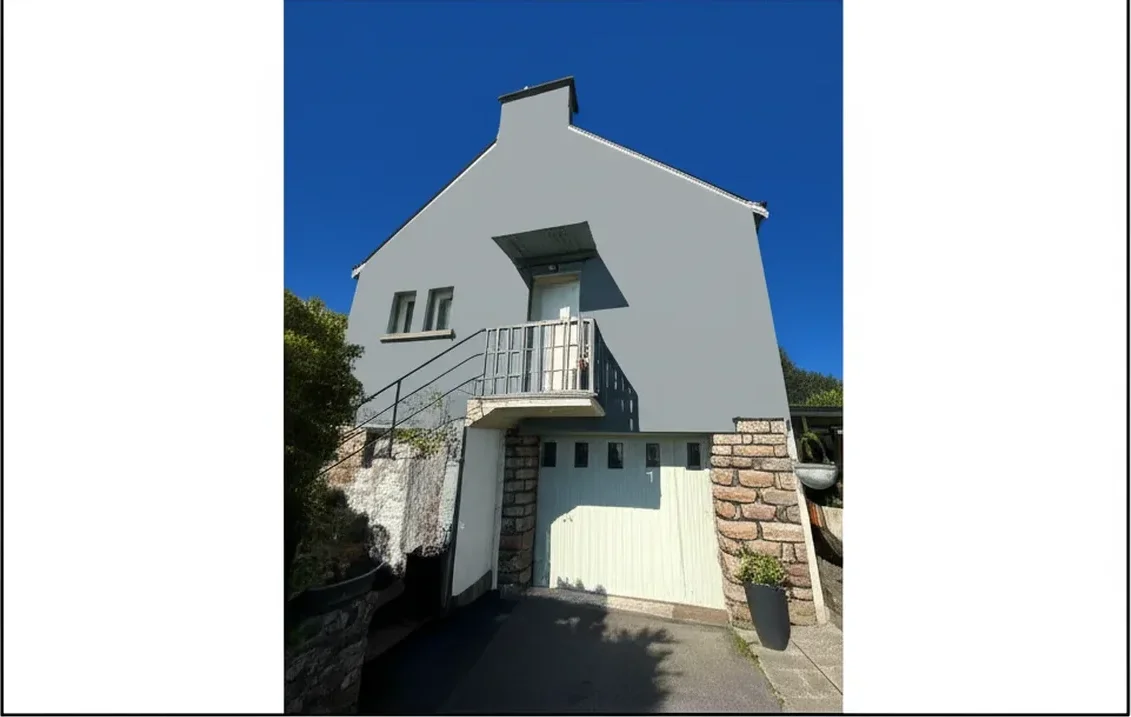
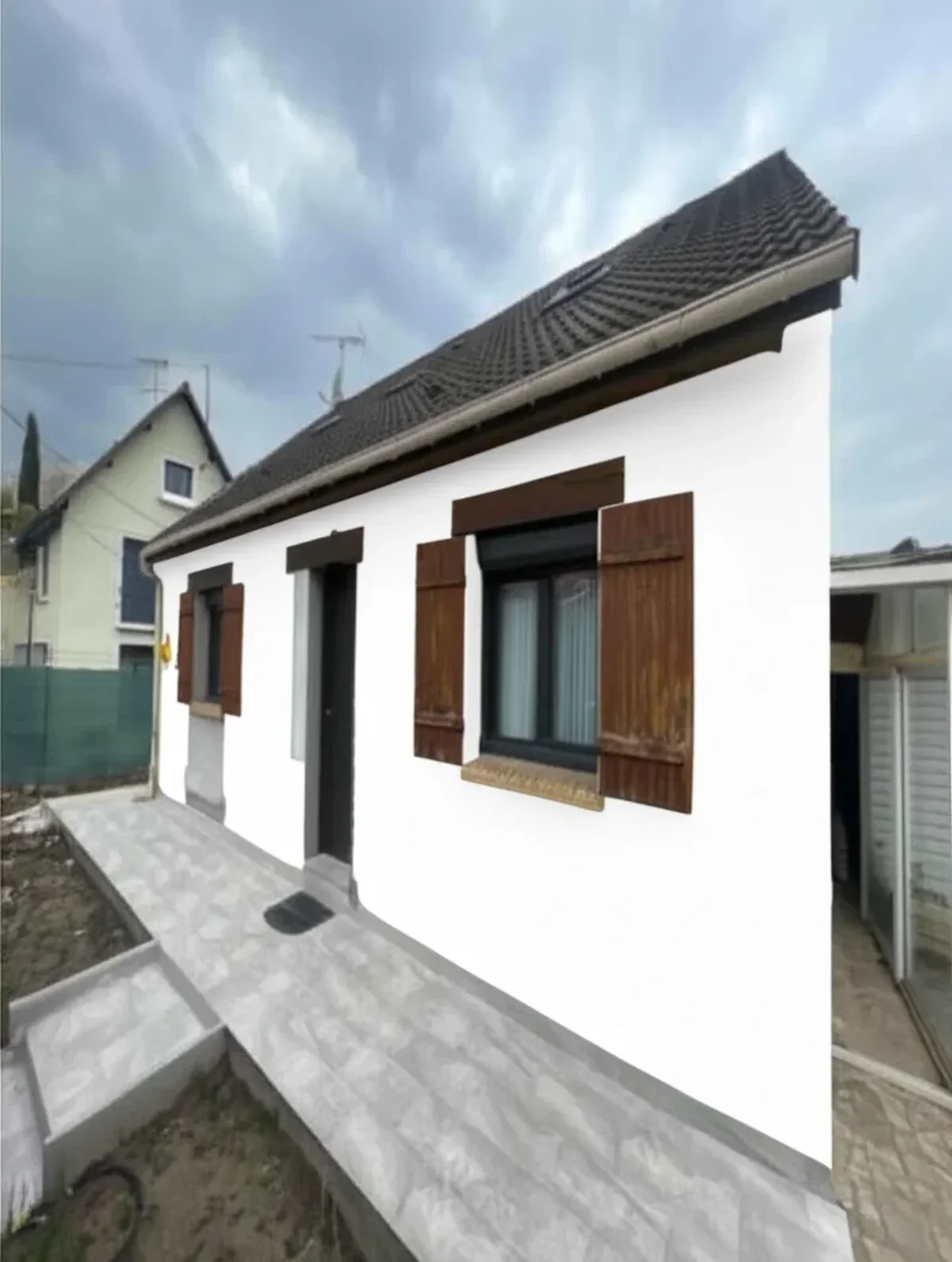
Upload a photo of your house and repaint only the window frames, doors and trim, so you can compare white, off-white and a heritage colour against your brick or render.
Try our free colour visualiserRepainting window frames in five stages
| Stage | What you do | Why it matters |
|---|---|---|
| 1. Weather and timber | A dry day above the paint's minimum; timber under 15% moisture (Farrow & Ball's limit) | Paint on damp wood blisters and peels |
| 2. Clean | Wash off dirt and algae; fungicidal wash where there is growth | Paint sticks to the dirt, not the frame |
| 3. Prepare | Scrape loose paint, feather edges, sand, cut out rot, fill joints, treat knots | Paint over weak layers fails with them |
| 4. Prime and undercoat | Prime all bare wood and end grain, then undercoat in the topcoat's tone | Undercoat is not a primer |
| 5. Topcoat | One or two coats by system, lapping about 1 mm onto the glass | The lap keeps rain out of the putty joint |
Try it on your house
No photo? Try a sample
Window frames are a small part of an exterior repaint but the part that fails first, because rain sits on sills and bottom rails. If you are budgeting for the whole house, our guide to exterior house painting costs in London and the UK shows where joinery sits in a decorator's quote.
When to paint window frames in a British climate
The Met Office describes the prevailing winds across the UK as west to south-westerly, with northern and western areas more exposed than the south and east. So the windows on west and south-west elevations take the driving rain, and south-facing ones the sun: repaint those first. Each product then sets its own weather window:
| Product | Base | Temperature limit given by the maker | Recoat |
|---|---|---|---|
| Farrow & Ball Exterior Eggshell | Water | 10°C to 30°C, humidity under 80% | 4 hours |
| Dulux Trade Weathershield Quick Dry Exterior High Gloss | Water | Not below 10°C; not after rain, fog or frost | 4 to 6 hours |
| Dulux Trade Weathershield Exterior High Gloss | Solvent | Not below 5°C, as BS 6150 recommends | 16 to 24 hours |
| Dulux Weathershield system (retail) | Varies by product | 8°C to 25°C, no rain forecast | Undercoat touch dry in 2 hours |
The Exterior Eggshell advice sheet adds two rules that matter as much as the thermometer: keep the surface at least 3°C above the dew point, and start early so the paint is dry before evening condensation. It also points to Annex C of BS 6150, the British code of practice for painting buildings. Late October, when this guide was written, is borderline: a mild, dry day that reaches 10°C by late morning is enough for a water-based coat on a sheltered elevation; the solvent gloss tolerates 5°C but needs a full day between coats. Dulux reminds buyers that its paint is only weatherproof once dry, so skip any day with rain forecast.
How often? Bristol City Council's traditional windows guidance says that, depending on exposure, timber windows will likely need a fresh coat after the first 10 years, then at seven-year intervals. Makers claim six years (Farrow & Ball), eight (Dulux Trade Weathershield) or ten (Dulux's retail guarantee, Sandtex). On an exposed west-facing sill, plan on the short end.
Which paint for exterior window frames? The UK systems compared
Five topcoats from three widely sold UK brands, as listed on each maker's product page. Each durability claim only holds with that maker's own primer and undercoat.
| Topcoat | Base | Sheen | Coverage (up to) | System under it | Durability claimed |
|---|---|---|---|---|---|
| Farrow & Ball Exterior Eggshell | Water | 20% | 13 m² per litre | Wood Primer & Undercoat, two coats | Up to 6 years |
| Farrow & Ball Full Gloss | Water | 95% | 12 m² per litre | Wood Primer & Undercoat, two coats | Up to 6 years |
| Dulux Trade Weathershield Exterior High Gloss | Solvent | High gloss | 18 m² per litre | Preservative Primer+ (BP), two coats of Flexible Undercoat, one of gloss | 8 years with the full system |
| Dulux Trade Weathershield Quick Dry Exterior High Gloss | Water | High gloss | 13 m² per litre | Part 3 of a three-part system | 8 years |
| Sandtex 10 Year Exterior Multi-Surface Gloss | Water | Gloss | Not stated | 10 Year Exterior Primer Undercoat, two coats | Up to 10 years |
Dulux Trade Weathershield is sold through selected stores rather than online. Its Exterior High Gloss is solvent-based and brush-only, and the Flexible Undercoat page sets out the system: Preservative Primer+ on new or bare wood, undercoat on all primed wood, a second undercoat overall, then one coat of gloss, with extra coats for strong colour changes. The Preservative Primer+ (BP) is a water-based basecoat against decay and blue-stain fungi; its own page asks for two even coats. The retail Dulux Weathershield system pairs Exterior Preservative Primer, Quick Dry Undercoat and a High Gloss or Quick Dry Satin topcoat, guaranteed for 10 years with the undercoat. Our Dulux Weathershield buyer guide covers the colours.
Farrow & Ball Exterior Eggshell is the low-sheen choice for period houses: its advice sheet names wooden window frames first among its uses, and, like the whole range, it is water-based. Sandtex offers a two-step water-based system, the 10 Year Exterior Multi-Surface Gloss with its matching primer undercoat, recoatable after 4 to 6 hours.
Gloss or eggshell? Gloss gives the traditional shine of Victorian and Edwardian joinery and wipes clean; eggshell looks softer on Georgian and cottage windows and is kinder to dented old timber. Water-based paints recoat in about four hours, so two coats fit into one dry day. For white, our guide to white outdoor paint for wood compares the brilliant whites, and the exterior wood paint guide covers doors, cladding and fences.
Preparing old timber frames: paint, lead, rot and knots
Farrow & Ball's sheet is blunt: poor preparation is the main cause of most paint problems. On window frames it is three quarters of the job.
- Wash, then dry. Soapy water for dirt, a fungicidal wash where mould, algae or lichen has taken hold, as the Dulux system recommends.
- Scrape and feather. Remove all peeling or blistering paint, feather the edges of the sound paint, and sand the frame lightly for a key.
- Assume old paint contains lead. The UK Health Security Agency notes that the sale of lead paint was banned in the UK from 1992, and Tendring District Council records that lead paint was used on windows and doors. Wet-sand or strip chemically, never burn it off, and keep children and pets away from the dust.
- Cut out rot, fill the rest. Probe sills and bottom rails with a bradawl; soft wood is cut back and spliced with new timber. Dulux Trade's Weathershield Exterior Flexible Filler is for open joints, splits and minor cracks, not for rebuilding a sill; leave it overnight before sanding.
- Treat knots. Farrow & Ball suggests drawing out resin with a hot air gun, scraping it off and cleaning with white or methylated spirit; for severe knots, a knotting solution, an aluminium-based wood primer or a wooden plug.
- Prime every bare patch, including end grain. Our comparison of exterior primers available in the UK covers wood, metal and difficult surfaces.
Filling the same cracks every repaint, Farrow & Ball notes, may mean the joinery is nearing the end of its life: call a joiner, though York's conservation team adds that windows often look worse than they are.
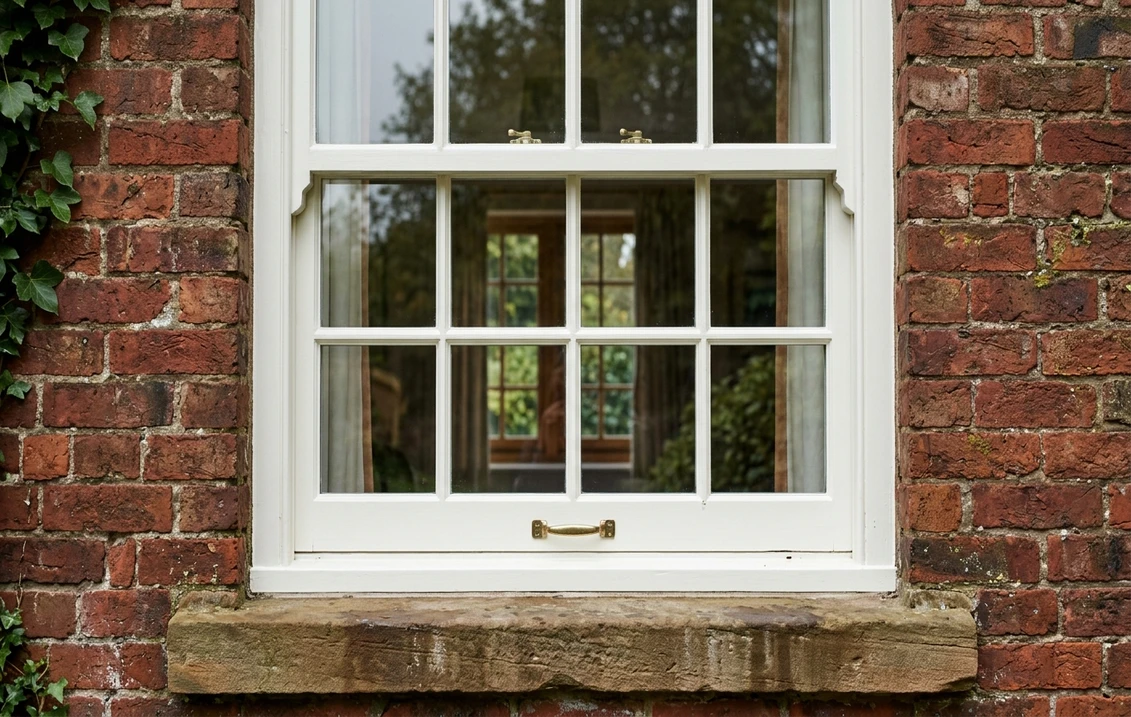
Painting a sash window step by step
A box sash has hidden cords and weights and running surfaces that must stay free. This order reaches every face without gluing the sashes shut.
- Reverse the sashes. Push the bottom sash up and pull the top one down, then paint the lower part of the top sash, including the normally hidden bottom of its meeting rail.
- Swap them back once touch dry, leaving a small gap top and bottom, and finish the top sash.
- Paint the bottom sash: glazing bars first, then rails and stiles, laying off along the grain.
- Paint the frame, sill last, working paint into the joint between sill and frame where water collects.
- Go easy on the runners. Keep paint off the cords and keep coats thin on the pulley stiles and beads the sashes slide against.
- Seal the glass line. Farrow & Ball asks for the last topcoat to overlap the clean glass by about 1 mm; masking tape set 1 mm off the timber gives a straight line if you pull it while the paint is slightly wet.
- Keep the sashes moving a few centimetres at intervals while the paint dries.
Under its water-based paints, Farrow & Ball recommends acrylic glazing putty, applied after an undiluted coat of Wood Primer & Undercoat on the bare rebate; with linseed putty, follow the maker's advice on skinning time. It does not recommend painting over silicone or other sealant, whose movement cracks the paint. Casements are simpler: edges first, then faces, then the frame, left ajar to dry. If the inside of your frames goes black with mould every winter, start with our window condensation guide.
Choosing a colour for window frames
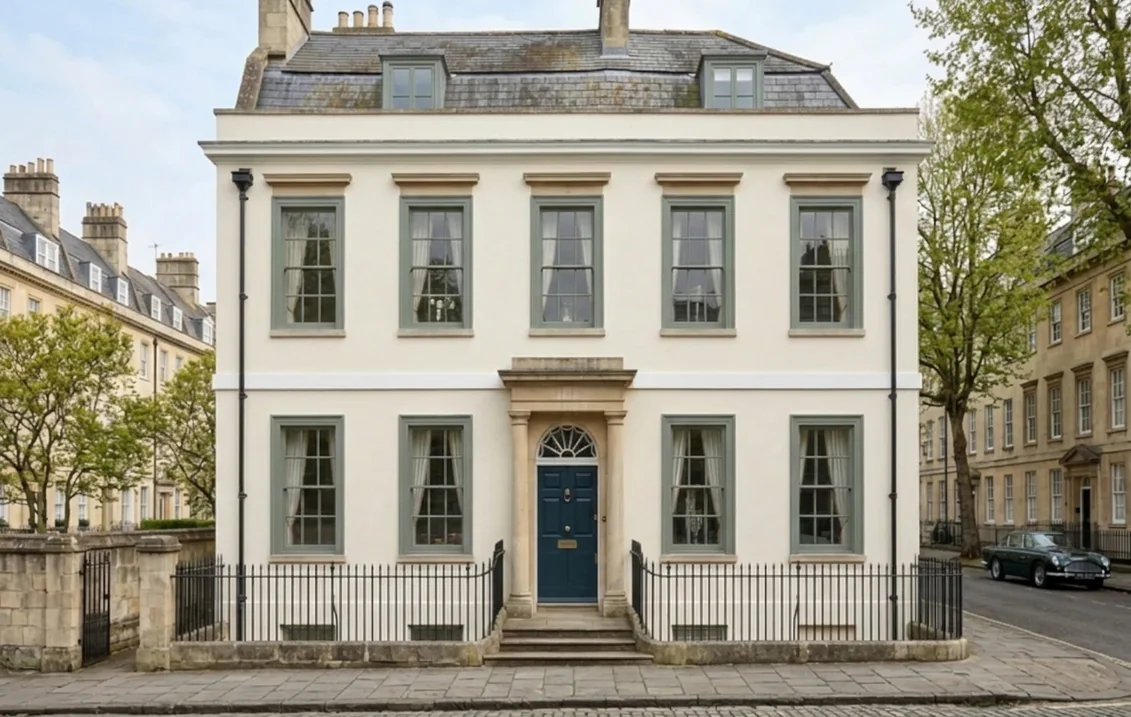
White is the British default, not the only historic answer. Tendring District Council's painting booklet says paint is the traditional finish for external joinery, that it need not be white, and that blues, greys or black can suit just as well; it also records that by the mid-nineteenth century, with coal smoke everywhere, windows were often painted a practical chocolate brown. York's conservation note points the same way: muted tones raise the fewest questions on a listed building.
A soft heritage green is a quiet step away from white. Farrow & Ball describes Green Smoke No. 47 as a smoky green blue, popular in late nineteenth-century interiors; outside it costs £38 for 750 ml of Exterior Eggshell (£91 for 2.5 litres), or £35 and £85 in Full Gloss, on its Dark Tones primer, with Shaded White No. 201 as its complementary white for a two-tone sill or fanlight.
Dark frames carry one technical risk. Farrow & Ball warns that going from light to dark greatly increases the heat timber absorbs from the sun, which can pull resin and gases from knots and blister the paint. For a big change on timber in direct sun it suggests a colour with a light reflectance value (LRV) above 55, or stripping back to treat the knots first; Dulux says to use light colours only on south-facing resinous wood. A green-grey on a north-facing terrace is low risk; the same colour on a south-facing sash that has always been white deserves a call to the maker. For whole-frontage schemes, see our Victorian terrace colour schemes, the stone grey render with black window frames pairing, and the UK front door colour guide so door and frames agree.
Do you need permission to repaint window frames?
For most houses in England, no. Painting the exterior of any building is permitted development under Class C of Part 2 of the General Permitted Development Order 2015, unless it is for advertisement, announcement or direction, and painting includes any application of colour. The Planning Portal lists "repainting window and door frames" among works that usually need no planning permission. Wales, Scotland and Northern Ireland have their own rules. Three situations change the answer:
- An Article 4 direction. The Planning Portal warns that a council can withdraw permitted development rights this way, and that conservation areas can carry extra restrictions. Each direction lists the works it covers: read yours before changing colour.
- A listed building. Listed building consent is needed for significant works, inside or out, and councils draw the line at colour. York's historic windows guidance note (December 2025) says painting windows will not normally require permission on a listed house, particularly in the same colour or muted tones; Tendring warns that repainting joinery in a different colour may require consent. Same colour, carry on; new colour, ask the conservation officer.
- Repairs that become replacement. Bristol notes that like-for-like repairs do not usually require permission, but replacing any window on a listed building does. York adds that renewing a rotten sill in quality timber with matched profiles needs no permission.
A lease can also control window colour on flats and leasehold houses. Our guides to painting in a conservation area and painting a listed building explain how to ask the council.
Painting uPVC window frames
Bristol's guidance is hard on plastic windows: it says uPVC discolours, loses its finish over time and cannot easily be repaired. Paint makers do sell systems for tired white frames:
- Sandtex lists weathered PVC-u among the surfaces for its 10 Year Exterior Multi-Surface Gloss, with the 10 Year Exterior Primer Undercoat.
- Dulux suggests its Primer for Difficult Surfaces under a trim paint, or Multi-Surface Quick Dry Satin with no primer, which claims six years of weather protection on uPVC doors.
- Farrow & Ball treats PVC as a difficult surface: degrease, abrade lightly, apply a specialist adhesion primer, then Wood Primer & Undercoat and two coats.
Mask the rubber gaskets and any sealant, ask the installer whether painting affects the guarantee, and ask the window maker before going much darker on a sunny elevation. Planning rules are the same as for timber.
How much paint for window frames? A worked example
Take a terrace with six box sash windows of about 0.9 m by 1.6 m. By our estimate, the outside face of each (box frame, two sashes, glazing bars, timber sill) carries 1 to 1.5 m² of paintable timber; call it 1.2 m², so about 7 m² in all. Real coverage on glazing bars falls short of the "up to" figures, so round up.
- Farrow & Ball Exterior Eggshell, two coats: about 14 m² at up to 13 m² per litre is 1.1 litres, so two 750 ml tins (£76 in Green Smoke), plus Wood Primer & Undercoat.
- Dulux Trade Weathershield: two coats of Flexible Undercoat (14 m² at up to 16 m² per litre, 0.9 litres) and one of High Gloss (7 m² at up to 18 m² per litre, 0.4 litres): a 1 litre tin of each, plus Preservative Primer+ (up to 5 m² per litre) for bare patches.
- Inside faces too? Double the figures, or use an interior trim paint indoors.
Allow time too: about two good days per elevation with water-based paints, four or five dry days with the solvent Weathershield system.
Compare white, off-white and a heritage colour on your own windows
Upload a photo of your front elevation and try the frames in two or three colours side by side before you order samples. More about the tool on our paint visualiser page.
Upload a photo of my houseSources and references
- Farrow & Ball, Exterior Eggshell product advice sheet (GBEXE, 10/09/2026): preparation, timber moisture, weather limits, BS 6150, putty, sealants, PVC, light-to-dark changes, coverage.
- Farrow & Ball, Exterior Eggshell, Full Gloss and Green Smoke No. 47: sheen, coverage, durability, primer tone and prices on 27 October 2026.
- Dulux Trade, Weathershield Exterior High Gloss, Exterior Flexible Undercoat, Preservative Primer+ (BP) and Exterior Flexible Filler: system, coats, coverage, recoat times, 5°C limit and 8-year claim (Quick Dry gloss page for the 10°C limit).
- Dulux, The Weathershield Exterior Gloss System: retail system, 10-year guarantee, 8°C to 25°C, south-facing resinous wood, uPVC options.
- Sandtex, 10 Year Exterior Multi-Surface Gloss: two-step system, weathered PVC-u, recoat time.
- legislation.gov.uk, GPDO 2015, Schedule 2, Part 2, Class C: exterior painting as permitted development.
- Planning Portal, Doors and windows: planning permission: repainting frames, Article 4, listed building consent.
- City of York Council, Historic Windows guidance note (December 2025): painting and repairs on listed buildings.
- Bristol City Council, Traditional Windows guidance: repainting intervals, permissions, uPVC.
- Tendring District Council, Painting booklet: historic joinery colours, lead paint, consent for a colour change.
- UK Health Security Agency, Lead: general information: 1992 ban on the sale of lead paint.
- Met Office, Where are the windiest parts of the UK?: prevailing west to south-westerly winds.
Frequently asked questions
Do I need planning permission to repaint my window frames?
What is the best paint for exterior wooden window frames in the UK?
Can you paint window frames in autumn or winter?
Can you paint uPVC window frames?
How often should exterior window frames be repainted?
How do I stop sash windows sticking after painting?
Official sources
To verify the regulatory information in this guide at the primary source:
- GOV.UK : When planning permission is required
- Planning Portal : Planning permission and building regulations (England and Wales)
- Historic England : Listed buildings and conservation areas
External links. FacadeColorizer is not affiliated with these bodies and their guidance may change over time.
Trademarks mentioned (Sherwin-Williams, Benjamin Moore, Behr, Caparol, Brillux, Sto, Alpina, Valspar, PPG, Glidden, Dulux, Crown Trade, Sandtex, Farrow & Ball, Johnstone's, Leyland) are property of their respective owners. FacadeColorizer is independent and not affiliated with any of them. Nominative fair use under Lanham Act §1125.