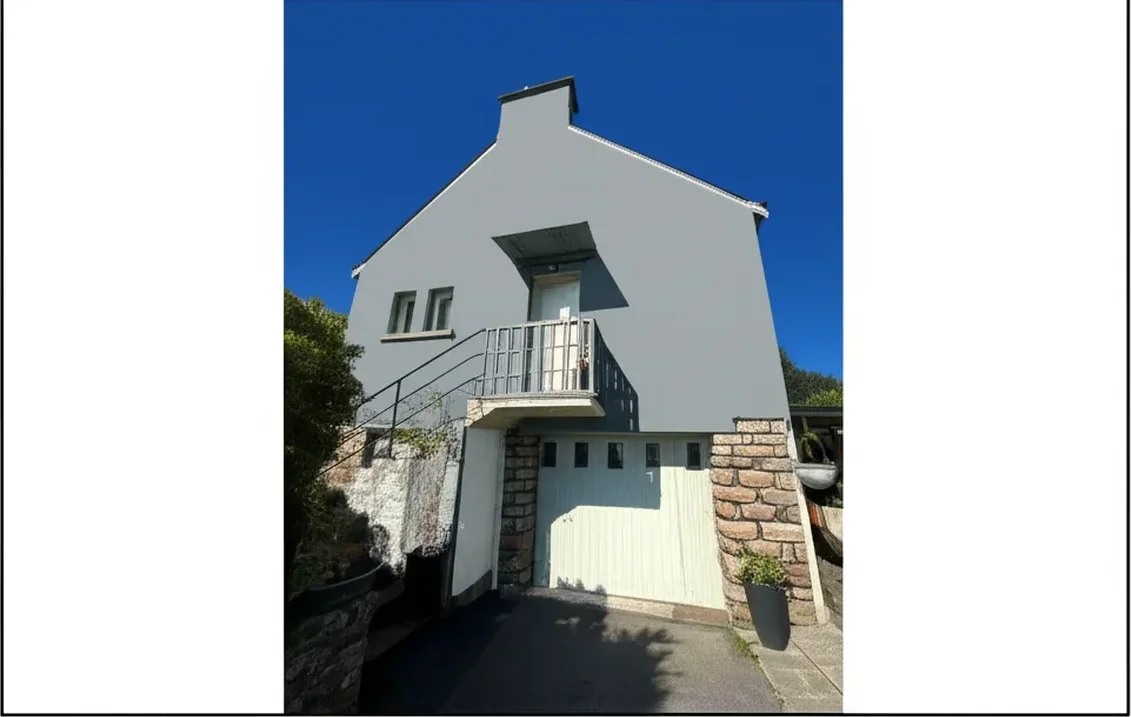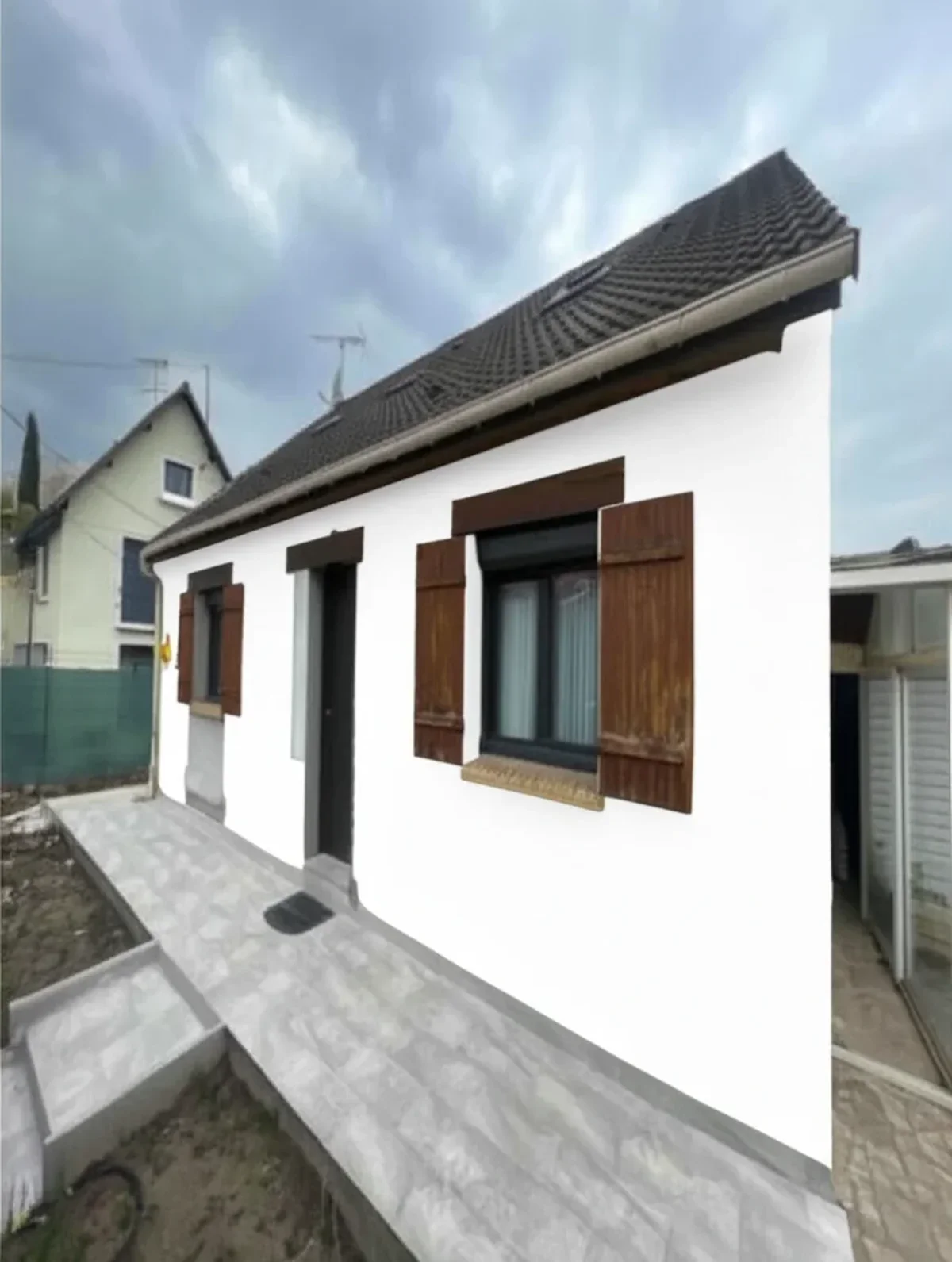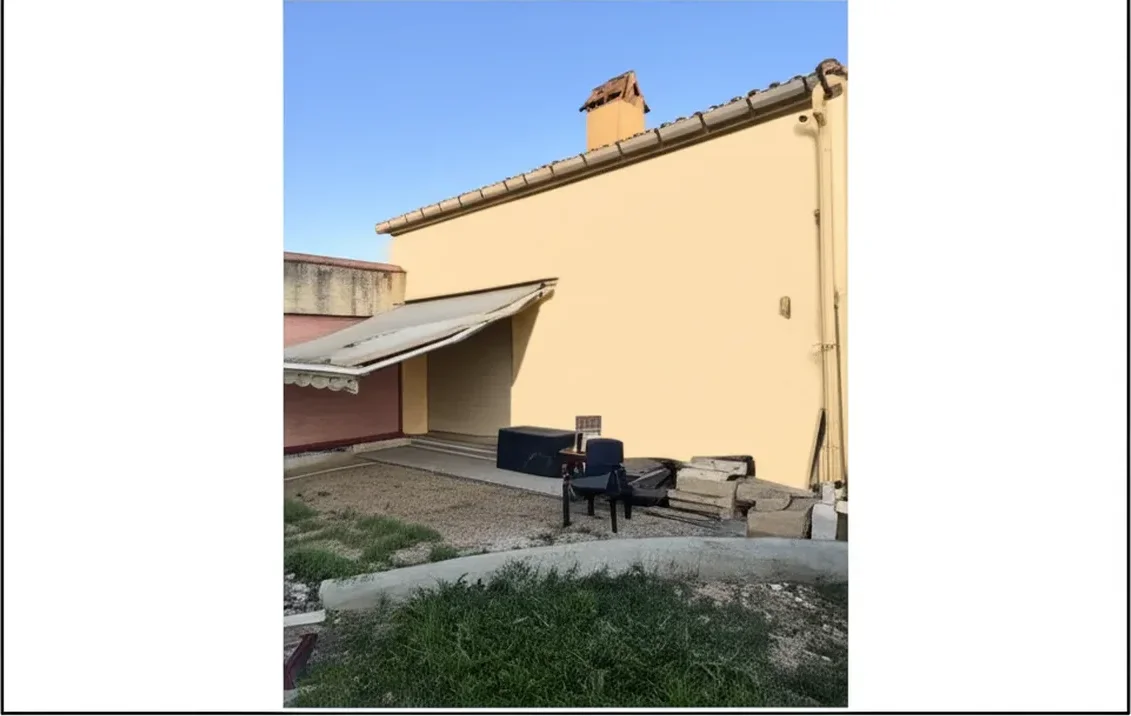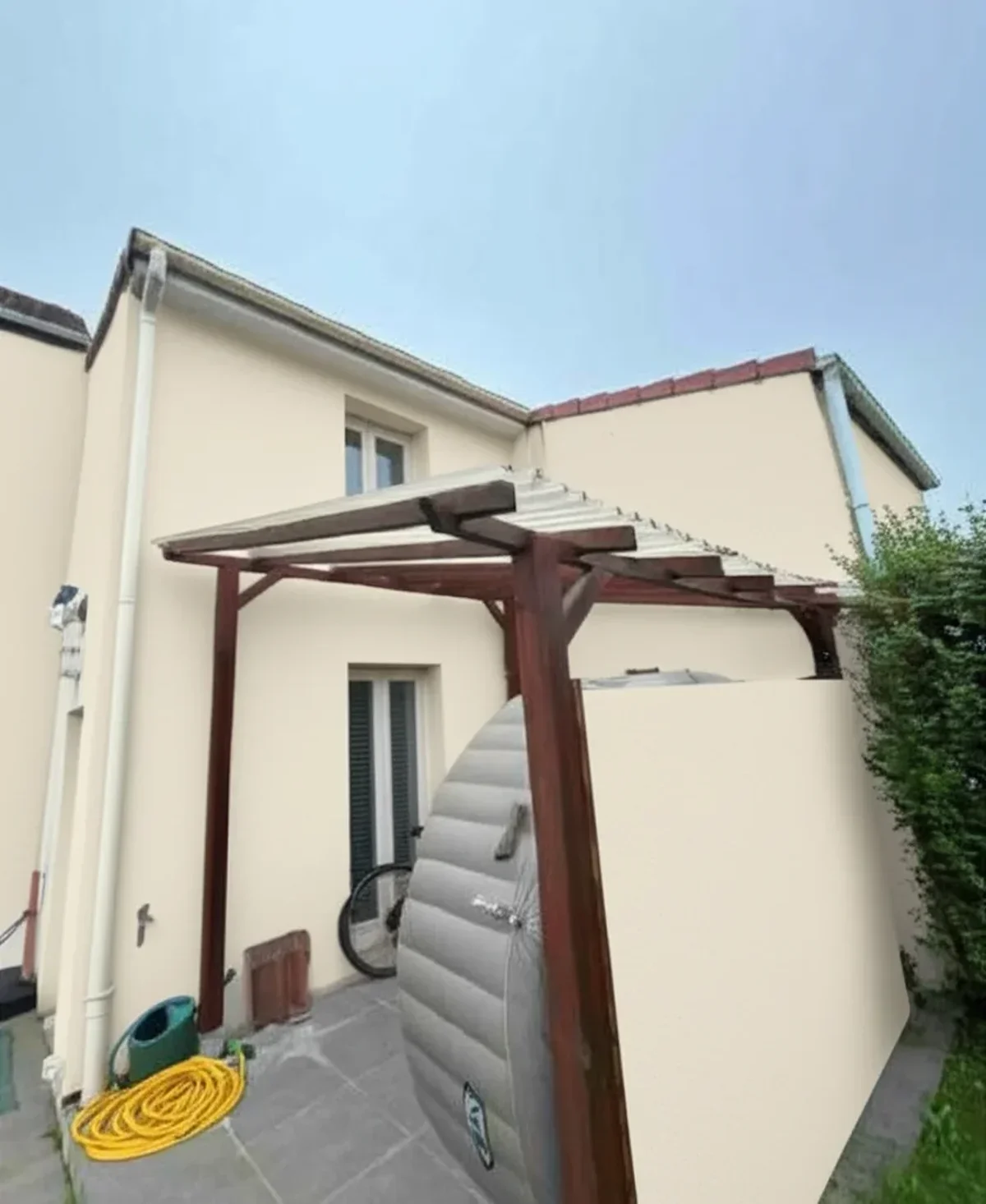
Try it on your house

Painting a British home in black is no longer the dramatic gesture it was in 2018. Across 16,983 previews on FacadeColorizer, queries for black masonry paint from London, Manchester, Birmingham, Bristol and Edinburgh now run alongside heritage cream and putty in the exterior top ten. The hard part is finding a black masonry paint that survives a UK winter without chalking grey by year three, holds depth on render and brick, and meets BS EN 1062 weathering classifications for British walls. This guide compares the matt black masonry paint, black gloss masonry paint and tinted blacks decorators actually specify in 2026, with real GBP prices for 1 litre, 2.5 L, 5 L and 10 L tins from B and Q, Wickes, Screwfix and Homebase.
Why black masonry paint fails faster in the UK climate
Black pigments absorb roughly 90 percent of incident solar radiation, against 20 percent for a typical neutral white masonry paint. On a south-facing render elevation in Bristol or Brighton, the surface temperature of a black wall can swing from 5 degrees C at dawn to 55 degrees C by 3 pm in July. That 50 degree daily delta drives accelerated thermal cycling, which in turn drives micro-cracks at the render-paint interface, mould colonisation on the cooler north faces and the dreaded chalky bloom that turns a deep black masonry paint into a tired charcoal grey within thirty months. British conditions also stack three additional stressors on top: driving rain from Atlantic westerlies, freeze-thaw on every elevation between November and March and the high humidity that allows airborne algae to settle.
For that reason, you cannot simply order a black exterior masonry paint at the lowest price and expect a 15 year life. The serious products in 2026 use one of two black pigment families: high carbon-black with UV stabilisers (Sandtex, Dulux Weathershield, Crown Trade) or iron oxide synthetic blacks (Beeck, Keim, Sto mineral). Cheap matt black masonry paint from generic value lines often relies on bone-black or vine-black tints, which fade fast and migrate at the chalk line. Always check the technical data sheet for BS EN 1062-3 water permeability (W3 low absorption) and BS EN 1062-7 crack-bridging at A3 minimum on render before you pay.
Before committing to a black on a UK semi, run a 200 mm test patch on the hidden gable or rear elevation and review it through three weather cycles. If the sample shows visible chalk, mineral bloom or efflorescence at six months, the product is not fit for purpose and you should walk away rather than recoat. This single discipline prevents the majority of failed black masonry projects we see across the British 2026 dataset.
Planning permission, Conservation Area and Listed Building rules for black exteriors
Black is one of the colours most likely to attract conservation officer attention. For an unlisted home outside a Conservation Area or Article 4 zone, repainting render or brickwork in any colour normally sits under Permitted Development and needs no application. Inside a Conservation Area, painting an exterior wall a noticeably different colour from the prevailing palette is treated as a material change to external appearance and may require planning permission, especially in Bath, Edinburgh New Town, Cheltenham, Bristol's Clifton, and most London Conservation Areas including Hampstead, Highgate, Greenwich and Blackheath. Bringing a previously cream or stone render to black masonry paint will almost always trigger a refusal letter, even on a humble semi.
For Listed Buildings (Grade I, Grade II* and Grade II), changing an exterior wall colour to black requires Listed Building Consent under the Planning (Listed Buildings and Conservation Areas) Act 1990. Painting without consent is a criminal offence with unlimited fines and the council can require the wall to be re-coated at the owner's cost. Search the Historic England National Heritage List before purchase, then consult the official guidance at the UK Planning Portal, your local conservation officer and the Welsh Cadw, Scottish gov.scot historic environment policies and the Northern Irish Historic Environment Division.
Article 4 Directions are also worth checking. Around 240 of these zones across the UK have removed Permitted Development rights for external repainting, meaning a black exterior masonry paint job could need full planning permission even on a 1960s estate house. Manchester, Birmingham, Liverpool, Brighton and most London boroughs publish Article 4 maps online. The Health and Safety Executive page at hse.gov.uk lists additional duties when working at height on render and brick (BS 7079 surface preparation, scaffold or MEWP for elevations over 2 metres).
Six best black masonry paint products UK 2026 compared (GBP prices)
Prices and coverage below were verified in May 2026 at B and Q Trade Point, Wickes, Screwfix, Homebase and Brewers Decorators Centres, plus direct trade pricing from Dulux, Sandtex and Crown Trade depots. Coverage assumes smooth render or fair-faced brick; expect 30 to 50 percent lower coverage on pebbledash, textured render or absorbent stock brick. Every product listed meets BS EN 1062 exterior masonry coating classifications.
| Black masonry paint product | Finish | Coverage (m2 per L) | Price 5 L (GBP) | Guarantee | Where to buy UK |
|---|---|---|---|---|---|
| Sandtex 365 Smooth Masonry (Jet Black tint) | Matt black masonry paint | 10 to 14 | 31 to 38 | 15 years | B and Q, Wickes |
| Dulux Weathershield Smooth (Black Pearl) | Matt black exterior masonry paint | 10 to 12 | 32 to 42 | 15 years | B and Q Trade Point, Homebase |
| Crown Trade Clean Extreme Smooth (Charcoal Black) | Matt with anti-mould | 11 to 14 | 36 to 45 | 10 years | Brewers, Screwfix Trade |
| Johnstone Trade Stormshield Smooth (Black) | Matt high-build | 9 to 11 | 34 to 41 | 15 years | Screwfix, Toolstation |
| Leyland Trade Weatherproof Smooth (Jet Black) | Matt budget trade | 10 to 12 | 28 to 34 | 10 years | Screwfix, Toolstation |
| Farrow and Ball Exterior Masonry (Pitch Black No. 256) | Matt heritage chalky | 8 to 10 | 68 to 78 | 6 years | F and B showrooms, online |
Try it on your house
No photo? Try a sample
Sandtex 365 Smooth Masonry in a jet black tint remains the volume choice for UK semis and terraces because it pairs the longest guarantee in the mass-market category (15 years) with the best B and Q availability across Sandtex 1 litre, 2.5 L, 5 L and 10 L tin sizes. Dulux Weathershield Smooth in Black Pearl is the closest competitor on Trade Point shelves. Crown Trade Clean Extreme Smooth pushes ahead on north-facing render and shaded gable ends thanks to its biocidal mould-resistance package, useful in damp Manchester, Glasgow and Cardiff microclimates. Farrow and Ball Pitch Black sits in a class of its own for heritage and Listed properties where conservation officers will sometimes approve a black exterior masonry paint provided the colour and chalky matt are consistent with the local palette.
One route the table above understates is the tinting counter. Wickes keep only a small black range on the shelf, but the Wickes Trade machine tints to order and lands within roughly 2 to 4 Delta E of most Farrow and Ball, Little Greene, Crown and Johnstone shades. That is the practical answer for a heritage black, because Pitch Black No. 256 in the exterior masonry base is a showroom or online order rather than something you collect on a Saturday morning. Our guide to Wickes masonry paint prices sets the own-label and branded tiers side by side, including the 8 to 12 GBP per 5 L you pay to move from Wickes Trade own label up to Dulux Weathershield or Sandtex 365, a premium that only really earns itself on coastal and driving-rain elevations.
Matt black masonry paint vs black gloss masonry paint: which finish for UK walls?
The instinct of many homeowners is to ask for a black gloss masonry paint, expecting that the higher gloss level will repel rain and resist algae. In reality the opposite is true on British render and brick. A true black gloss masonry paint sits at BS EN 1062-1 G1 gloss level (above 60 gloss units at 60 degrees) and behaves as a near-impervious film, trapping moisture inside the wall and forcing it to migrate sideways through mortar joints. On a 1930s solid-wall semi without a cavity, that is a recipe for internal damp on the west and south-west elevations within three to four winters.
A matt black masonry paint at G3 gloss level (below 10 gloss units) does the opposite. The chalky-matt surface allows water vapour to migrate outwards through the coating (V1 or V2 vapour permeability) while still presenting a W3 low water absorption barrier to driving rain. That combination is exactly what BS EN 1062 was designed to measure, and it is what every credible British exterior masonry product targets. For genuine black gloss aesthetics on a UK exterior, use a satin-finish exterior wood and metal paint on fascia, soffit, dormers, sash windows and rainwater goods, then keep the wall itself in a matt black masonry paint. The visual contrast between matt black walls and satin black trim is the look most copied from London town houses in Islington, Notting Hill and Stoke Newington.
There is a small middle ground: silk-finish or mid-sheen masonry paint at G2 gloss level. Crown Trade Clean Extreme can be specified at a slight sheen on smooth render, which gives the deeper black tone reading some homeowners want without sacrificing breathability. Reserve true gloss only for non-porous substrates: cast-iron downpipes, painted concrete plinth courses, lead-painted Victorian render reveals and metal frame conservatories that pre-date 1990.
Black masonry paint 1 litre, 2.5 L, 5 L, 10 L: which tin size for which job?
Black masonry paint is sold across four standard tin sizes in the UK. Each has a clear use case, and buying the wrong size is the most common way decorators destroy the margin on a small job. The table below sets out realistic 2026 GBP prices and the wall area each tin will cover at two coats on smooth render or fair-faced brick. Pebbledash, roughcast or stock brick can drop coverage by half: factor in 20 percent extra.
| Tin size | Wall area (m2, 2 coats smooth) | Typical price 2026 (GBP) | Best use case | Cost per m2 (GBP) |
|---|---|---|---|---|
| Black masonry paint 1 litre | 5 to 7 | 11 to 15 | Single gable feature, bin store, planter wall | 1.80 to 2.30 |
| Black masonry paint 2.5 L | 12 to 17 | 18 to 24 | Garden wall, single elevation porch, shed front | 1.40 to 1.70 |
| Black masonry paint 5 L | 25 to 35 | 28 to 45 | Terrace front, single elevation of semi | 1.10 to 1.40 |
| Black masonry paint 10 L | 50 to 70 | 52 to 78 | Full semi front and side, three bed terrace whole-house | 0.95 to 1.20 |
For a typical British three bed semi with around 90 m2 of render across front, side and gable, the rational purchase is two 10 L tins of Sandtex 365 in jet black or Dulux Weathershield in Black Pearl, plus a 2.5 L Sandtex Trade Stabilising Solution as primer. Total materials cost in 2026 lands at 130 to 180 GBP depending on retailer. For a smaller Victorian terrace front (around 35 m2) a single 5 L black masonry paint tin plus a 1 L stabilising primer is enough. Always buy 15 to 20 percent over the calculated minimum: returning to B and Q mid-job for a second batch risks a slightly different tint between cans and you can see the join across the wall on a black exterior.
Preview black masonry paint on your actual house before you buy a single tin
Upload a daylight photo of your front elevation and see how Sandtex Jet Black, Dulux Black Pearl and Farrow and Ball Pitch Black look on your render, brick or pebbledash. Generous free trial: 1 HD plus 3 free previews.
Visualise freeApplying black masonry paint on render, brick, pebbledash and stone
Black masonry paint application is unforgiving. Every drip, lap mark and roller-pile inconsistency reads ten times harder on a black wall than on a cream one. Start with the BS 7079 surface preparation grade Sa 2 equivalent for masonry: pressure wash at 100 to 120 bar to remove algae and chalk, scrape any flaking coatings to a sound edge, wire-brush mortar joints clean, then apply a tinted stabilising primer where the substrate is dusty or absorbent. Sandtex Trade Stabilising Solution and Dulux Weathershield Stabilising Primer are the two mass-market choices on B and Q and Wickes shelves.
On smooth render and through-coloured silicone render, roll with a 12 mm medium-pile sleeve, work in 1 metre sections and keep a wet edge moving up the wall rather than across. Two coats minimum is non-negotiable on black: a single coat will show roller drag, micro-pinholes and primer ghosting through the topcoat. For pebbledash and roughcast render, switch to a long-pile 18 mm roller and consider a third coat on the south-facing elevation only, where the UV load is heaviest. Spraying with a HVLP or airless rig (Wagner Project 119, Graco MarkV) is faster but you must mask windows, gutters, soffits and neighbouring brickwork with 9 mm masking and dust sheets, and back-roll immediately to break up spray patterns.
For brick courses, work the brushes first into the recessed mortar joints, then roll the face of the bricks. On stone walls in Cotswold, Yorkshire or Cornwall vernacular settings, black masonry paint is rarely the right choice: consult our Cotswold Yorkshire Cornwall cottage exterior colours guide for the heritage-appropriate alternatives. Application temperature should sit between 8 degrees C and 25 degrees C with no rain forecast for 12 hours after the second coat. That window in the UK realistically runs from late April to mid October.
Pairing black masonry paint with trim, doors and roof colours
A fully black house elevation is rare even in 2026. The dominant 2026 UK pattern is black masonry paint on the main walls with a contrasting trim colour on fascia, soffit, window reveals and the front door. The three combinations now over-indexing on FacadeColorizer UK previews are: black walls with warm white timber trim (Sandtex Jet Black plus Dulux Pure Brilliant White Satinwood), black walls with brass-yellow hardware (Crown Trade Charcoal Black plus Farrow and Ball Yellowcake door), and black walls with sage green sash windows (Dulux Black Pearl plus Farrow and Ball Card Room Green). For more on door colour science, see best exterior paint colours UK 2026.
Roof tile coordination matters more than people realise. A black masonry paint reads cleaner against a grey concrete tile roof (most 1960s to 1990s UK stock) than against a red clay pantile roof (Yorkshire, East Anglia, north Kent). On red clay, the warm-red roof clashes with cool blacks like Pitch Black and reads better against warm blacks such as Farrow and Ball Off-Black No. 57 or Crown Trade Charcoal Black with a brown undertone. For period properties built before 1919 the safest rule is to look at the original sash, dado or picture rail joinery: if it survives in dark green, dark red or natural oak, lean into Off-Black rather than Jet Black for harmony.
Garages, gable ends and dormer cheeks often need a separate decision. Painting a gable end in black masonry paint while leaving the main elevation in cream can create a striking modern look but only works on detached and semi-detached houses with significant set-back from the kerb. On a Victorian terrace the gable is usually shared, and painting only your half is both unneighbourly and frequently a Conservation Area issue. For more border cases including dormers and chimney stacks, our conservation area painting rules UK guide covers the legal position.
How to test it on your own home before you buy
No third-party report replaces your own walls: the same colour reads differently on a north elevation and a south one, next to red brick or a grey roof, under morning and evening light. Take a daylight photo, upload it to the free AI paint visualiser, and run two or three candidates on the same image so the comparison is fair. Keep the one or two that survive the side-by-side, buy a tester pot of each, and brush them out on the actual surface in the actual light before you order the full quantity.
Frequently asked questions
What is the best black masonry paint UK 2026?
Can I use black gloss masonry paint on my house exterior UK?
How much does black masonry paint cost per litre UK 2026?
Do I need planning permission to paint my house black UK?
What is the difference between matt black masonry paint and black gloss masonry paint?
Where can I buy black masonry paint UK?
How long does black masonry paint last on a British house?
Trademarks mentioned (Sherwin-Williams, Benjamin Moore, Behr, Caparol, Brillux, Sto, Alpina, Valspar, PPG, Glidden, Dulux, Crown Trade, Sandtex, Farrow & Ball, Johnstone's, Leyland) are property of their respective owners. FacadeColorizer is independent and not affiliated with any of them. Nominative fair use under Lanham Act §1125.