Try it on your house

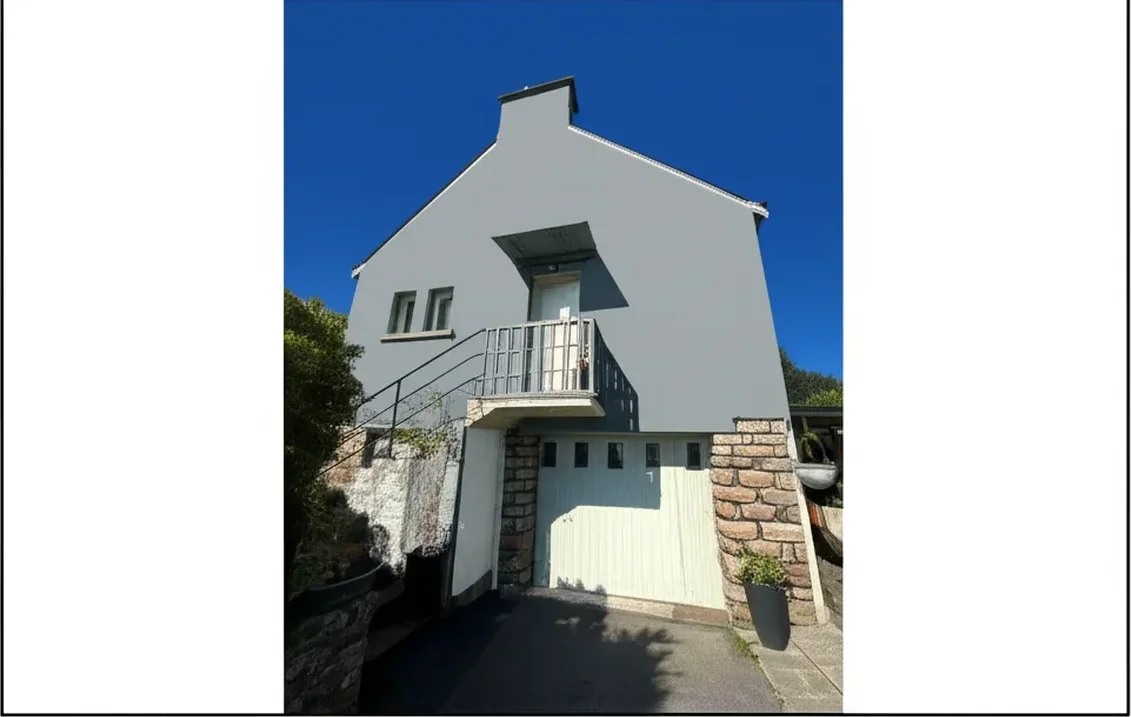
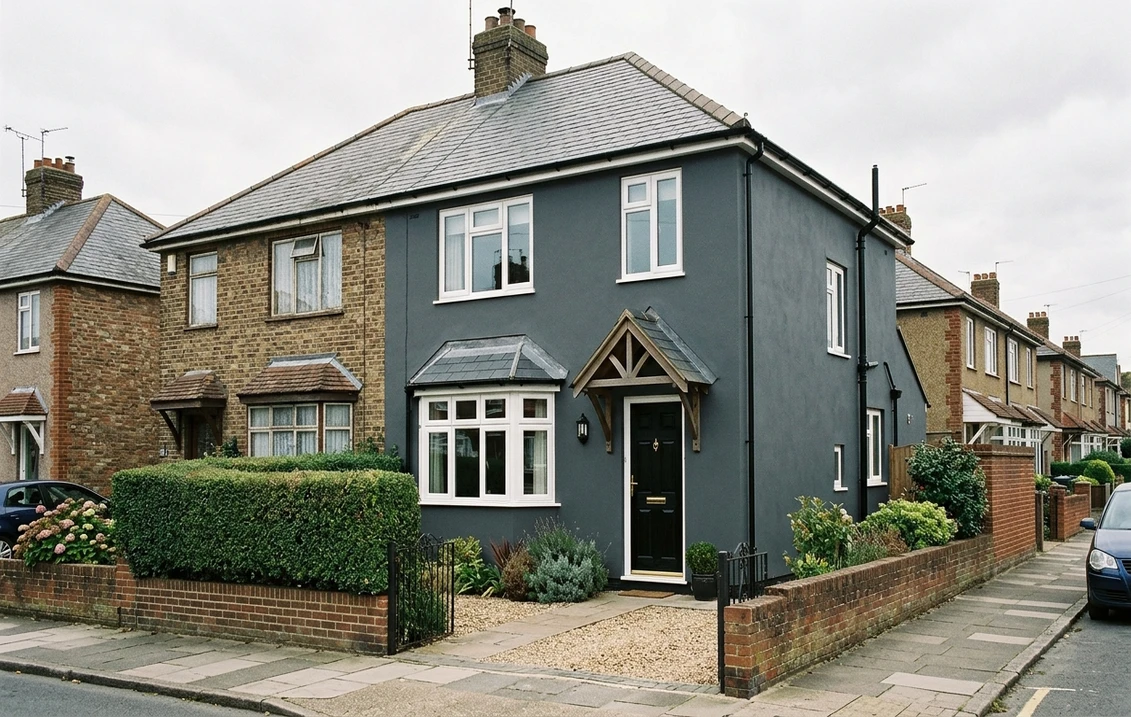
Anthracite masonry paint is the colour of the modernised British semi: a smooth-rendered 1930s house in a deep, slightly blue charcoal, white uPVC windows, a black door and a slate roof. Before you buy, three things decide whether it will work on your house rather than just on the swatch. First, what "anthracite" actually is on a masonry chart and which brand carries it. Second, whether your wall can take a very dark colour at all: a thin coloured silicone render, a pre-1919 brick wall and a painted pebbledash behave differently under a coating that reflects only about 8 per cent of the light. Third, whether you need permission: in most of England you do not, but Article 4 directions, conservation areas and listed buildings change the answer. This guide takes the three in order, using the manufacturers' own datasheets rather than reviews.
What "anthracite" means on a masonry paint chart
Anthracite is not a single standardised colour in the UK; it is a family of very dark, cool greys whose reference point is RAL 7016 Anthracite Grey, the window and door colour that spread from aluminium joinery to render over the last decade. RAL 7016 has a light reflectance value (LRV) of 8.07 according to the RAL colour database: the surface reflects about 8 per cent of the light that falls on it and absorbs the rest, which is the single number behind every warning about dark colours on render. A mid grey such as a "concrete" or "pebble" shade typically sits between LRV 25 and 45; a white masonry paint sits above 80.
Each brand names the family differently. Sandtex sells ready-mixed shades called Anthracite, Slate Grey, Plymouth Grey, Vermont Grey, Gallery Grey, Light Grey and French Grey, plus Black, within the 45 colours listed on the Sandtex Microseal Smooth Masonry page. Dulux Weathershield Smooth Masonry is sold ready-mixed in a short list of shades and mixed to order in Dulux colour-mixing stores, which is how most Weathershield anthracites are bought. Johnstone's Trade Stormshield comes off the shelf in Brilliant White and Black and is otherwise tinted to order, including to RAL references. In practice, "anthracite masonry paint" therefore means either a Sandtex ready-mixed tin or a tinted RAL 7016 from a trade counter.
| Shade family | Approximate LRV | Ready-mixed examples | Where it suits |
|---|---|---|---|
| Anthracite (RAL 7016 region) | about 8 | Sandtex Anthracite; Weathershield or Stormshield tinted to RAL 7016 | Smooth render on a 1930s semi or a modern extension; bands and plinths |
| Slate and charcoal | about 10 to 18 | Sandtex Slate Grey | Whole elevations where pure anthracite would read as black |
| Mid grey | about 25 to 45 | Sandtex Plymouth Grey, Vermont Grey, Gallery Grey | Pebbledash and roughcast, terraces, north-facing walls |
| Pale grey | about 50 to 70 | Sandtex Light Grey, French Grey | Cottages, coastal houses, anywhere the render maker limits dark shades |
Try it on your house
No photo? Try a sample
The three UK masonry paints, on their own datasheets
Beyond the three retail leaders, the trade and budget options (Leyland Granocryl, Bedec Extra-Flex for cracked render, the seasonal Aldi tin) are compared on the same datasheet basis in our guide to the best masonry paint for UK walls.
The three brands a British decorator will reach for all claim fifteen years of protection, and the differences are in rain resistance, coverage and how the colour is supplied. Sandtex Microseal Smooth Masonry is described by Sandtex as breathable, dirt resistant and resistant to mould and algae, "rainproof in just 1 hour", with coverage of 12 to 16 square metres per litre and a recoat time of 3 to 4 hours. Dulux Weathershield Smooth Masonry is listed on the Dulux Weathershield range page at two coats, a four-hour drying time and fifteen years of protection, with "Alkali Guard Technology" against salts from new render and anti-fade technology in the formulation; the mixing version gives coverage of up to 15 square metres per litre and a recoat time of 2 to 4 hours. Johnstone's Trade Stormshield Smooth Masonry is a trade product: rain resistant after 20 minutes, up to 17 square metres per litre, touch dry in an hour, recoat in 2 to 4 hours, two coats, and application allowed between 2 and 35 degrees, with anti-carbonation protection for concrete.
| Product (manufacturer data) | Protection claimed | Rain resistance | Coverage | Recoat | Anthracite supplied as |
|---|---|---|---|---|---|
| Sandtex Microseal Smooth | 15 years | 1 hour | 12 to 16 m² per litre | 3 to 4 hours | Ready-mixed "Anthracite", "Slate Grey" |
| Dulux Weathershield Smooth | 15 years | not stated on the range page | up to 15 m² per litre | 2 to 4 hours | Mixed to order in store |
| Johnstone's Trade Stormshield Smooth | 15+ years | 20 minutes | up to 17 m² per litre | 2 to 4 hours | Tinted to order (RAL accepted); Black off the shelf |
Two reading notes. Coverage figures are for a smooth, sealed surface at the stated spreading rate: pebbledash and roughcast absorb far more, and a first coat on bare render always covers less than the datasheet. And "15 years" is a durability claim, not a colour claim: the film may still be sound while a dark shade has faded or chalked, which is why the anti-fade wording matters more on anthracite than on magnolia. For how the two retail brands compare on an actual wall, our Sandtex vs Dulux Weathershield comparison goes substrate by substrate.
Dark colours on render: the rule the render manufacturer sets, not the paint maker
A wall that reflects 8 per cent of the light heats up far more in sun than a white one, and on a rendered wall that heat has to go somewhere. On a solid, old-fashioned sand-and-cement render over brick, the mass of the wall absorbs it and the risk is mostly cosmetic. On a modern thin-coat system over external wall insulation, the render is a few millimetres thick over a foam or mineral-wool board that cannot conduct the heat away, and a very dark colour can take the surface to temperatures that crack the render and debond the reinforcing mesh. This is why render manufacturers publish light-reflectance limits: as the render supplier Renders World explains from the manufacturer's sheet, one silicone render permits shades above 6 per cent HBW only over a reinforced layer of a named adhesive, and "the same charcoal may be straightforward on one render and unavailable on another because thresholds differ by product".
The practical consequences for an anthracite repaint are three. If your house has a through-coloured silicone render such as K Rend, the colour is in the render itself and the manufacturer's datasheet describes a finish where "the silicone allows water vapour to pass freely through the render whilst allowing the finish to remain weather resistant" (K Rend Silicone TC technical datasheet, classified V2 for vapour permeability and W3 for water absorption under BS EN 15824). Overpainting it in anthracite with an ordinary masonry paint changes both the colour and the permeability of that system, so ask the render manufacturer in writing before you do, and read our guide to changing the colour of K Rend for the two honest options. If your house has external wall insulation, treat the HBW limit on the render manufacturer's sheet as binding and expect anthracite to be excluded or restricted to a special formulation. If your house has a traditional render over solid masonry, anthracite is technically straightforward, and the questions become breathability and planning, below.
The quick test before you buy anthracite
Tap the wall. A hollow, drum-like sound and a render only a few millimetres thick over a board means an insulated, thin-coat system: ask the render maker for the light-reflectance limit before you choose any colour darker than mid grey. A solid, dull sound and a thick render over brick means the dark colour is allowed; the remaining questions are whether the wall needs to breathe and whether you need permission.
Pre-1919 walls, brick and lime: breathability comes before colour
If the wall is lime-rendered or soft brick, the question is not which anthracite but whether any resin paint at all: limewash and mineral silicate paints let the wall dry out, masonry paints largely do not, and limewash will not bond to hard cement render or engineering brick. The decision, wall type by wall type, is in our limewash versus masonry paint guide.
A large share of the British housing stock, every Victorian and Edwardian terrace included, has solid walls with no cavity, built in porous brick and lime mortar. Such a wall manages rain by absorbing moisture and releasing it by evaporation, and the conservation guidance of a local planning authority puts the risk plainly: "Most modern external paints provide a water tight barrier which can have the same effect as using concrete render trapping water in walls which rely upon evaporation to prevent long term damp problems", and "Preventing the building from breathing increases the build up of moisture in the walls and is one of the main causes of damp found in older houses" (Tendring District Council, technical advice on painting listed buildings and conservation areas). The same booklet notes that limewash is "the most breathable" exterior finish, and that a "Heritage Paint" label is no guarantee of suitability on an old wall.
What this means for anthracite specifically: the colour is not the problem, the film is. On a previously painted render in sound condition, a modern breathable masonry paint (the three above all describe themselves as breathable or vapour-permeable) adds little risk. On bare brick that has never been painted, painting at all is a one-way decision that most conservation officers advise against whatever the colour, because it is close to impossible to reverse. On a lime-rendered cottage, a dark modern masonry paint is the wrong product in the wrong colour: a limewash or a mineral silicate paint in a mid tone respects both the wall and the street. The classification that lets you compare coatings on these properties is BS EN 1062-1, the British Standard for "coating materials and coating systems for exterior masonry and concrete", which classes products by water vapour transmission, liquid water permeability and crack bridging; a datasheet that quotes its class is telling you more than one that quotes a number of years.
Do you need permission to paint your house anthracite?
In England, painting the outside of a house is normally permitted development. The Planning Portal's guidance for flats, which mirrors the rule for houses, says "You will not need to apply for planning permission to paint or maintain the external walls", then gives the two exceptions that catch dark colours: "in some areas these rights have been removed (by way of what is known as an article 4 direction)", and "If your flat is a listed building you will need listed building consent, unless it is repainting in the existing colour" (Planning Portal). Article 4 directions are common in conservation areas precisely to stop a single house in a uniform terrace turning anthracite, so check your council's conservation-area map before buying paint; our guide to conservation area painting rules explains how to check and what an application involves. Planning is devolved: Wales and Scotland publish their own permitted-development rules, and leaseholders need the freeholder's consent whatever the planning position.
Where anthracite works on British houses, and where it does not
- 1930s and 1950s semis with smooth render: the natural home of the colour. White windows, a black or oak door, a slate or dark concrete-tile roof, and the brick plinth left bare for warmth.
- Modern extensions and cubes: anthracite render against the original brick of the main house, with slim dark window frames, is the standard contemporary contrast.
- Render bands, plinths and gables: the lowest-risk use. Painting only the band or the gable in anthracite gives the modern look on a fraction of the area, and keeps most of the wall light.
- Bungalows: a long, low anthracite elevation can look heavy; a mid grey body with anthracite fascias and door usually reads better.
- Where to avoid it: north-facing walls that stay damp and grow algae (dark shades show green streaks less than white, but hold moisture longer), old pebbledash that is cracking (the colour highlights every repair), uniform terraces under Article 4, and any thin-coat insulated render whose maker has not approved the shade. For the pebbledash case, our guide to pebbledash paint colours covers the mid greys that hide the texture rather than exaggerate it.
Pairings: windows, doors, roof and brick
Anthracite is a frame colour, which is why it works best when something lighter sits inside it. White uPVC windows are the classic pairing and the cheapest, because most houses already have them. Anthracite windows on anthracite render flatten the elevation into one dark block; if the frames are already RAL 7016, paint the walls a mid grey or a warm off-white instead. Doors: black and very dark green disappear, oak and bright colours (a deep red, a sage, a mustard) carry the entrance; our guide to front door colours for UK homes has the pairings by body colour. Roof: slate and dark grey concrete tiles match; red clay pantiles clash, and a mid grey wall is the better answer under a red roof. Brick: leave the plinth and any brick detailing bare; the contrast between anthracite render and warm brick is the whole point of the scheme.
Preparation, weather window and quantities
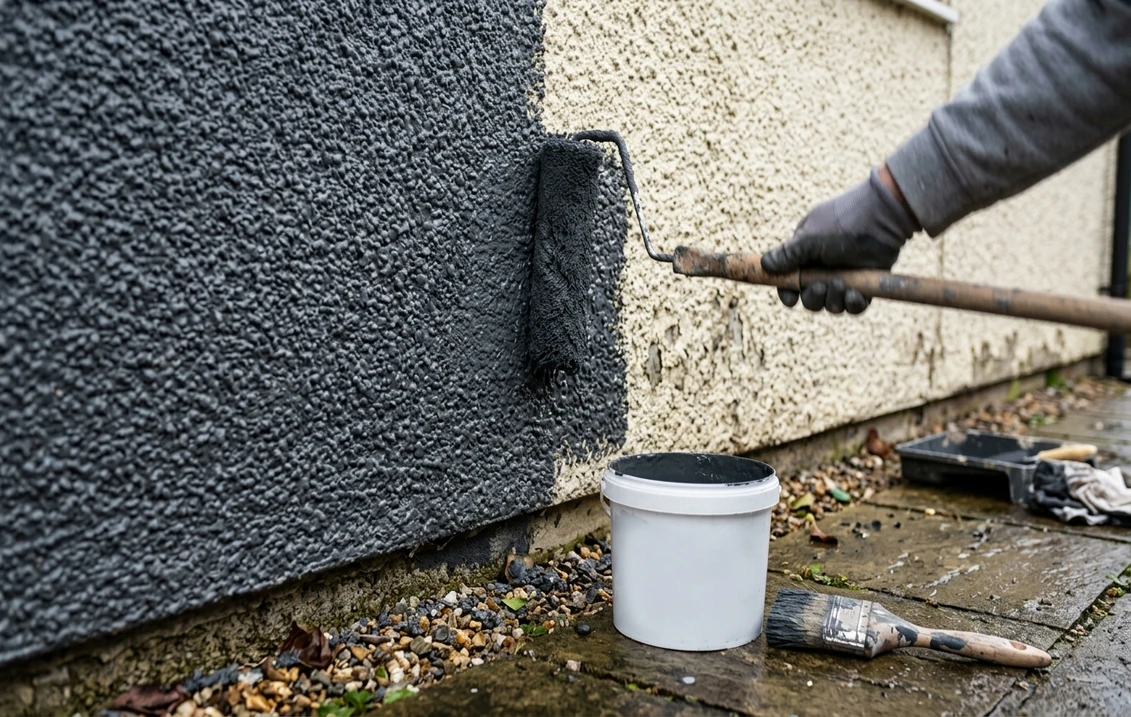
Dark colours show every defect in the surface, so preparation is more important on anthracite than on cream. Wash off dirt and algae and treat biological growth with a fungicidal wash; let it dry. Scrape and brush flaking paint back to a firm edge; stabilise chalky or powdery render with the manufacturer's stabilising primer. Fill cracks with an exterior filler and sand flush, because a filled crack in anthracite reads as a pale scar if it is left proud. Mask windows, sills and the brick plinth carefully: dark drips on red brick do not come off.
The British weather window is the real constraint. Masonry paint needs a dry surface and a few dry hours after application; the brands differ in how few, from Stormshield's 20 minutes to Sandtex's one hour, and all of them want the temperature above the low single figures (Johnstone's states 2 to 35 degrees) with no frost overnight. Avoid painting a south or west wall in direct summer sun, when a dark coat skins before it flows and shows roller marks. Two coats are standard; on anthracite over a pale existing colour, expect the first coat to look patchy and judge the result only after the second.
For quantities, measure the rendered area (height times width of each elevation, minus windows and doors) and divide by the datasheet coverage, then double it for two coats. A typical three-bedroom semi with about 90 square metres of smooth render needs around 12 to 15 litres for two coats at 12 to 15 square metres per litre; pebbledash can need half as much again. Buy all the tins from one batch, or have the mixed colour made in one go, because anthracite is a tinted colour and two batches can differ visibly on a large flat wall. Our guide to painting pebbledash walls has the quantities and the brush-versus-roller question for textured surfaces.
How anthracite ages on a British wall
Three things happen to a dark masonry paint over its fifteen years. It fades on the sunny elevations, which is why both Dulux and the trade brands advertise anti-fade or colour-retention technology; the north wall stays darker than the south, and the difference shows at the corners after five or six years. It chalks, the binder breaking down at the surface into a powder that lightens the colour and comes off on a hand; a repaint restores it. And it shows salts: efflorescence from new or damp render that would be invisible on white appears as pale blooms on anthracite, which is what Dulux's "Alkali Guard" wording is about. What it does not show is dirt: an anthracite wall by a main road stays presentable far longer than a cream one.
Test it on your own house first
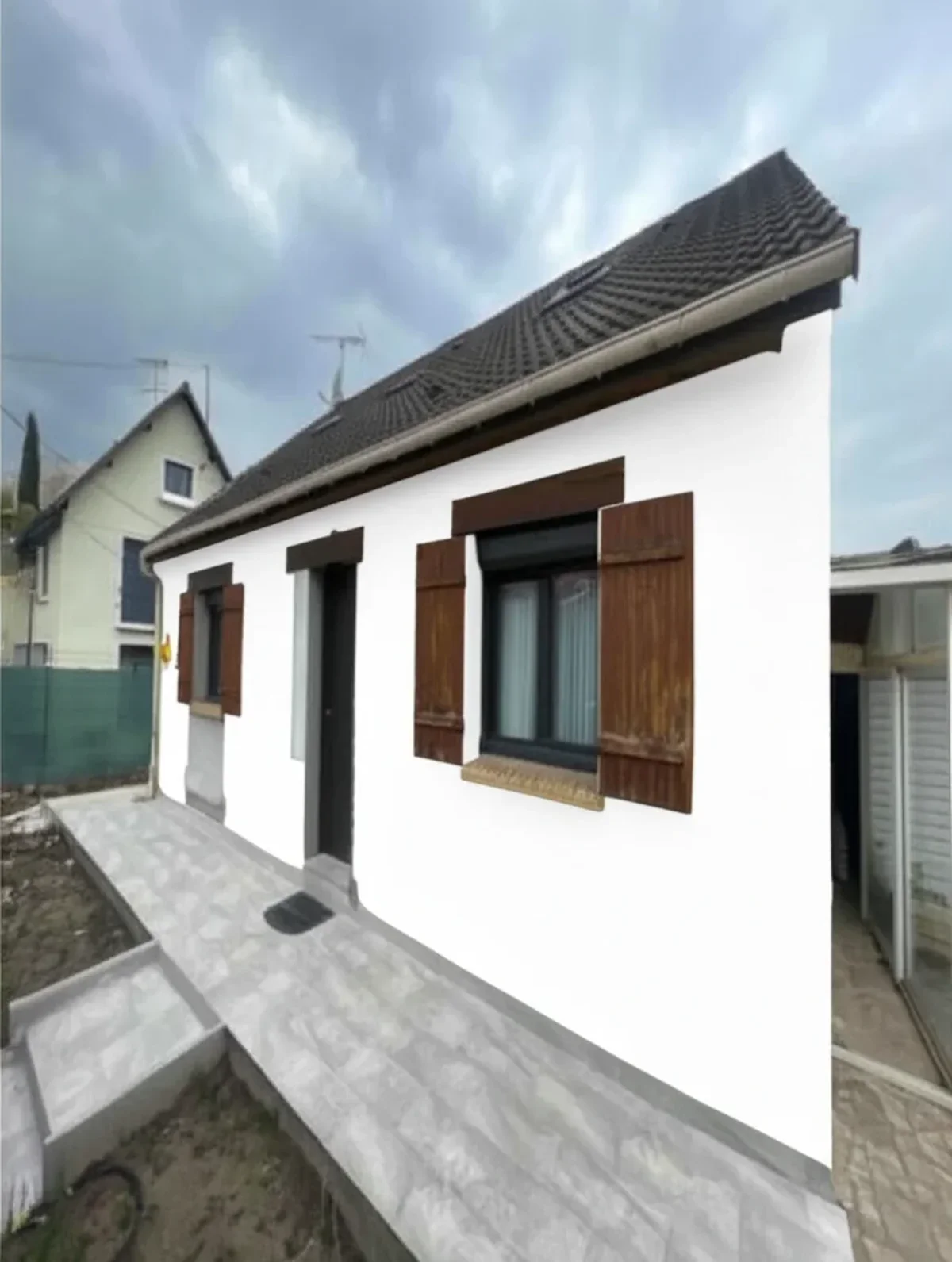
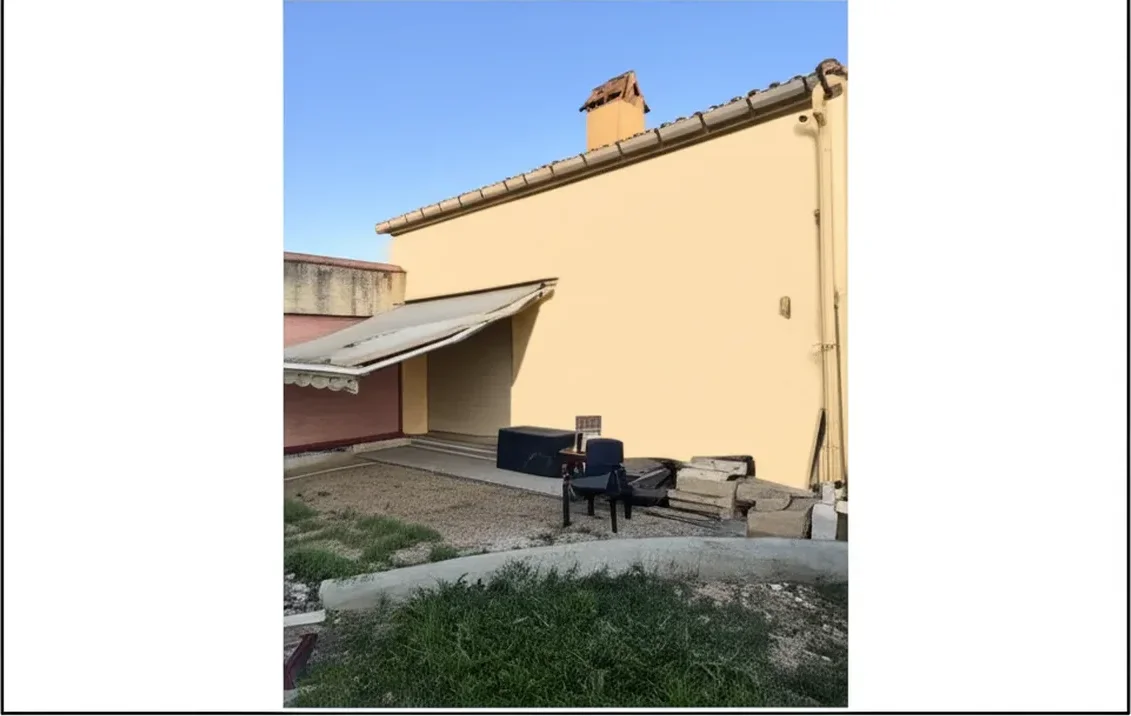
A sample pot on a square metre tells you how the paint goes on; it does not tell you how a whole anthracite elevation will look against your roof, your neighbour's house and your street. Photograph the front of the house from the pavement in flat daylight, apply anthracite, a slate grey and a mid grey to the render on the photo, and compare the three side by side with the windows and door you have. Then buy the sample pot for the one that wins, paint a patch on the sunniest wall, and look at it on a bright day and a dull one before ordering the full quantity. For the wider palette, our guide to the best exterior paint colours for UK homes puts the greys against the creams and greens that are also selling in 2026.
Sources and references
- Sandtex, Microseal Smooth Masonry Paint: 15 years, rainproof in 1 hour, 12 to 16 m² per litre, recoat 3 to 4 hours, the 45 ready-mixed colours including Anthracite, Slate Grey and Plymouth Grey.
- Dulux, Weathershield range and Paint Mixing Weathershield Smooth Masonry: 15 years, two coats, 4 hours, Alkali Guard, anti-fade, up to 15 m² per litre, mixed colours.
- Johnstone's Trade Stormshield Smooth Masonry (retailer datasheet): 15+ years, rain resistant after 20 minutes, up to 17 m² per litre, 2 to 35 degrees, Brilliant White and Black plus tinted colours.
- RAL colour database, RAL 7016 Anthracite Grey: light reflectance value 8.07.
- Renders World, Choosing silicone render colours: the HBW thresholds on manufacturers' datasheets for dark shades over insulated render.
- K Rend, Silicone TC technical datasheet (PDF): vapour permeability of a through-coloured silicone render, BS EN 15824 classes V2 and W3.
- Tendring District Council, Technical advice on painting listed buildings and conservation areas (PDF): breathability of solid walls, modern paints trapping moisture, limewash, Article 4.
- Planning Portal, Paint the outside of a flat: permitted development, Article 4 directions, listed building consent.
- BSI, BS EN 1062-1: classification of coating systems for exterior masonry and concrete.
Frequently asked questions
Which brands sell anthracite masonry paint in the UK?
Can I paint K Rend or an insulated render anthracite?
Do I need planning permission to paint my house anthracite?
Is anthracite masonry paint suitable for a Victorian brick house?
Official sources
To verify the regulatory information in this guide at the primary source:
- GOV.UK : When planning permission is required
- Planning Portal : Planning permission and building regulations (England and Wales)
- Historic England : Listed buildings and conservation areas
External links. FacadeColorizer is not affiliated with these bodies and their guidance may change over time.
Trademarks mentioned (Sherwin-Williams, Benjamin Moore, Behr, Caparol, Brillux, Sto, Alpina, Valspar, PPG, Glidden, Dulux, Crown Trade, Sandtex, Farrow & Ball, Johnstone's, Leyland) are property of their respective owners. FacadeColorizer is independent and not affiliated with any of them. Nominative fair use under Lanham Act §1125.