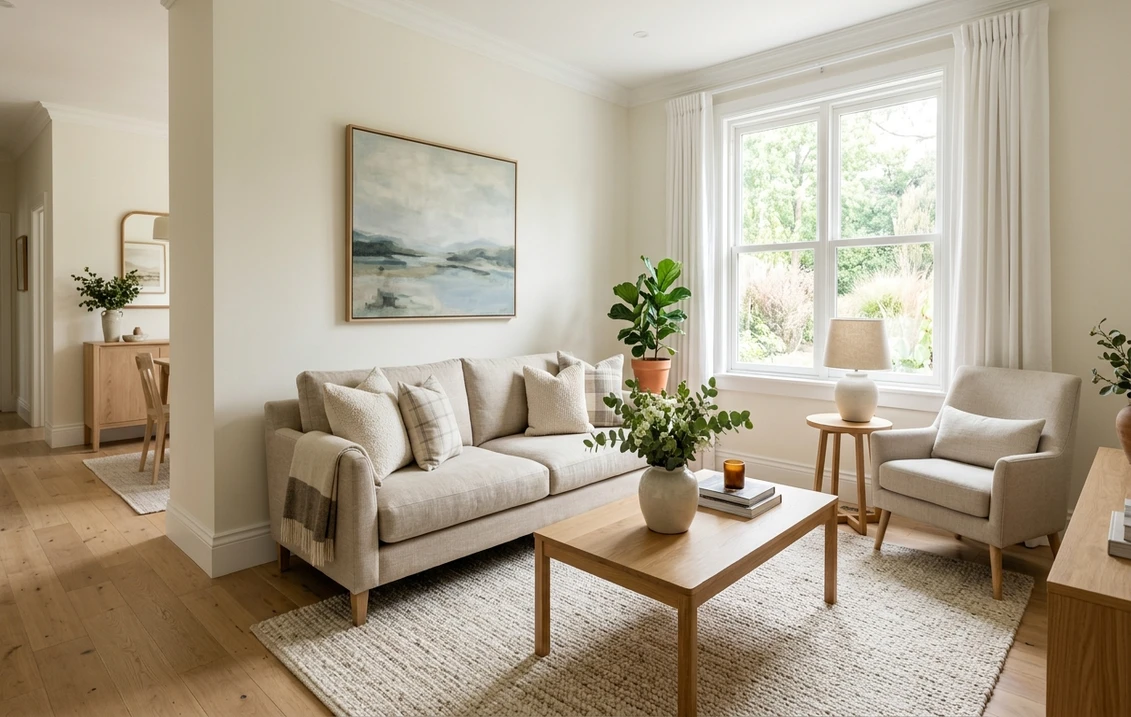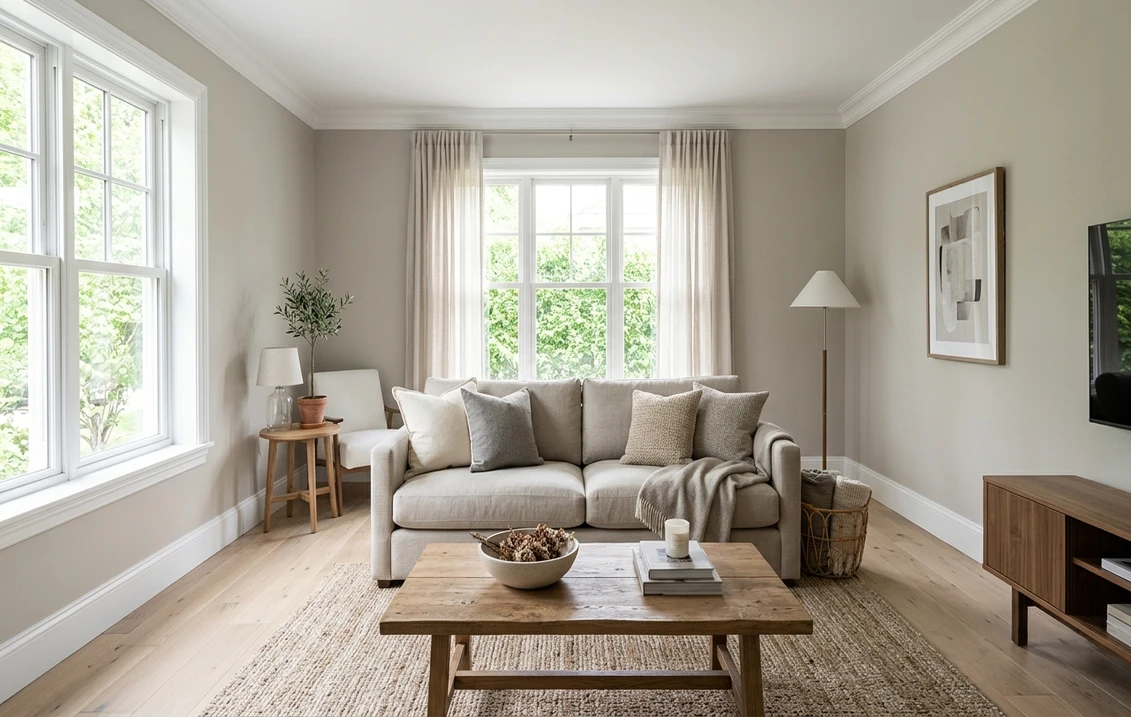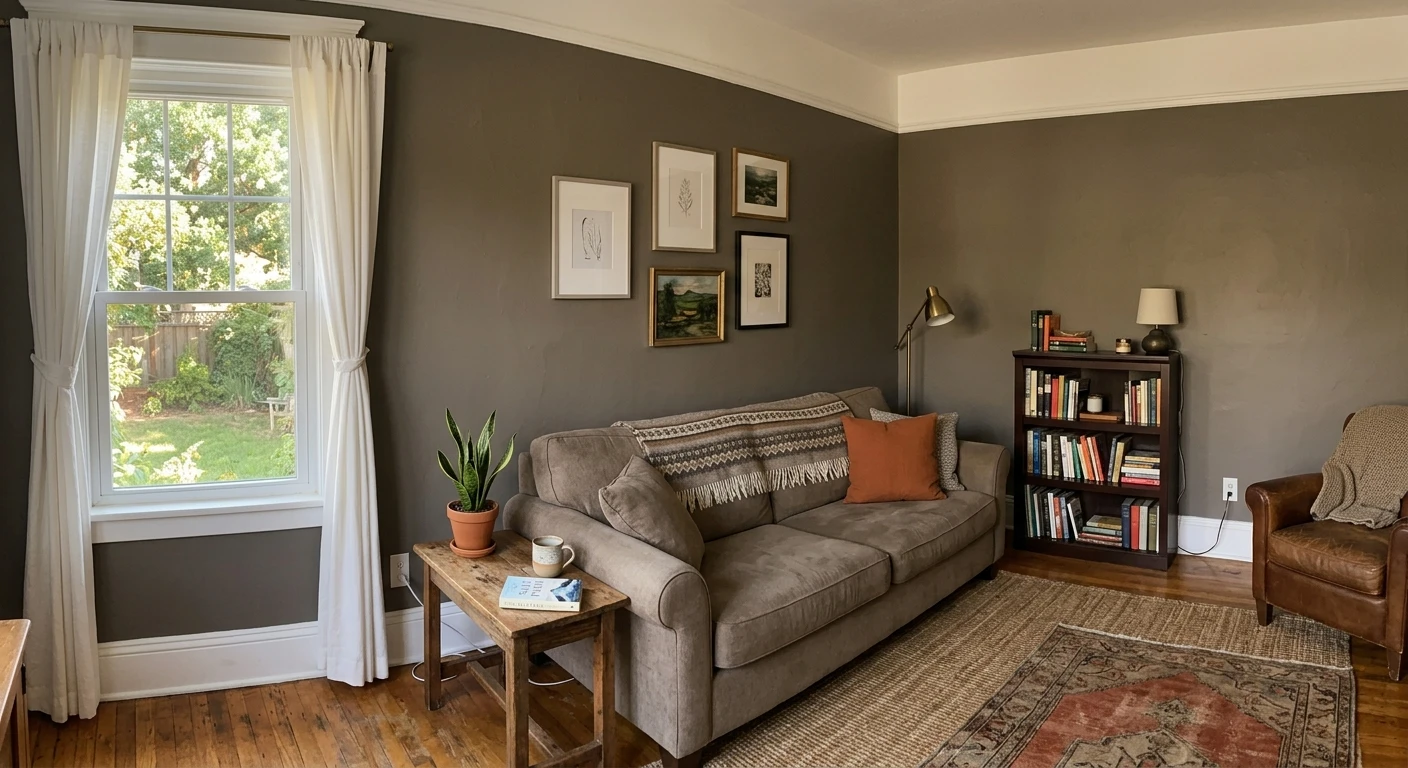
Try it on your room

The first thing to know about Benjamin Moore Distant Gray (OC-68) is that the name lies a little. It is not a gray. It is a soft, quiet off-white with the faintest cool whisper buried inside it, the kind of near-white that most people read as simply white until you set a truly bright white next to it. That is exactly why homeowners reach for it, and exactly why they search for it in a panic at the paint counter when the chip looks almost identical to three other colors in the fan deck. If you are trying to figure out whether Distant Gray is white or gray, whether it is warm or cool, and how it differs from Chantilly Lace, Oxford White and White Dove, this is the page that sorts it out.
Quick orientation before the deep dive. Distant Gray OC-68 carries a second number you will also see on shelves, 2124-70, and it sits high on the brightness scale with a published LRV of about 85 and a hex approximation of #EDEDE7 (RGB 237, 237, 231). That is off-white territory, not gray territory: it reflects almost as much light as a pure white, which is why it is a beloved ceiling color and a soft alternative to a stark wall white. The undertone is a barely-there cool gray with a hair of green, just enough to take the edge off without ever reading as a color. This profile is one stop in our wider Benjamin Moore interior paint colors guide, and it lives at the lightest end of that family, right where whites and grays blur together.
Upload a photo of your actual room and preview BM Distant Gray under your own light in about 30 seconds. Free: 1 HD render plus 3 variations.
Distant Gray at a glance: the numbers that matter
Before any opinions, here are the verifiable specs from the Benjamin Moore color library. These are the values you can take to a paint counter, and they explain almost everything about how this color behaves:
| Spec | Distant Gray OC-68 (2124-70) |
|---|---|
| Color number | OC-68, also listed as 2124-70 (Off White collection) |
| LRV (Light Reflectance Value) | Approximately 85: a near-white, reflects almost as much light as a true white |
| Hex / RGB (approx.) | #EDEDE7 / 237, 237, 231 |
| Color family | Off-white, not a true gray despite the name |
| Primary undertone | Very faint cool gray with a trace of green; clean, never yellow |
| Best use / finish | Ceilings (flat), walls (eggshell or matte), trim (satin or semi-gloss) |
Try it on your house
No photo? Try a sample
The takeaway: at LRV 85, Distant Gray is functionally a white. The OC-68 number and the 2124-70 number are the same color from two collections, so do not panic if the counter pulls one and you wrote the other. The whole identity of this color is restraint. It is a white that someone took one quiet step back from full brightness, draining out the warmth and the glare so it reads soft and unobtrusive rather than clinical. That is a feature, not a flaw, and it is the reason designers love it on ceilings and on walls that need to recede.
Is Distant Gray white or gray, warm or cool?
This is the question behind almost every Distant Gray search, so let us be precise. Distant Gray is a white by every practical measure: its LRV near 85 is white-range, and on a finished wall under normal light it reads as a soft, clean white. The word gray in the name describes the undertone, not the color itself. There is a faint cool gray sitting underneath, with the smallest trace of green, and it is that undertone that keeps Distant Gray from looking yellow or creamy the way warmer off-whites do.
On the warm-cool axis, Distant Gray lands just barely on the cool side of neutral. It is not an icy, blue-cool white, and it is nowhere near a creamy warm white. It is the closest thing Benjamin Moore makes to a true, undecided neutral white that simply softens a room. In bright daylight the cool gray ghost shows most clearly, giving the wall a calm, slightly silvery quiet. In warm lamplight at night the green-gray relaxes almost completely and the color reads as a plain, gentle white. It does not flash blue, it does not flash purple, and it does not go dingy, which is precisely why it is such a low-risk pick.
Watch out for one quirk specific to near-whites at this LRV. Against a brighter pure white (think Chantilly Lace trim, or a stark builder ceiling) Distant Gray will suddenly look noticeably grayer and softer than it does on its own. That contrast is what tricks people into thinking they chose a real gray. On its own, with no whiter white in the frame, it reads as white.
LRV and how Distant Gray behaves in every light
At LRV 85 this color is a light-bouncer. It brightens dim rooms, makes low ceilings feel higher, and almost never goes flat or muddy because there is so little pigment to shift. But near-whites are still sensitive to the direction of your light, so here is how Distant Gray reads across the day:
| Indoor light | How Distant Gray reads |
|---|---|
| South-facing (bright, warm) | A clean soft white; the warm light cancels the cool ghost and it looks bright but never glaring |
| West-facing (warm afternoon) | Warmest read of the day; nearly a plain white, the gray undertone all but disappears |
| East-facing (cool after noon) | Fresh and white in morning sun, settles to a calm cool-white once the direct light moves on |
| North-facing (cool, indirect) | The cool gray-green ghost shows most here, giving a soft, very faintly silvery white; still bright, never dull |
| Artificial light at night | Warm 2700K bulbs read it as a plain soft white; cool 4000K bulbs nudge it a touch grayer and crisper |
Sources: Benjamin Moore OC-68 / 2124-70 color data 2026; off-white LRV reference data; designer field reports compiled by FacadeColorizer.
Free visualizer. Test the off-white on your real walls and ceiling before buying a single sample pot.
Best rooms and uses for Distant Gray
Because it is a soft, cool-leaning near-white, Distant Gray shines anywhere you want clean and bright without the glare or the chill of a stark white. Its highest and best use is not actually a wall:
Ceilings (its signature job)
This is where Distant Gray earns its reputation. A flat-finish ceiling in OC-68 reads as a soft, clean white that quietly recedes, instead of the slightly blue-bright or chalky look of many default ceiling whites. Its faint cool undertone keeps it from going yellow over time and lets it sit happily above almost any wall color, warm or cool. If you are weighing ceiling whites, our ceiling paint colors and best whites guide shows exactly where it fits.
Whole-home walls that need to disappear
On walls, Distant Gray is the soft white for people who find Chantilly Lace too crisp and White Dove too warm. It gives a gallery-clean backdrop that lets art, wood tones, and furniture do the talking, with just enough quiet so the room never feels sterile. It is a strong choice for open-plan main floors where one soft white needs to carry the whole flow. For where it sits among the year's other whites, our best white paint for walls guide is a useful map.
Trim, doors, and built-ins
Distant Gray makes excellent soft trim against a deeper wall color, especially cool grays and greens, because it stays clean without the sharp contrast a pure bright white creates. Use it as trim when you want trim and wall to feel like one calm, cohesive envelope rather than a high-contrast frame.
Where to think twice
If you want a crisp, brilliant, modern white with snap (the white behind black windows and matte-black hardware), Distant Gray will look slightly soft and grayed by comparison; reach for a true bright white instead. And in a very cool, dim north room with cool LED bulbs only, the gray-green ghost can show enough to make a small space feel a touch flat. There it wants warm 2700K bulbs to bring it back to white.
Trim, ceiling, and decor pairings
A near-white is defined by what you put next to it. Here is how to build a scheme around Distant Gray with real Benjamin Moore colors:
- Crisp trim against Distant Gray walls: BM Chantilly Lace (OC-65, LRV near 90) gives a clean, brighter trim that makes the walls read as a soft tone by contrast. This is the classic combo when you want subtle dimension in an all-white room.
- Monochrome soft envelope: use Distant Gray on walls, trim, and ceiling for a seamless, architectural, gallery-quiet look. Vary the finish (matte walls, satin trim, flat ceiling) so the surfaces still read distinctly.
- Warm-white pairing (use with care): if you pair it with BM White Dove (OC-17) trim, expect a visible warm-cool split; White Dove will look distinctly creamier. That can be intentional and lovely, but it is not a same-family match.
- Wall colors it flatters as trim: cool grays like Gray Owl, soft sages, and muted blues all look tailored with Distant Gray trim or ceiling above them.
- Floors and decor: pale oak, white oak, natural stone, brushed nickel, and linen reinforce its clean, calm read. Very orange-toned wood will make the cool undertone show more, so balance with cooler textiles if that happens.
For a fuller picture of how the BM whites relate to each other, the crisp end of the family is covered in our Benjamin Moore Chantilly Lace OC-65 review, and the warm end in our Benjamin Moore White Dove OC-17 review.
See walls, trim, and ceiling together in one preview, free.
Distant Gray vs the near-whites it gets confused with
Near-whites are where the most expensive mistakes happen, because four colors can look identical on a chip and read completely differently on a wall. These are the three Distant Gray is most often mixed up with, and how to tell them apart:
- vs BM Chantilly Lace (OC-65): the biggest difference in the group. Chantilly Lace (LRV near 90) is a crisp, bright, clean white with almost no undertone; it has snap and reads modern and pure. Distant Gray (LRV near 85) is softer, a half-step darker, and carries that quiet cool-gray ghost. Choose Chantilly Lace for a bright, high-contrast white; choose Distant Gray when you want the glare taken off and a calmer, softer white.
- vs BM Oxford White (CC-30): the trickiest twin. Oxford White is a clean white with a very slight cool, sometimes faintly green-gray, undertone, and it is a touch brighter and a hair cleaner than Distant Gray. Distant Gray sits marginally softer and grayer. In practice they are close cousins; Oxford White reads a step more like a true ceiling-and-trim white, while Distant Gray reads a step more like a soft wall off-white. If you want a forgiving all-purpose clean white, Oxford White; if you want a slightly softer, more recessive near-white, Distant Gray.
- vs BM White Dove (OC-17): these go opposite directions on the warm-cool axis. White Dove (LRV near 85) is the same brightness but leans warm, with a soft cream-gray undertone that feels cozy and gentle. Distant Gray leans cool, with a gray-green undertone that feels clean and crisp. Same lightness, opposite temperature: pick White Dove for warmth and softness, Distant Gray for a cooler, cleaner soft white.
The one-line cheat sheet: Chantilly Lace is the brightest and crispest, White Dove is the warm one, Oxford White is the clean all-purpose white, and Distant Gray is the soft cool near-white that recedes. They are genuinely different jobs despite the near-identical chips.
Notice that all four live at the bright end of the scale: choosing between them is a question of temperature and softness, never of depth. So if you have swatched the whole group and every one of them still feels a little cold or a little glaring, the fix is not another near-white. It is to step down the reflectance scale on purpose. Benjamin Moore Maritime White OC-5 sits near LRV 73 with a creamy yellow undertone, and at that level the wall stops reading as white and starts reading as a soft warm color. That is a change of category, not a shade adjustment, which is exactly why people who reject Distant Gray for being too cool usually end up there.
Naming note: Distant Gray Benjamin Moore, BM Distant Gray, distant grey, OC-68, and 2124-70 all point to this same color.
How to test Distant Gray before you commit
With near-whites, a tiny fan-deck chip is almost useless, because the difference between Distant Gray, Oxford White and Chantilly Lace is a few percent of brightness that a 2-inch chip cannot show. Two better methods:
- Paint large swatches side by side: roll 12-by-12-inch samples of Distant Gray next to your other finalists on the same wall, and look at all of them mid-morning, mid-afternoon, and at night under your normal bulbs. The trick with whites is comparison; alone they all look white, together the temperature and brightness differences finally appear.
- Preview it digitally first: upload a real photo of your room and apply Distant Gray (plus a brighter white like Chantilly Lace and a warmer one like White Dove) before you buy any samples, so you narrow four near-identical chips to the one worth painting. Budget context for the full repaint is in our interior house painting cost guide for 2026.
Preview Distant Gray against a brighter white and a warmer white, side by side, free.
Frequently asked questions
Is Benjamin Moore Distant Gray actually a gray or a white?
Despite the name, Distant Gray (OC-68 / 2124-70) is a white, not a gray. Its LRV of about 85 puts it firmly in off-white territory, and on a finished wall it reads as a soft, clean white. The word gray describes the undertone: a very faint cool gray with a trace of green that keeps it from looking yellow. It only looks grayer when you place a brighter pure white right next to it.
What is the LRV of Distant Gray OC-68?
Distant Gray has a Light Reflectance Value of about 85, with a hex approximation of #EDEDE7 (RGB 237, 237, 231). That makes it a near-white that reflects almost as much light as a pure white, so it brightens dim rooms, makes low ceilings feel higher, and rarely goes flat or muddy. OC-68 and 2124-70 are the same color listed in two collections.
Is Distant Gray warm or cool?
Distant Gray sits just barely on the cool side of neutral. It has a faint cool gray-green undertone, so it reads clean rather than creamy, but it is not an icy or blue-cool white. In warm afternoon or lamplight it relaxes to a plain soft white; in cool north light the cool ghost shows most. It never flashes blue or purple, which makes it a low-risk near-white.
What is the difference between Distant Gray and Chantilly Lace?
Chantilly Lace (OC-65, LRV near 90) is the brightest, crispest, purest white with almost no undertone and lots of snap. Distant Gray (OC-68, LRV near 85) is a half-step softer and darker with a quiet cool-gray undertone, so it reads calmer and more recessive. Use Chantilly Lace for a bright high-contrast white, and Distant Gray when you want the glare softened.
Distant Gray vs Oxford White vs White Dove, which should I pick?
Oxford White (CC-30) is a clean, slightly cool all-purpose white that is a hair brighter than Distant Gray; it is the safe ceiling-and-trim white. White Dove (OC-17) is the same brightness as Distant Gray but leans warm and creamy. Distant Gray is the soft, cool, recessive near-white in the middle. Pick Oxford White for a clean all-rounder, White Dove for warmth, and Distant Gray for a soft cool white that disappears.
Preview BM Distant Gray on your actual walls and ceiling under your own light. Free: 1 HD render plus 3 variations, no sample pot required.
Disclaimer: Benjamin Moore, Distant Gray (OC-68 / 2124-70), Chantilly Lace (OC-65), Oxford White (CC-30), White Dove (OC-17), and Gray Owl (OC-52) are trademarks of Benjamin Moore & Co. FacadeColorizer is an independent paint visualization service and is not affiliated with, endorsed by, or sponsored by Benjamin Moore. Color reproduction on screens approximates the manufacturer's chip; always confirm with a manufacturer sample under your own light before purchase. Sources: Benjamin Moore OC-68 / 2124-70 Distant Gray color data 2026, Benjamin Moore OC-65 Chantilly Lace, CC-30 Oxford White, and OC-17 White Dove color data 2026, off-white LRV reference data, designer field reports compiled by FacadeColorizer.
Trademarks mentioned (Sherwin-Williams, Benjamin Moore, Behr, Caparol, Brillux, Sto, Alpina, Valspar, PPG, Glidden, Dulux, Crown Trade, Sandtex, Farrow & Ball, Johnstone's, Leyland) are property of their respective owners. FacadeColorizer is independent and not affiliated with any of them. Nominative fair use under Lanham Act §1125.