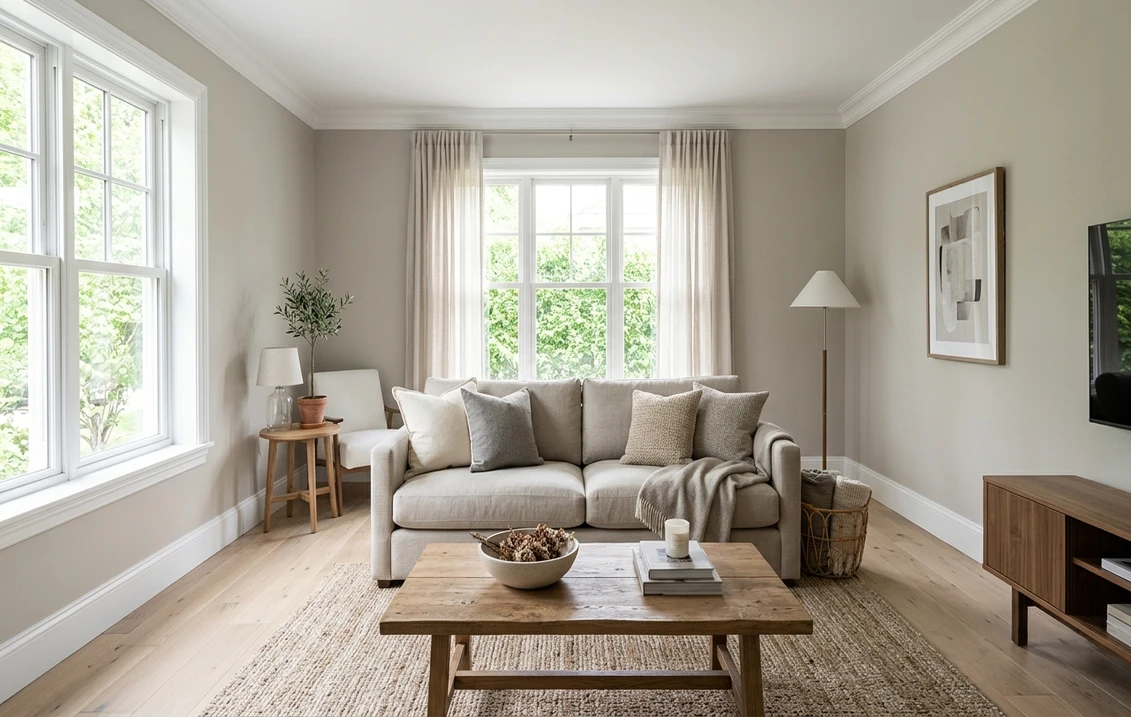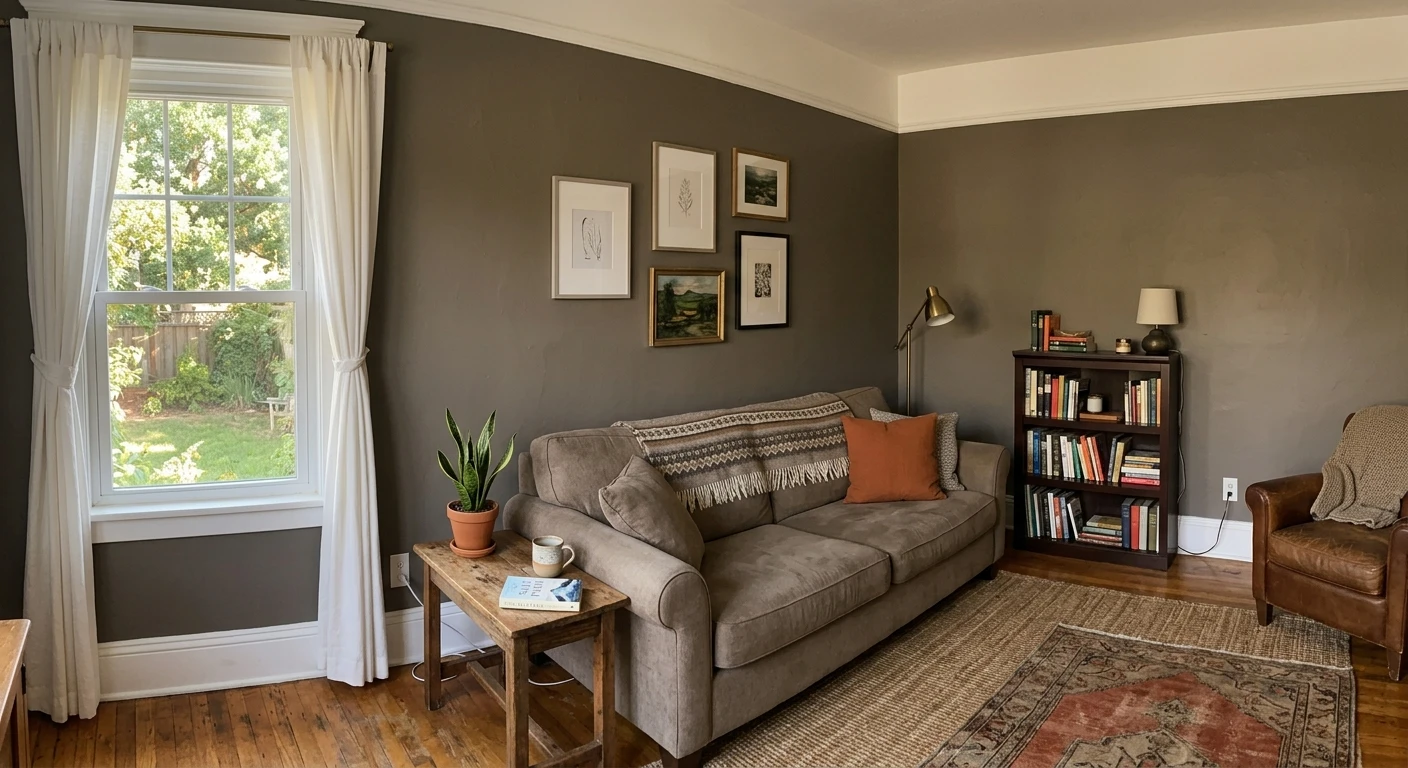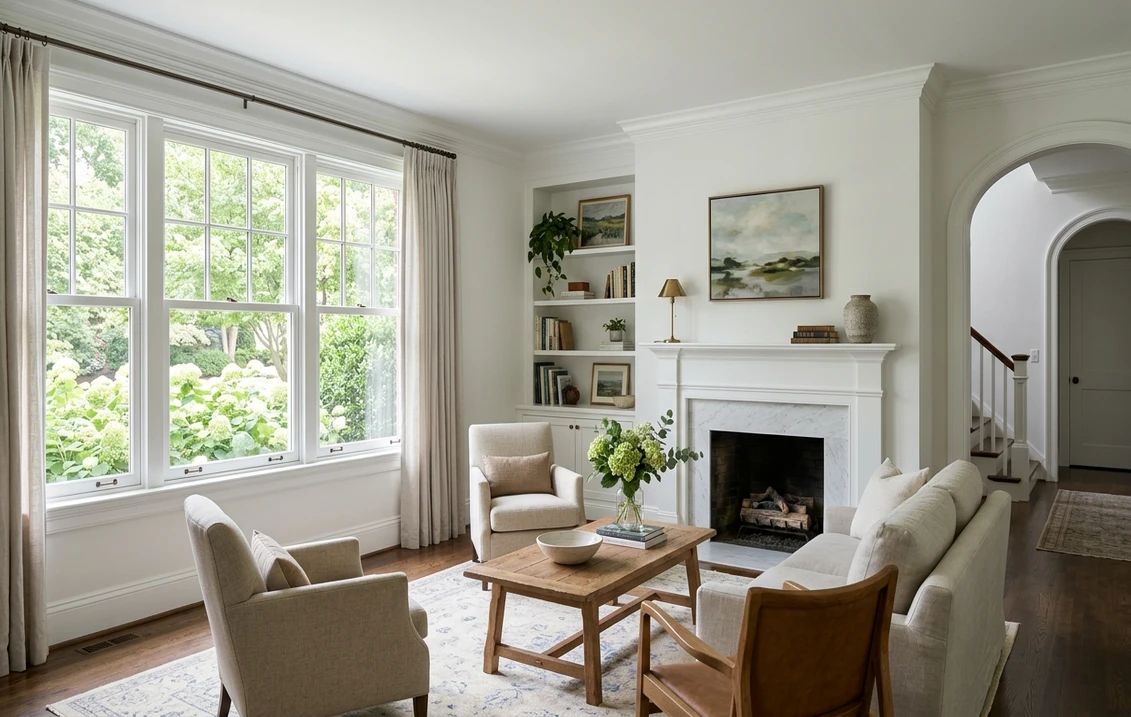
Try it on your room

There is a particular kind of white that almost nobody chooses for a wall and almost everybody ends up using anyway, and Benjamin Moore Oxford White (CC-30) is exactly that white. It is the quiet workhorse hiding inside thousands of Benjamin Moore color cards, the white that gets brushed onto baseboards, crown molding, door casings, and ceilings without ever being the star of the room. If you have searched oxford white paint trying to figure out whether it is too cool, too gray, or just plain enough to be the trim color behind your real wall color, this page is the one that sorts it out. Oxford White is a clean white with a faint, deliberate cool gray-green calm, and that tiny undertone is the entire reason it works so well as trim and so quietly on a ceiling.
Quick orientation before the deep dive. Oxford White CC-30 has a published LRV of about 82 and a hex approximation of #ECECE3 (RGB 236, 236, 227). That puts it firmly in clean-white territory: very bright and reflective, but a clear step below the chalk-white extremes, with just enough softness to avoid the glare of a stark blue-white. The undertone is a subtle cool gray-green that keeps it from ever reading creamy or yellow. This profile is one stop in our wider Benjamin Moore interior paint colors guide, and it sits in the same family as the brighter, crisper Chantilly Lace OC-65 and the warmer White Dove OC-17. The whole point of this article is to show why Oxford White is genuinely a different job from those two, not a redundant near-twin.
Upload a photo of your actual trim, ceiling, or walls and preview BM Oxford White under your own light in about 30 seconds. Free: 1 HD render plus 3 variations.
Oxford White at a glance: the numbers that matter
Before opinions, here are the verifiable specs straight from the Benjamin Moore color library. These are the values you can take to a paint counter:
| Spec | Oxford White CC-30 |
|---|---|
| Color number | CC-30 (Color Capture / Color Preview collection) |
| LRV (Light Reflectance Value) | Approximately 82: clean bright white, very reflective |
| Hex / RGB (approx.) | #ECECE3 / 236, 236, 227 |
| Color family | Clean white, slightly cool |
| Primary undertone | Faint cool gray-green; no yellow, no pink |
| Best base / finish | Often sold as a ready-mixed white; semi-gloss or satin on trim, flat or matte on ceilings |
Try it on your house
No photo? Try a sample
The takeaway from those numbers: Oxford White is a true clean white that has been kept honest by a sliver of gray-green. At LRV 82 it is bright and bounces a lot of light, but it is not the blinding, chip-of-paper white that some pure whites become on a sunny south wall. That faint gray-green is what stops it from going either creamy or icy: it sits dead center, which is exactly the temperament you want from a color whose entire job is to frame other colors without competing with them. It is the white that disappears, and disappearing well is harder than it sounds.
Is Oxford White warm or cool? The undertone, decoded
Oxford White leans cool, but only just. Calling it a cool white overstates it; calling it a true neutral understates it. The accurate read is a clean white with a barely-there cool gray-green undertone. Here is what is happening underneath, and why it matters for trim specifically.
Every white has a bias, and the bias decides what the white does next to the color it frames. Oxford White's faint gray-green keeps it from yellowing, which is the single most common failure of cheaper builder whites. Next to a warm beige or a greige wall, Oxford White stays crisp and clean instead of going dingy. Next to a cool gray or a blue wall, the same gray-green undertone reads as cohesive rather than clashing, because it shares a temperature with the wall. That dual flexibility is precisely why it is such a popular all-purpose trim white: it does not pick a fight with warm or cool palettes.
Watch out for one quirk. Because the gray-green is so quiet, Oxford White can look almost identical to a clean true-white on a chip, but the moment you brush it next to a brighter white like Chantilly Lace, the gray-green reveals itself and Oxford White suddenly looks a half-step softer and slightly cooler. That is the test that catches people off guard at the counter: in isolation it looks like a pure white, in comparison it looks like a quiet, slightly recessive white.
| Indoor light | How Oxford White reads |
|---|---|
| South-facing (bright, warm) | Stays clean and bright; the gray-green tempers the glare so it does not blow out |
| West-facing (warm afternoon) | Softens slightly and looks its warmest, but never goes cream |
| East-facing (cool after noon) | Fresh and crisp in morning, settles to a calm neutral by afternoon |
| North-facing (cool, indirect) | At its coolest; the gray-green shows most here, reading as a quiet, very slightly gray white |
| Artificial light at night | Warm 2700K bulbs neutralize the cool cast; cool 4000K bulbs let the gray-green show as a clean, slightly grayer white |
Sources: Benjamin Moore CC-30 color data 2026; manufacturer LRV references; designer field reports on trim and ceiling whites compiled by FacadeColorizer.
Free AI visualizer. Test Oxford White on your real trim and ceiling before buying a single sample pot.
Best uses for Oxford White: trim and ceilings first
Oxford White is, above almost everything, a trim and ceiling white. That is not a limitation; it is its specialty. Here is where it consistently earns its keep, and where it does not.
Trim, baseboards, and casings
This is Oxford White's home turf. As a semi-gloss on baseboards, crown, and door casings, its faint cool undertone reads as a crisp, clean edge against almost any wall color, warm or cool. Because it never yellows, it keeps looking fresh for years instead of slowly going ivory the way a warmer trim white can. If you are matching trim across a whole house, Oxford White is one of the most forgiving choices on the fan deck. For the bigger picture on trim selection, our trim paint colors guide covers how a neutral white frames different palettes.
Ceilings
On a ceiling, the slight cool gray-green is an asset: it keeps the overhead plane reading clean and high rather than yellowing into a dingy dome the way a warm white can in a room with lamps. At LRV 82 it bounces enough light to keep a room feeling open, but it is soft enough that the ceiling does not glare against the walls. If you want a deeper look at how to pick a ceiling white and finish, our ceiling paint colors guide walks through flat versus same-as-walls strategies.
Walls in modern, gallery-style rooms
Oxford White can absolutely go on walls, but it shows its hand there. In a bright, modern, art-forward room it reads as a clean, neutral gallery white that lets furniture and artwork carry the color. In a low-light or cozy room, though, a wall of Oxford White can feel a touch flat or institutional, because the cool undertone has nothing warm to play against. For walls, many people prefer a softer white; our roundups of the best white paint for walls and the broader shades of white decoded show where Oxford White lands among them.
Where to think twice
A cozy, warm, lamp-lit room where you want walls to feel soft and enveloping is where Oxford White is the wrong call as a wall color: its coolness can read clinical. There, a warm white like White Dove or a creamy off-white does the cozy job better. Save Oxford White for the trim and ceiling in that same room, where its clean neutrality is exactly what you want framing a warmer wall.
Coordinating colors: what to pair Oxford White with
Because Oxford White is usually the supporting actor, the question is less what trim goes with it and more what walls it flatters. It is one of the most versatile framing whites Benjamin Moore makes, so the list is long:
- Cool gray walls: BM Stonington Gray (HC-170) or Gray Owl (OC-52) share Oxford White's cool temperature, so the trim reads cohesive and crisp rather than clashing. This is one of the cleanest, most modern combinations on the fan deck.
- Greige and warm-neutral walls: next to a greige, Oxford White stays clean and bright instead of going dingy, because it has no yellow of its own to muddy against the wall. It gives warm walls a fresh, tailored edge.
- Deep, saturated accent walls: against a navy, charcoal, forest green, or black accent, Oxford White trim reads as a sharp, gallery-clean frame. The cool undertone keeps the contrast crisp instead of creamy.
- Ceilings over almost anything: as a ceiling white above a colored wall, Oxford White stays high and clean and does not pick up a yellow cast under lamps.
- Avoid: pairing Oxford White trim with a very warm, yellow-cream wall. The cool trim can make the warm wall look slightly orange and the trim look faintly gray by contrast. If the wall is warm cream, a warm white like White Dove makes a more harmonious trim.
For floors and finishes, Oxford White flatters cool-toned oak, white oak, polished nickel, chrome, marble, and stainless. It is less natural next to very orange-toned wood or aged brass, where its coolness can feel like a mismatch; temper that with cooler textiles or a warmer trim choice.
See walls, trim, and ceiling together in one preview, free.
Oxford White vs the whites people confuse it with
With whites this close, a 2-inch chip is nearly useless, because the difference is a few percent of brightness and a whisper of undertone that the chip cannot reveal. These are the three comparisons that fill the search box, and they are genuinely different jobs despite near-identical chips:
- vs BM Chantilly Lace (OC-65): the brightest comparison. Chantilly Lace (LRV near 90) is a crisper, cleaner, more brilliant pure white with essentially no undertone to speak of. Oxford White (LRV 82) is a clear step softer and reads slightly cooler and grayer next to it. Choose Chantilly Lace when you want the brightest, most modern crisp white, especially on walls in a bright room; choose Oxford White when you want a clean trim or ceiling white that is a touch quieter and less glaring. Held side by side, Chantilly Lace makes Oxford White look gently gray.
- vs BM White Dove (OC-17): the temperature comparison. White Dove (LRV near 85) is a soft warm white with a gentle cream-gray bias, the cozy choice. Oxford White is cooler and cleaner with its gray-green lean. Choose White Dove for warm, soft, enveloping trim and walls in a cozy room; choose Oxford White for a crisper, cooler, more neutral frame, especially next to cool gray walls. They lean opposite directions in temperature, so they rarely belong in the same room.
- vs BM Simply White (OC-117): the warmth-and-brightness comparison. Simply White (LRV near 91) is a bright white with a noticeable soft yellow warmth, sunny and cheerful. Oxford White is cooler, slightly less bright, and reads neutral rather than warm. Choose Simply White when you want a warm, luminous white that glows in good light; choose Oxford White when you want a clean, cool-neutral white that frames rather than glows. Simply White can yellow under warm bulbs in a way Oxford White never does.
The one-line cheat sheet: Chantilly Lace is the brightest pure white, Simply White is the warm sunny white, White Dove is the soft cozy warm white, and Oxford White is the clean cool-neutral trim and ceiling white that frames everything else. Four genuinely different jobs despite near-identical chips. For the full set of dedicated profiles, see our Simply White OC-117 review alongside the Chantilly Lace and White Dove pages linked above.
Spelling note: oxford white paint, BM Oxford White, and Oxford White Benjamin Moore all point to this same CC-30. It is also sometimes listed in older fan decks under a Color Preview code, but the LRV and undertone are the same white described here.
How to test Oxford White before you commit
With near-whites, a tiny fan-deck chip is the number-one reason people pick the wrong one, because a few percent of brightness and a whisper of gray-green simply cannot be judged on a 2-inch card. Two better methods:
- Paint a large swatch: brush Oxford White onto a piece of trim or a poster board and hold it against your actual wall color, mid-morning, mid-afternoon, and at night under your normal bulbs. The only way to judge a trim white is in contact with the wall it will frame, never in isolation.
- Preview it digitally first: upload a real photo of your room and apply Oxford White to the trim and ceiling, then swap in White Dove and Chantilly Lace to see the temperature difference on your own surfaces before you buy any samples. Pricing context for the full repaint is in our ceiling painting cost guide for 2026.
Preview Oxford White against White Dove and Chantilly Lace, side by side, free.
Frequently asked questions
Is Oxford White warm or cool?
Oxford White (CC-30) is a clean white that leans slightly cool, thanks to a faint gray-green undertone. It is not a true cool white and it is not a true neutral; it sits just barely on the cool side. That gray-green keeps it from ever yellowing, which is why it works as an all-purpose trim white next to both warm and cool walls. In north light it shows its coolest, quietly gray read; under warm 2700K bulbs the coolness is largely neutralized.
What is the LRV of Oxford White?
Oxford White has a Light Reflectance Value of about 82, with a hex approximation of #ECECE3 (RGB 236, 236, 227). That makes it a clean, bright, very reflective white, but a clear step below the brightest pure whites like Chantilly Lace (LRV near 90) or Simply White (LRV near 91). The slightly lower LRV is what gives it its softer, less glaring quality on trim and ceilings.
Is Oxford White a good trim and ceiling color?
Yes, trim and ceilings are exactly what Oxford White does best. Its faint cool gray-green keeps it from yellowing over time, so trim stays crisp for years, and it reads as a clean edge against almost any wall color, warm or cool. On a ceiling it stays high and clean rather than going dingy under lamps. It is less ideal as a wall color in cozy, low-light rooms, where its coolness can feel slightly clinical.
What is the difference between Oxford White and Chantilly Lace?
Chantilly Lace (OC-65, LRV near 90) is a brighter, crisper, near-pure white with almost no undertone. Oxford White (CC-30, LRV 82) is a clear step softer and reads slightly cooler and grayer because of its gray-green lean. Held side by side, Chantilly Lace makes Oxford White look gently gray. Choose Chantilly Lace for the brightest modern white, and Oxford White for a quieter, less glaring trim and ceiling white.
Oxford White vs White Dove: which trim white should I use?
They lean opposite ways in temperature. White Dove (OC-17) is a soft warm white with a gentle cream-gray bias, the cozy choice that flatters warm rooms and creamy walls. Oxford White (CC-30) is cooler and cleaner with a gray-green lean, the crisp choice that flatters cool gray walls and modern palettes. Use White Dove when you want warmth and softness, and Oxford White when you want a cool, neutral, gallery-clean frame.
Preview BM Oxford White on your actual trim, ceiling, and walls under your own light before buying a single sample.
Disclaimer: Benjamin Moore, Oxford White (CC-30), Chantilly Lace (OC-65), White Dove (OC-17), Simply White (OC-117), Stonington Gray (HC-170), and Gray Owl (OC-52) are trademarks of Benjamin Moore & Co. FacadeColorizer is an independent paint visualization service and is not affiliated with, endorsed by, or sponsored by Benjamin Moore. Color reproduction on screens approximates the manufacturer's chip; always confirm with a manufacturer sample under your own light before purchase. Sources: Benjamin Moore CC-30 Oxford White color data 2026, Benjamin Moore OC-65 Chantilly Lace, OC-17 White Dove and OC-117 Simply White color data 2026, designer field reports on trim and ceiling whites compiled by FacadeColorizer.
Trademarks mentioned (Sherwin-Williams, Benjamin Moore, Behr, Caparol, Brillux, Sto, Alpina, Valspar, PPG, Glidden, Dulux, Crown Trade, Sandtex, Farrow & Ball, Johnstone's, Leyland) are property of their respective owners. FacadeColorizer is independent and not affiliated with any of them. Nominative fair use under Lanham Act §1125.