Try it on your room

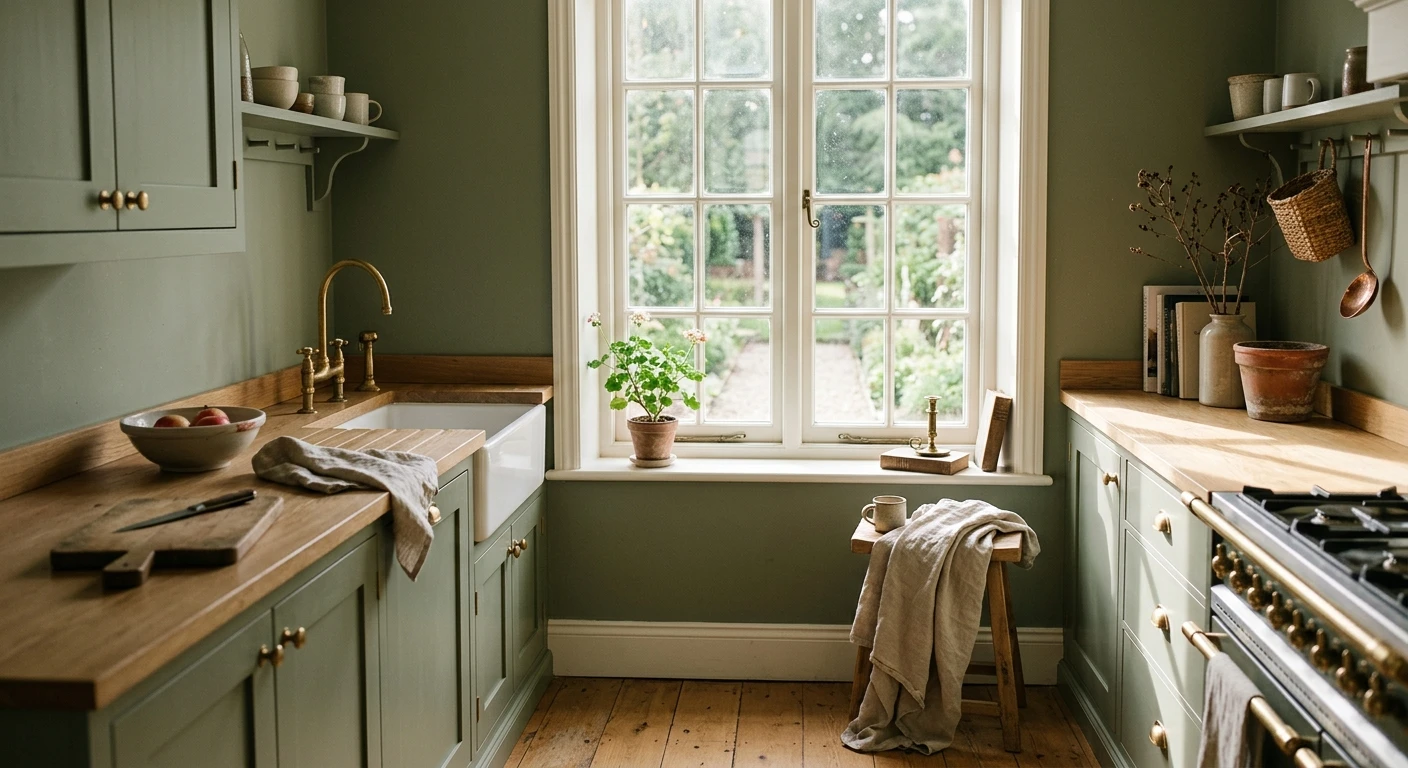
A neighbor asked me to look at her kitchen the week before a remodel, certain she wanted a clean white box. We pulled three samples anyway, and the one that stopped her was a soft gray-green on the back wall above the range. By the time the second coat dried she had cancelled the white order. On a chip a green kitchen reads like a gamble, but on a real wall, next to wood and morning light, it reads warm and grown-up instead of trendy. This guide walks through 14 looks, from barely-there sage to a blackened back wall, with the shades, LRV numbers, and pairings that make each work.
Green is the most adaptable color you can put in a kitchen because it sits between warm and cool: warm oak pulls it earthy, brass pulls it rich, a white quartz counter keeps it crisp. The job is matching the depth of the green to your light and to how much wall you have. This page is part of our broader room-by-room paint color ideas hub; for the full family of indoor greens with an LRV and undertone for each, see our interior green paint shades reference.
Upload a photo of your kitchen and preview any green below under your own light in about 30 seconds, free.
How green reads on a kitchen wall (before you pick a shade)
A kitchen is a strange room to paint. Cabinets, a backsplash, a hood, and a window eat most of the wall, so the paint shows up in patches, each sitting next to a counter or tile that will fight or flatter it. Here is the short version.
- Light gray-greens and sages (LRV 40 to 60): these behave almost like neutrals, keeping the room bright beside white counters and warm wood. Safest everyday choice.
- Mid greens, olives, and earthy greens (LRV 20 to 40): rich and characterful in a bright eat-in kitchen, but they can close down a small galley or north-facing space. Test these hard.
- Deep forest and blackened greens (LRV under 18): stunning on one back wall, island front, or pantry, heavy if you wrap a small kitchen. Use as the accent, not the field.
- The undertone tell: a yellow-leaning green reads warm and appetizing, a blue-leaning green reads cool and clean. Warm task LEDs push every green more golden than the chip, so judge it at night too.
For which counters, tiles, and trim flatter each green, our colors that go with green interior guide breaks it down shade by shade. And if your plan is to leave the walls neutral and color the lower units instead, our complete cabinet color guide covers that route.
14 green kitchen paint ideas for 2026
These green kitchen ideas run from lightest to deepest, the way you would actually shortlist them. Each lists a shade, its LRV, and the one move that makes it land. Mix and match: a light sage on the walls plus a deep green on the island is one of the year's most requested combinations.
1. Whisper-soft sage on the open wall
The safest green kitchen idea there is. A pale sage in the LRV 45 to 55 range reads almost like a warm gray, so it brightens the room without announcing itself. Cut in clean against soft white trim and it reads fresh. The green for people who swear they hate green. Sage is the family doing most of that work, and it has enough range to deserve its own shortlist: our sage green kitchen paint ideas guide narrows it to five shades with their LRV, from a barely-there gray-sage to a dustier green you would keep to an island.
2. Smoky gray-green back wall
SW Evergreen Fog (SW 9130, LRV 30) is the gray-green that quietly took over remodels, and it is the best deeper green for a working kitchen because it never goes muddy. Run it behind open shelving or above the range, leave the rest a warm off-white, and it forgives the grease-and-fingerprints reality.
3. Earthy olive for a warm, lived-in cook space
Olive leans yellow, which makes it glow under warm task lighting and pair effortlessly with butcher block, brass, and unlacquered hardware. On the open walls of a bright kitchen it reads like a 1970s revival done right.
4. Blackened forest on the island front
SW Pewter Green (SW 6208, LRV 12) is barely green until the light hits it, then a deep teal-forest surfaces. Painting just the island base gives the kitchen a center of gravity while the walls stay light. Wrapping a small kitchen in this depth is too much.
5. Sage and cream color-drenched calm
Color-drenching the walls, trim, and ceiling in one quiet sage erases the fussy lines around windows and soffits and makes a broken-up kitchen feel enveloping. Keep the LRV above 45 so the work surfaces stay lit.
6. Green walls with white oak and white counters
A mid sage or gray-green over white oak floors, with a white quartz or marble-look counter, is the cleanest current green kitchen look there is. The cool-warm tension keeps it from feeling dated, and an unlacquered brass faucet makes it look designed, not decorated.
7. Sage walls with terracotta tile
Green and rust-terracotta are complementary, so a sage wall above a terracotta or clay-toned floor feels balanced and warm. It leans Mediterranean without trying too hard.
8. Two-tone scheme: green walls, neutral uppers
Paint the open walls a soft green and keep the surrounding millwork in a warm white. You get the character with the brightness a small room needs, and it reads as a deliberate band rather than swallowing it.
9. Light-filled sage in a south-facing kitchen
South light is warm and generous, so it flatters even a mid-depth green. Here you can push deeper than you would dare in a dim galley and the wall still feels alive at every hour, a great spot for a true sage.
10. North-facing kitchen, gray-green only
North light is cool and flattens warm colors, so skip the yellow-olives here. A gray-green like Evergreen Fog holds its character in cool, indirect light and will not turn murky next to the counter. Warm 2700K bulbs at night bring back the cozy the day strips out.
11. Green walls behind open shelving
Open shelves need a backdrop, and a mid green is the best one going: the depth makes white ironstone, glassware, and brass pots read like a still life. Run it only on the shelving wall for impact without committing the whole room.
12. Sage with black-framed windows
A muted sage wall beside black window frames or a black-trimmed door gives the kitchen a modern, graphic edge while staying soft. The black grounds the green so it never reads sweet; echo it in the faucet or pendants.
13. Butler's pantry or coffee nook in deep green
A pantry, coffee station, or appliance garage is the safest place to be brave. A deep forest in a small enclosed nook turns it into a jewel box and lets you live with a dark green before taking it anywhere visible.
14. Two-green tonal layering
For the confident: a lighter green on the open walls and a deeper green from the same family on the island or pantry. Tonal, layered, and serene. Keep both in the same undertone lane so the pair stays harmonious instead of clashing.
Free visualizer. Test any green on your real walls before buying a sample pot.
Green kitchen shades compared: LRV, undertone, and best use
Four greens cover almost every kitchen job. Here is how they stack up so you can match the shade to your light, your counters, and your nerve:
| Shade | LRV | Undertone | Best use in a kitchen |
|---|---|---|---|
| Light sage (range) | 45 to 55 | Soft gray-leaning sage | Open walls and nook; near-neutral and bright |
| Evergreen Fog (SW 9130) | 30 | Smoky gray-green | Back or shelving wall; holds up in north light |
| Olive / earthy green | ~22 to 35 | Warm, yellow-leaning | Open walls in a bright south-facing kitchen |
| Pewter Green (SW 6208) | 12 | Deep teal-forest | Island front, pantry, or one wall; drama only |
Try it on your house
No photo? Try a sample
Sources: Sherwin-Williams color data 2026 for the named shades; The Spruce and designer field reports on green-wall light behavior compiled by FacadeColorizer. Sage and olive LRV vary by exact pick.
See a light sage and a deep forest on the same wall before you choose, free.
Counters, trim, and pairing rules for green kitchen walls
A green wall in a kitchen lives or dies on the hard surfaces around it. Get these right and the green looks intentional; get them wrong and it reads murky under task light.
- White and warm-white counters (safest): a soft white quartz or marble-look surface lets sage and gray-green stay fresh. A stark blue-white counter can leave a warm green looking dull, so keep your white in the same temperature lane.
- Wood and warm metals: white oak, walnut butcher block, brass, and aged bronze are green's natural partners. They pull the earthiness forward and keep the room from feeling cold.
- Backsplash: a white or zellige tile keeps a green wall calm. A green tile with a green wall only works when one is clearly lighter; matching them too closely flattens the zone.
- Trim: warm white keeps sage cozy and traditional; a crisper white sharpens a deep green with black-framed windows.
- Avoid: a yellow-leaning olive with a cool gray floor or blue-white tile. The clash can make the green look slightly dirty under the lights you cook by.
For full ready-made palettes built around a green anchor, our kitchen palettes guide gives you combinations to copy straight to a paint counter.
How to test a green before you commit the kitchen
Green is the color people regret most when they skip testing, and a kitchen makes it worse: a fan-deck chip cannot show how far the shade shifts between your bright window, the shadow under the uppers, and the warm task LED at night. Two reliable methods:
- Paint a large swatch: roll a 12-by-12-inch sample (two coats) near the window and in the darkest run under the cabinets, then check it morning, afternoon, and night with a counter offcut held against it.
- Preview it digitally first: upload a real photo of your kitchen and apply a light sage, a gray-green, and a deep forest before you buy anything, narrowing three contenders to one worth a sample pot.
Preview a sage, a gray-green, and a forest green on your real walls, side by side, free.
Frequently asked questions
What is the best green for a kitchen?
For most kitchens a soft gray-leaning sage in the LRV 45 to 55 range is the safest everyday green, because it reads almost like a warm neutral and sits happily next to white counters and warm wood. If you want a deeper green that still works in a busy cook space, Evergreen Fog (SW 9130, LRV 30) is the most reliable because it never turns muddy.
Is a green kitchen a good idea?
Yes, green is one of the most adaptable colors for a kitchen because it sits between warm and cool: warm oak makes it earthy, brass makes it rich, a white counter keeps it crisp. The key is matching the depth to your light, using lighter sages on the open walls and saving deep forest greens for a single back wall, island front, or pantry.
What colors go with green kitchen walls?
White and warm-white counters, white oak or walnut wood, and warm metals like brass and aged bronze are green's most natural partners. A white or zellige backsplash keeps the wall calm, while terracotta tile gives a warm complementary scheme. Avoid pairing a yellow-leaning olive with a cool gray floor or a stark blue-white tile, which can make the green look slightly dirty under task lighting.
Does a green kitchen make the room look smaller?
A light sage with an LRV above 45 keeps a kitchen feeling open and even calmer and larger. Deep forest and blackened greens (LRV under 18) do visually shrink a space, which is why they work best on one back wall, an island front, or a pantry rather than wrapped around a small kitchen, where they create a cozy jewel-box effect instead.
What green works best in a north-facing kitchen?
North light is cool and flattens warm colors, so skip yellow-leaning olives there. A smoky gray-green like Evergreen Fog (SW 9130) holds its character in cool, indirect light and will not turn murky next to the counter. Warm 2700K bulbs over the prep zone at night bring back the warmth the daytime light takes away.
Preview any shade from this guide on your actual walls under your own light before buying a single sample.
Disclaimer: Sherwin-Williams, Evergreen Fog (SW 9130), and Pewter Green (SW 6208) are trademarks of The Sherwin-Williams Company. FacadeColorizer is an independent paint visualization service and is not affiliated with, endorsed by, or sponsored by Sherwin-Williams. Color reproduction on screens approximates the manufacturer's chip; always confirm with a manufacturer sample under your own light before purchase. LRV figures are published manufacturer values, and the sage and olive ranges vary by exact pick. Sources: Sherwin-Williams color data 2026 for the named shades, The Spruce green-wall light coverage, and designer field reports compiled by FacadeColorizer.
Trademarks mentioned (Sherwin-Williams, Benjamin Moore, Behr, Caparol, Brillux, Sto, Alpina, Valspar, PPG, Glidden, Dulux, Crown Trade, Sandtex, Farrow & Ball, Johnstone's, Leyland) are property of their respective owners. FacadeColorizer is independent and not affiliated with any of them. Nominative fair use under Lanham Act §1125.