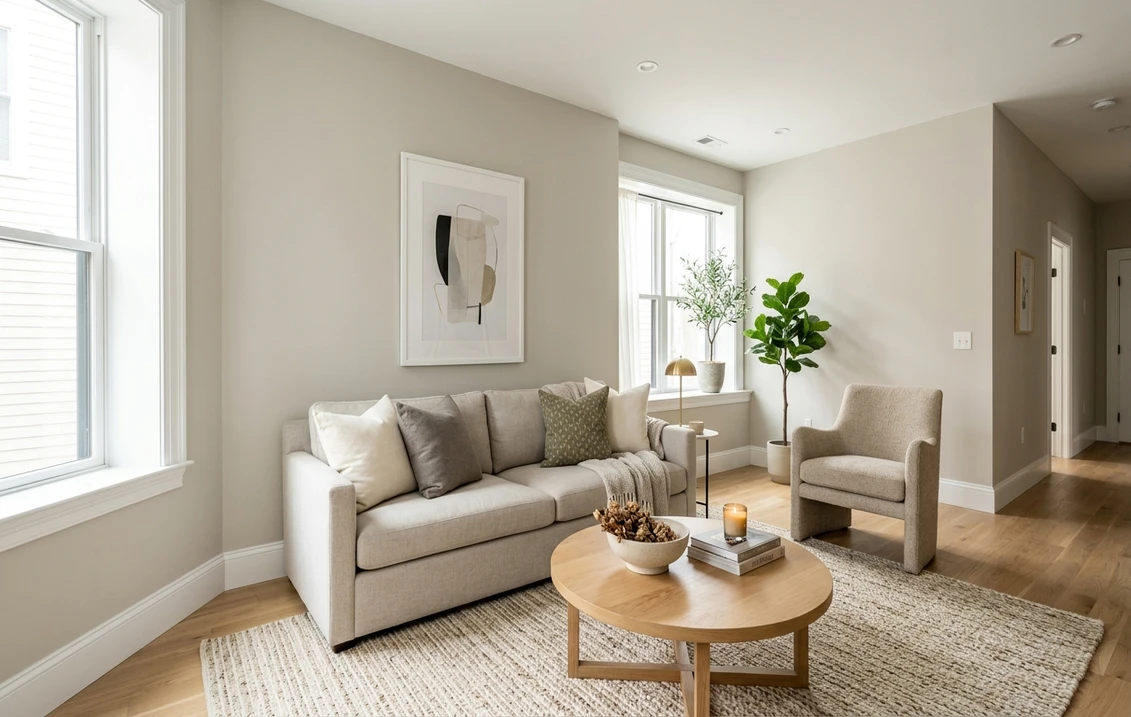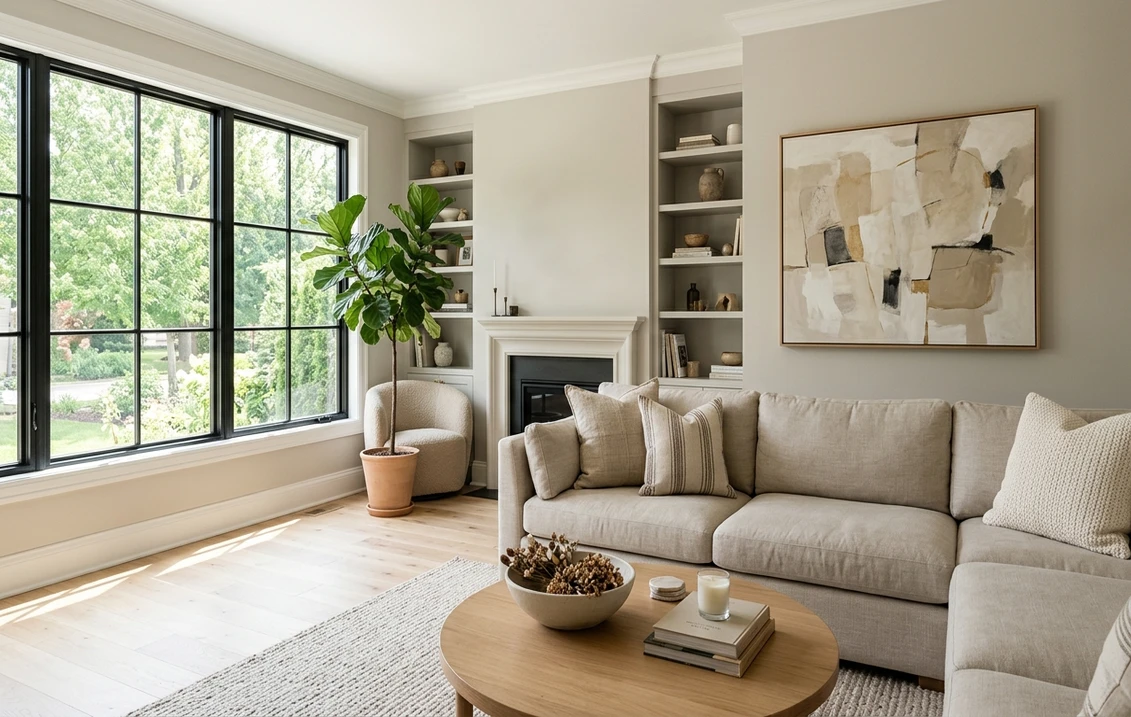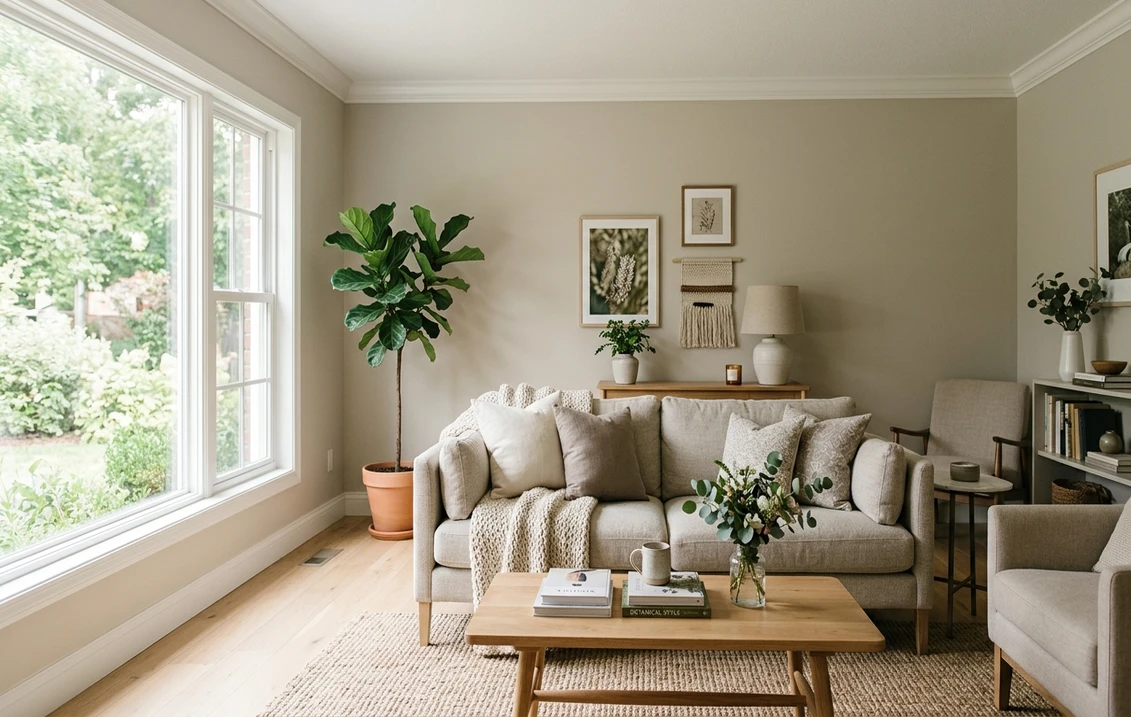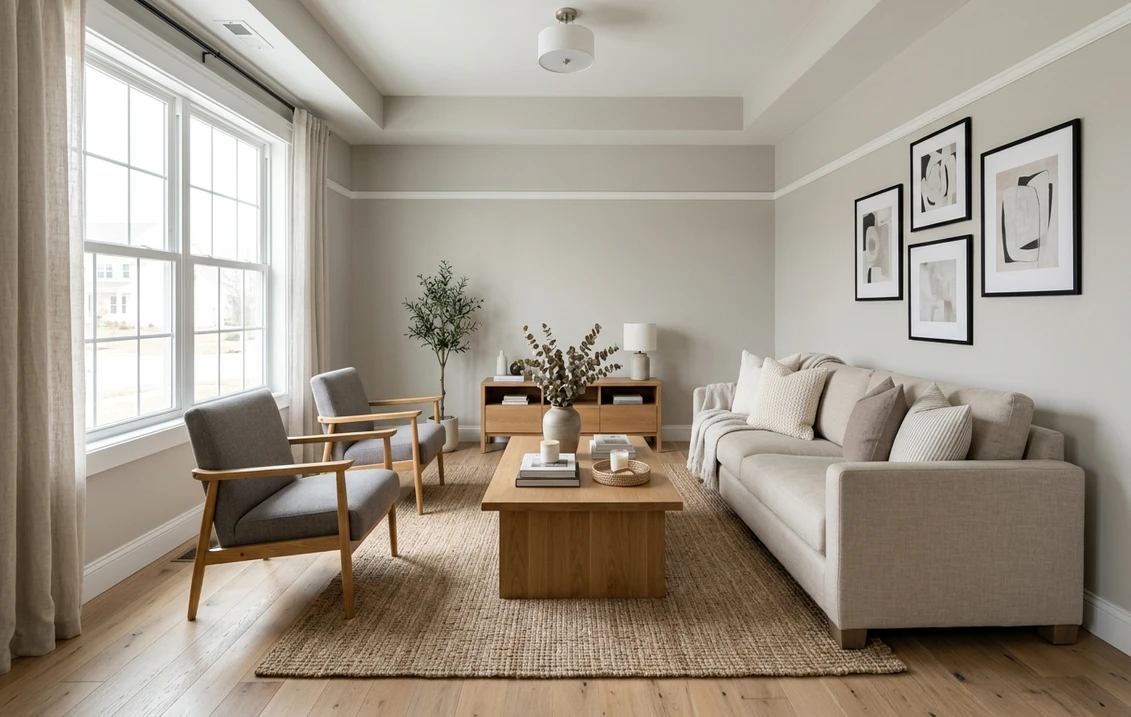
Try it on your room

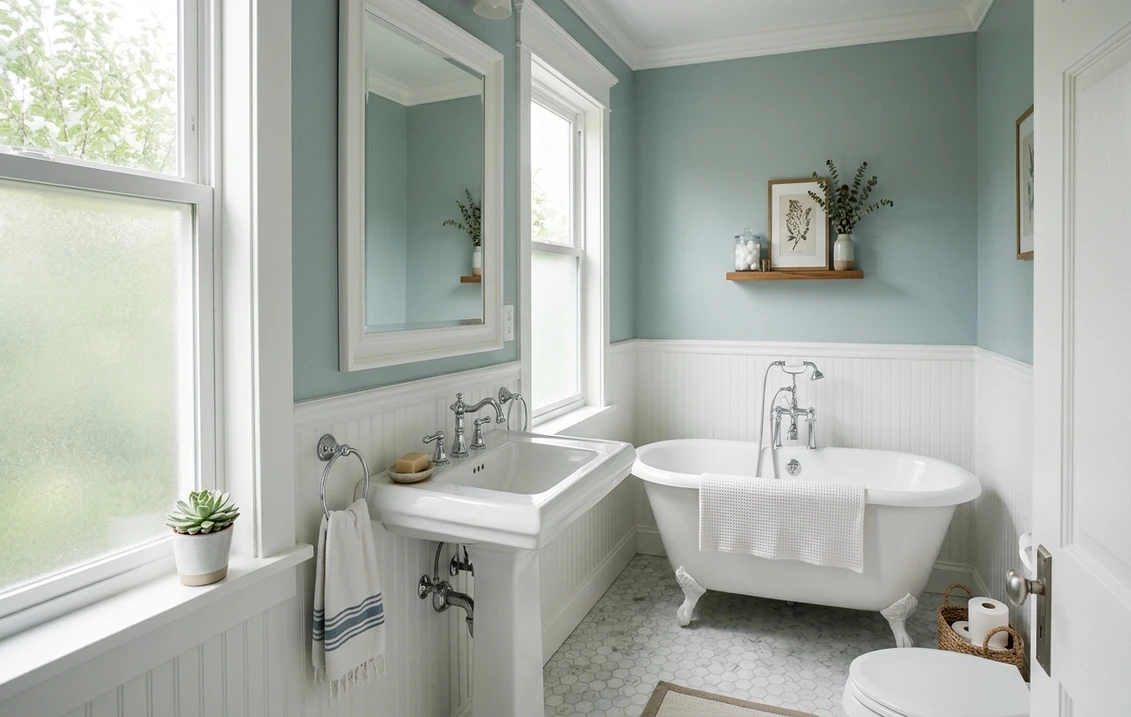
Sherwin-Williams Silvermist (SW 7621) is the color people reach for when Sea Salt feels a touch too green and a plain gray feels too flat. It is a cool blue-green-gray that lands a step deeper and a step bluer than the famous spa neutrals, with the kind of misty, watercolor quality that gives it the name. Tape a sample to a bathroom wall and it can read as a soft seafoam in the morning, a pale gray-blue at midday, and a quiet green-gray after dark. That movement is the whole appeal, and it is also why a small fan-deck chip almost always sells it short.
This profile is for the homeowner deciding whether Silvermist is the one: how its undertones trade places, the published LRV, the rooms it flatters, how it performs outdoors on siding and doors, the trim and decor that keep it crisp instead of cloudy, and exactly how it differs from the SW colors it gets confused with. One housekeeping note first: many people search for the "Silver Mist paint color" as two words. Sherwin-Williams spells it Silvermist, one word, SW 7621; Benjamin Moore sells a different, plainer gray called Silver Mist 1619. This guide covers the Sherwin-Williams color and flags the difference below. It is one of the cool, watery hues in our wider Sherwin-Williams interior paint colors guide, and you can see where the soft spa tones rank in our best interior paint colors for 2026 roundup.
Upload one photo and preview SW Silvermist under your room's actual light in about 30 seconds, free.
The numbers behind Silvermist SW 7621
Start with the published data; these figures predict the wall better than any fan-deck chip. Sherwin-Williams publishes the LRV on its SW 7621 Silvermist color page, and color databases such as PaintDB republish the same manufacturer values with a screen approximation of the color:
| Spec | Value |
|---|---|
| SW code | SW 7621 Silvermist |
| HEX (screen approximation) | #B0B8B2 |
| RGB approximation | 176, 184, 178 |
| LRV (Light Reflectance Value) | 47 |
| Hue family | Cool blue-green-gray, misty spa tone with a clear blue cast |
| Closest SW cousins | Sea Salt (SW 6204), Comfort Gray (SW 6205), Rainwashed (SW 6211) |
Try it on your house
No photo? Try a sample
Sources: Sherwin-Williams SW 7621 Silvermist color data; PaintDB and Hackrea color records (LRV 47, hex #B0B8B2). Hex and RGB are screen approximations, never a substitute for a physical sample.
The LRV of 47 is the figure that sets Silvermist apart from the lighter spa neutrals. At 47 it sits just under the middle of the scale: bright enough to keep a bathroom or bedroom feeling open, but with real depth, so it reads as a clear color rather than a tinted white. That is a full 16 points lower than Sea Salt's 63, which is why Silvermist feels noticeably more grounded and moodier in the same room, and it even lands a touch below Comfort Gray (LRV 54), the color most people assume is the darker of the two. It is also far brighter than a true enveloping sage like SW Evergreen Fog (LRV 30); for that cozier direction, our SW Evergreen Fog profile shows how a low-LRV green reshapes the same space.
Three undertones, with blue in the lead
Silvermist is a blue-green-gray, like Sea Salt, but the balance is tipped. Where Sea Salt holds green and blue at near-equal weight, Silvermist leans cooler and bluer, with the green sitting just behind and a soft gray base under both. Which one you notice is decided by the room's light at that moment.
- The blue read. Its default direction. Under cool or indirect light (an overcast sky, a north window, a 4000K to 5000K daylight LED), the blue surfaces clearly and Silvermist reads as a soft, watery seafoam or gray-blue.
- The green read. Under warm light (direct afternoon sun or a 2700K bulb), the warmth tempers the blue and the green-gray steps forward, closer to a muted spa sage. Even then it stays cooler than Sea Salt.
- The gray read. In dim or balanced light (dawn, dusk, a windowless powder room under builder bulbs), blue and green cancel and the silvery gray base takes over, the read that earns the name.
None of these is the "wrong" Silvermist; they are all the same paint behaving as designed. Because the undertones are finely tuned and the blue is dominant, the direction a room faces moves Silvermist more than it moves a committed beige or gray, as the interior color families guide explains. Typical behavior across the four Northern Hemisphere orientations, and the bulb color you should pair with each:
| Room orientation | Daylight character | How Silvermist reads |
|---|---|---|
| North-facing | Cool, indirect, no direct sun | Bluest and coolest version, a clear gray-blue or seafoam; can drift chilly, so warm it with 2700K bulbs |
| South-facing | Warm, abundant midday light | Warmest and greenest version, a balanced spa green-blue; the most flattering room for it |
| East-facing | Warm early sun, neutral later | Soft green-blue in the morning, settling to a silvery gray-blue by afternoon |
| West-facing | Cool by day, very warm at sunset | Gray-blue most of the day, glowing softly greener in late-afternoon sun |
Orientation behavior summarized from the reviews cited in the Sources section (Hackrea, Rosenberry Rooms) and Sherwin-Williams SW 7621 color data.
Want the spa-blue you fell for? A north or east room with daylight bulbs delivers it. Want the warmer green-blue side? Put Silvermist in a south room and lean to 2700K. The one combination to plan around is a north room with cool LEDs, where Silvermist can tip genuinely chilly; warm bulbs are the fix. For a neutral that holds far steadier across orientations, our profile of SW Repose Gray is the predictable counterpoint.
The rooms Silvermist was made for
Silvermist earns its keep in rooms where calm and a touch of cool sophistication are the point. The slightly lower LRV and blue lean steer it toward spaces where you want a real color presence without heaviness:
- Bathrooms and powder rooms: the signature use. The watery blue-green reads clean and spa-like against white tile, marble, and polished chrome or brushed nickel. Its depth gives a small bath more character than a pale tint, while an LRV of 47 keeps it from closing in.
- Bedrooms: the cool, low-saturation hue is genuinely restful, a quiet, serene envelope that layers under white, cream, or natural-linen bedding and pairs beautifully with light oak.
- Home offices and reading nooks: blue-greens are the calming, focus-friendly hues, and Silvermist gives a workspace a composed, uncluttered feel.
- Laundry, mudrooms, and built-ins: it brings quiet life to utility spaces and looks custom on a bookcase or vanity, where its depth reads richer than a flat color. For the cabinetry call, our Sherwin-Williams vs Benjamin Moore interior comparison covers how the two brands' finishes wear.
Where to be careful: a windowless bathroom under warm builder bulbs can flatten Silvermist's freshness to a murky gray-green, and in a large, very bright north-facing great room it can read as a lot of cool color across the day, so many designers use it on a feature wall or in a smaller room rather than wall to wall in an open plan. Our interior house painting cost guide covers what the repaint should run.
Free AI visualizer: test Silvermist in a bathroom, bedroom, or on a vanity before you buy a sample.
Trim, ceiling, and decor that keep it crisp
Because Silvermist is a soft cool color rather than a true neutral, the white beside it decides whether it reads spa-fresh or cloudy. Clean, only-faintly-warm whites win; a heavily warm cream can fight the blue and make it look dingy:
- Best all-around trim: Sherwin-Williams Pure White (SW 7005, LRV 84). Bright and barely warm, it frames Silvermist cleanly and keeps the blue-green crisp without going icy. The default designer pairing.
- For a softer scheme: SW Extra White (SW 7006, LRV 86) leans slightly cool and reinforces Silvermist's clean, watery side, good in a bright bath. Use Alabaster (SW 7008) only if you specifically want to warm and mute the color.
- Ceiling: a flat white keeps the room open. Avoid running Silvermist overhead in a low room; the cool color can feel heavy above you.
- Deeper coordinating tones: for an accent, a built-in, or a vanity, SW Comfort Gray (SW 6205) steps the family down a shade, and a navy like SW Naval (SW 6244) or a deep teal makes a confident in-family contrast.
- Decor and finishes: white oak and light woods, natural linen, rattan, polished nickel, chrome, and soft brass all flatter it. Heavy warm-beige flooring and orange-toned woods fight the blue; cool gray-washed or pale floors are a safer match.
To ground a Silvermist scheme with a warm neutral in adjoining rooms, the greiges are the natural partners; our profiles of SW Accessible Beige and SW Agreeable Gray both flow comfortably beside a soft cool blue-green and keep the home from reading all-cool. When the adjoining room needs more body than a light greige gives it, SW Balanced Beige (SW 7037) is the deeper step in the same family, a warm taupe-greige with a faint pink whisper that reads noticeably cozier than Accessible Beige. That extra warmth is what makes it work in a living room or a bedroom opening onto a Silvermist bath, where a light greige would just look pale next to the blue-green.
Silvermist vs the colors people cross-shop
Silvermist has a small cluster of near-twins, and most wrong-sample regrets come from confusing it with one of them. Here is how to tell them apart before you spend on the wrong quart:
- vs SW Sea Salt (SW 6204): the most common mix-up. Sea Salt is lighter (LRV 63) and greener, an airy spa-sage that holds its green side longer. Silvermist is deeper (LRV 47) and bluer, reading cooler and a touch moodier in the same room. Choose Sea Salt for an airy, greener calm; choose Silvermist when you want more color presence and a clearer blue.
- vs SW Comfort Gray (SW 6205): Comfort Gray is the grayer, greener member of this family, with the blue dialed back. Despite the name it is not the darker one: Sherwin-Williams lists Comfort Gray at LRV 54 against Silvermist's 47, a seven-point gap that shows most after dark, when Silvermist goes shadowier and Comfort Gray stays a soft green mist. Silvermist keeps a livelier, more obvious blue. Pick Comfort Gray when you want the spa feel to whisper in a lighter green-gray; pick Silvermist when you want a clearer blue and a little more depth.
- vs SW Rainwashed (SW 6211): Rainwashed is closer to Sea Salt, a light, clearly blue spa tone (LRV 59) that stays bright and consistent. Silvermist is deeper and a little grayer, so it reads more sophisticated and less sweet, where Rainwashed reads fresh and beachy.
One name trap worth flagging: Benjamin Moore sells a color called Silver Mist (BM 1619), two words, a different, more straightforwardly gray paint. SW Silvermist is one word, SW 7621, with a clear blue-green character. If a designer or a Pinterest pin says "silver mist," confirm the brand and code before sampling. We untangle how the two brands differ in formula, coverage, and finish in the full Sherwin-Williams vs Benjamin Moore interior comparison, and if a softer green-sage is what you are really after, compare it against our SW Sea Salt profile.
Silvermist as an exterior paint color
Silvermist is sold in Sherwin-Williams' exterior lines as well as interior ones, and it has a second life as a house color. Outdoors, the rule of thumb is that every color reads lighter and brighter in full daylight than it does on an interior wall, so a mid-tone with an LRV of 47 lands on siding as a soft, misty blue-gray rather than a dark one. That is exactly why it works on a whole house: it has enough depth to read as a real color from the street, but not so much that it soaks up heat or turns somber on the shaded elevation. The reviews cited below single out the same strengths, calling it a neutral exterior color that holds its character in direct daylight and suits siding, front doors, sheds, and porches.
- As the body color: on lap siding, board and batten, or stucco, Silvermist gives a coastal or cottage feel without the sweetness of a true pastel. It pairs naturally with white trim and a natural-wood or black front door. Expect the north side to read bluer and grayer and the south side to warm toward green, the same shift you see indoors, only stronger.
- As an accent: on shutters and a front door against white, cream, or light-gray siding, it reads as a calm, slightly blue accent that is friendlier than navy and more distinctive than charcoal. On a red-brick house it works as a door color because the blue-green sits opposite the brick's orange-red on the color wheel.
- Trim that keeps it crisp: the same whites as indoors, only brighter: SW Pure White (SW 7005) or SW Extra White (SW 7006) for clean contrast, and, for the brightest possible trim on a dark-blue or dark-green scheme, SW High Reflective White (SW 7757). Avoid warm creams outdoors too; they turn Silvermist muddy in the same way they do inside.
- Deeper partners: SW Naval (SW 6244) for a door on a Silvermist body, or a Silvermist door on a deeper gray-blue house. The Rosenberry Rooms review also lists Quietude (SW 6212) as the bluer neighbor, Mineral Deposit (SW 7652) as the grayer one, and Oyster Bay (SW 6206) as the lighter, more coastal option, useful if Silvermist samples a shade too deep on your elevation.
- Sheen: satin on siding hides small surface flaws and sheds dirt; semi-gloss on doors and shutters makes the blue read a little deeper and glossier.
Where it fits stylistically, Silvermist belongs to the soft coastal blues that dominate our beach house exterior paint colors roundup, and it sits comfortably in the green-gray family covered in best exterior green paint colors when the light pulls it that way. The one exterior warning is the same as indoors: a heavily shaded north elevation under a gray sky can push it cold. If that is your main facade, sample Oyster Bay beside it before you commit.
Upload a photo of your home and preview Silvermist on the siding, then on the door and shutters, free.
Silver Mist or Silvermist? Make sure you are sampling the right paint
Searches for "silver mist paint color" bring up two very different paints, and the mix-up costs people a wasted sample more often than any undertone surprise does. Sherwin-Williams Silvermist is one word, SW 7621, the cool blue-green-gray described throughout this guide, LRV 47. Benjamin Moore Silver Mist is two words, 1619, a near-neutral pale gray with only a faint green-gray whisper and no real blue; we profile it separately in our Benjamin Moore Silver Mist 1619 review. If a Pinterest pin or a designer's list says "silver mist" and shows a watery spa blue, they mean the Sherwin-Williams color; if it shows a quiet greige-gray, they mean Benjamin Moore. Check the code before you buy: 7621 versus 1619. And if what you actually want is the Benjamin Moore brand in the Sherwin-Williams color, our guide to the Benjamin Moore equivalent of Silvermist walks through the closest matches and their LRV gaps.
How to test Silvermist before you commit
Silvermist is a textbook color where a 3-inch fan-deck chip will mislead you. Viewed under store light near 4000K, the chip lands on a balanced gray-blue that may be none of the reads you get at home, and because the blue is dominant it can look chillier on the wall than the chip suggests. The reliable method is a large peel-and-stick sample (Sherwin-Williams sells one) taped to at least two walls and checked mid-morning, mid-afternoon, and after dark under your normal bulbs; the dim-light silvery gray is the version you live with at night, and the cool-bulb test tells you whether a north room will feel too chilly. The faster, no-paint first pass is a digital visualizer: upload a photo of the room and apply Silvermist beside a lighter, greener option (Sea Salt) and a grayer one (Comfort Gray) to see which way your light pulls each, ruling out the colors that were never going to work before you spend on samples.
Preview Silvermist beside a greener and a grayer alternative under your real light, free.
Sources and references
- Sherwin-Williams, Silvermist SW 7621 color page, plus the Sea Salt SW 6204 and Comfort Gray SW 6205 pages: official color data for the three colors compared here.
- PaintDB, Sherwin-Williams Silvermist SW 7621: LRV 47, hex #B0B8B2, RGB 176, 184, 178, sourced from manufacturer specifications; also Comfort Gray (LRV 54) and Rainwashed (LRV 59).
- Hackrea, Silvermist SW 7621 review: undertone description (gray-green-blue with a foggy gray trace), interior and exterior approval, daylight behavior outdoors.
- Rosenberry Rooms, Sherwin-Williams Silvermist SW 7621 review: exterior applications, trim pairings, and the coordinating colors Quietude, Mineral Deposit, Oyster Bay, and Magnetic Gray.
- Samplize, Silvermist 7621 peel-and-stick sample: the 12 by 12 inch sample format recommended in the testing section.
See SW Silvermist under your real light, beside a greener and a grayer alternative, before you buy. One HD preview plus three variations, free.
Disclaimer: Sherwin-Williams and SW 7621 Silvermist are trademarks of The Sherwin-Williams Company. Benjamin Moore and Behr are trademarks of their respective owners. FacadeColorizer is an independent paint visualization service and is not affiliated with, endorsed by, or sponsored by Sherwin-Williams, Benjamin Moore, or Behr. Screen color approximates the manufacturer's sample; always confirm with a physical sample before purchase. Sources: Sherwin-Williams color data for SW 7621 Silvermist, Pure White SW 7005, Extra White SW 7006, Alabaster SW 7008, Sea Salt SW 6204 and Comfort Gray SW 6205, Benjamin Moore Silver Mist 1619 color data, and the reviews and color databases listed in the Sources and references section.
Frequently asked questions
Is Silvermist green, blue, or gray?
What is the LRV of SW Silvermist?
What is the difference between Silvermist and Sea Salt?
What trim color goes with Silvermist?
Is SW Silvermist the same as Benjamin Moore Silver Mist?
Trademarks mentioned (Sherwin-Williams, Benjamin Moore, Behr, Caparol, Brillux, Sto, Alpina, Valspar, PPG, Glidden, Dulux, Crown Trade, Sandtex, Farrow & Ball, Johnstone's, Leyland) are property of their respective owners. FacadeColorizer is independent and not affiliated with any of them. Nominative fair use under Lanham Act §1125.