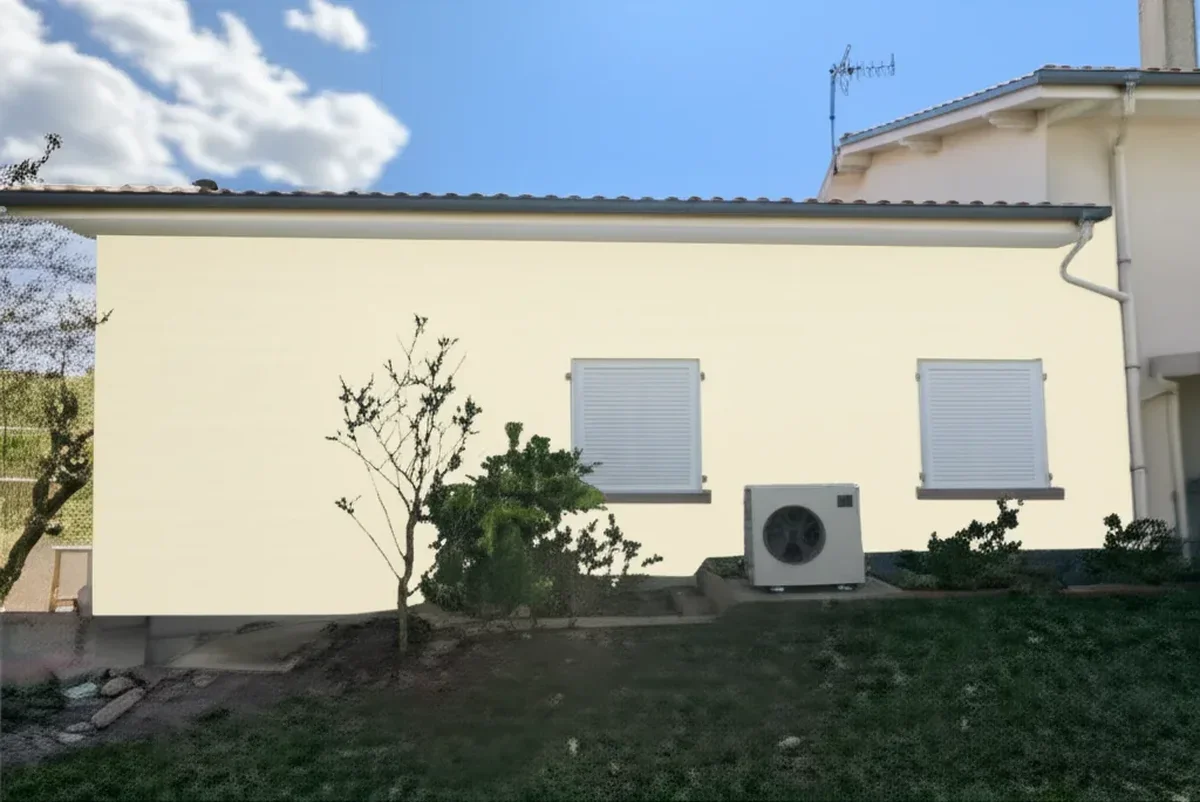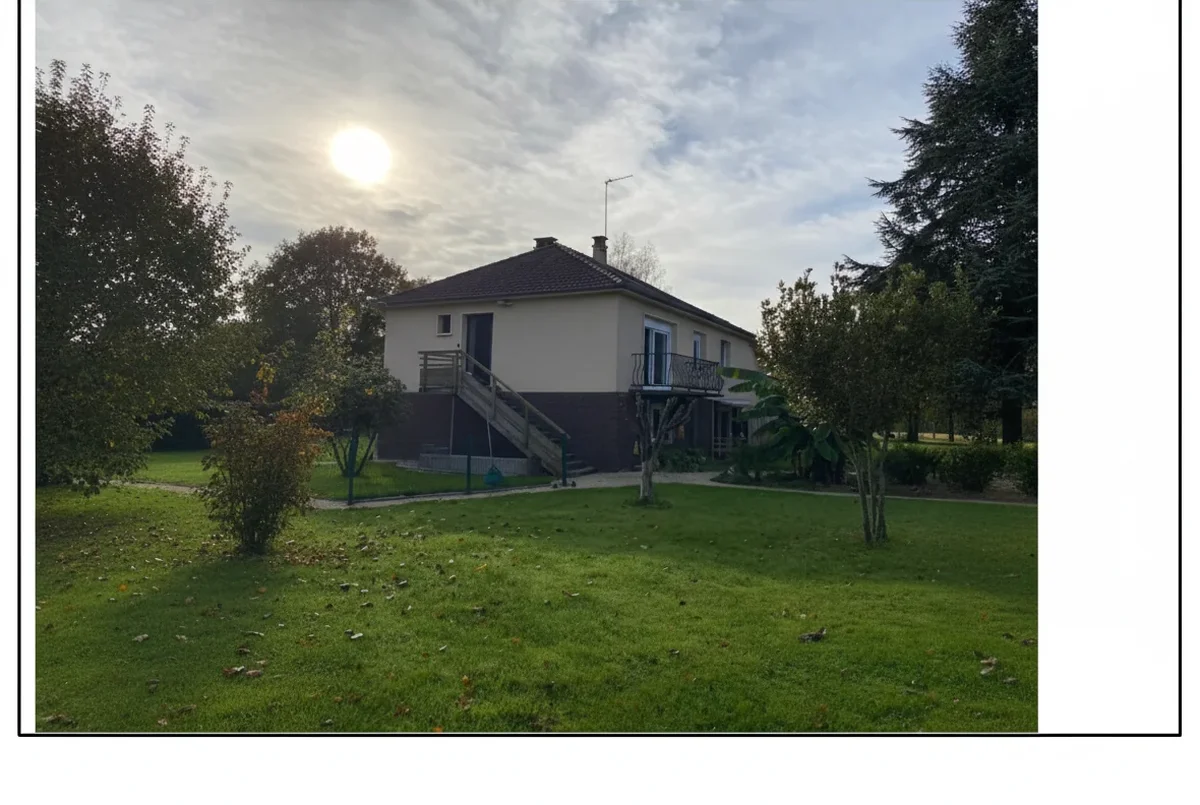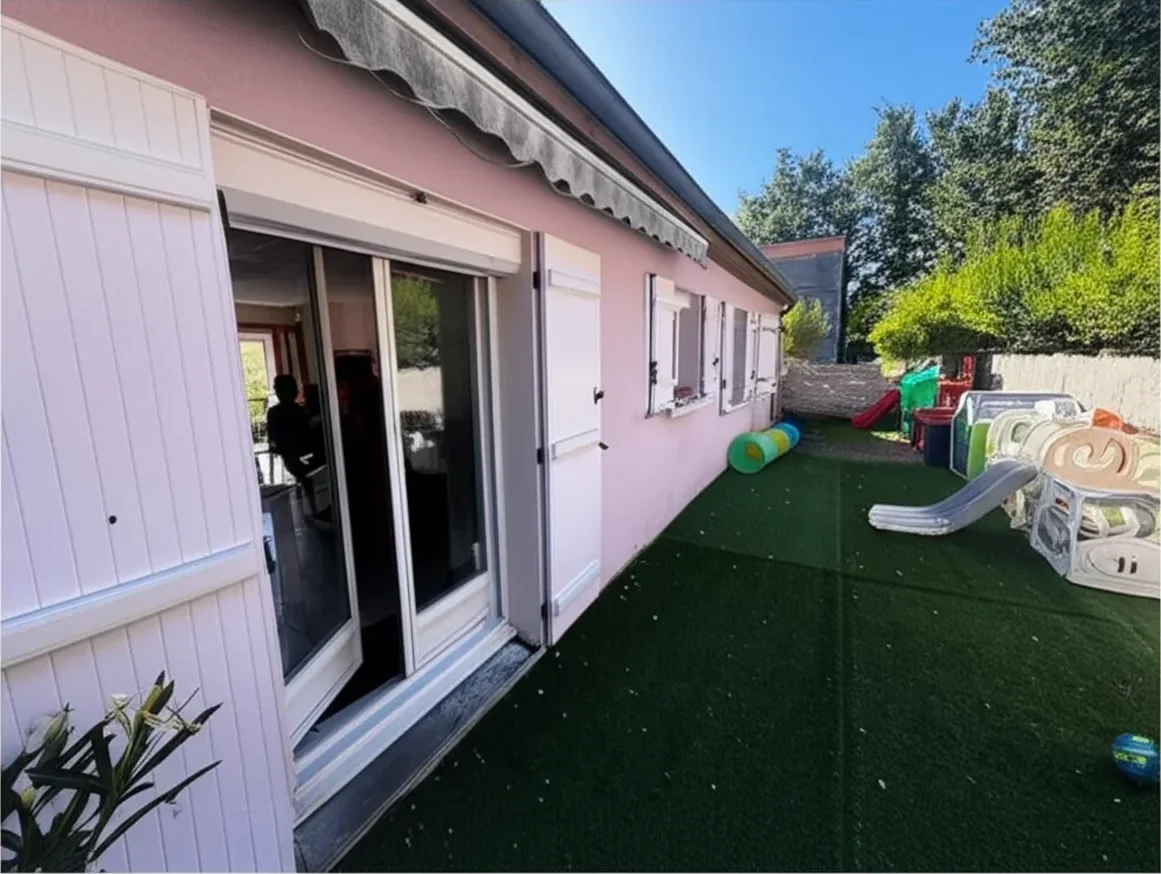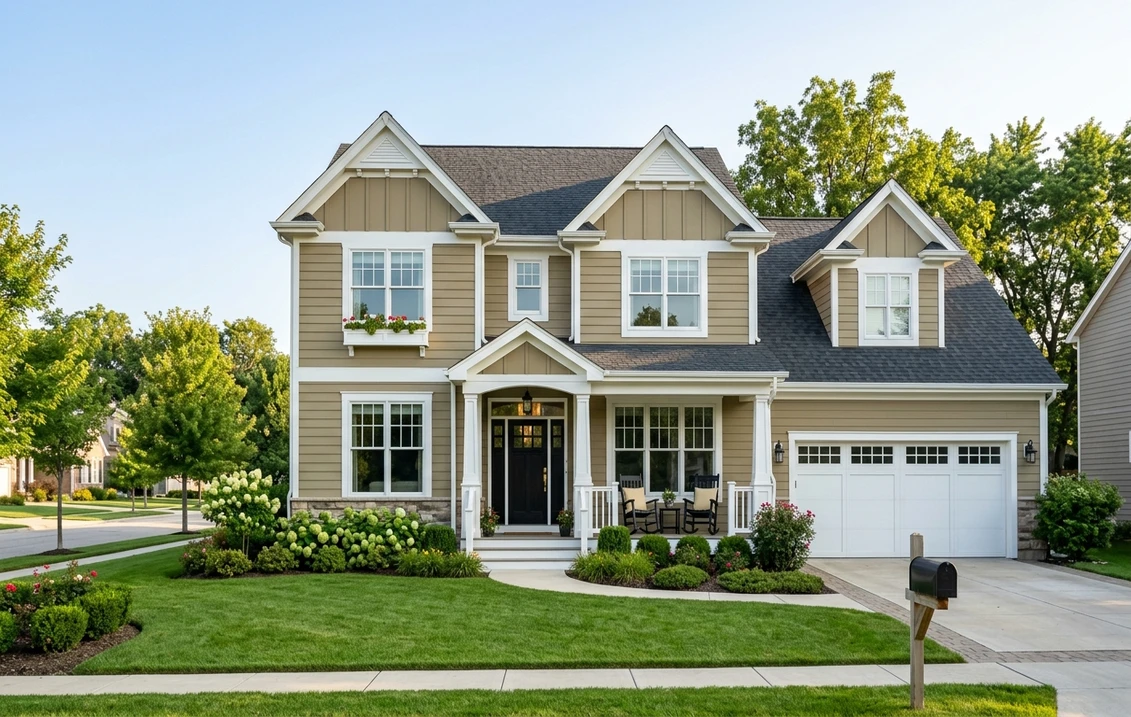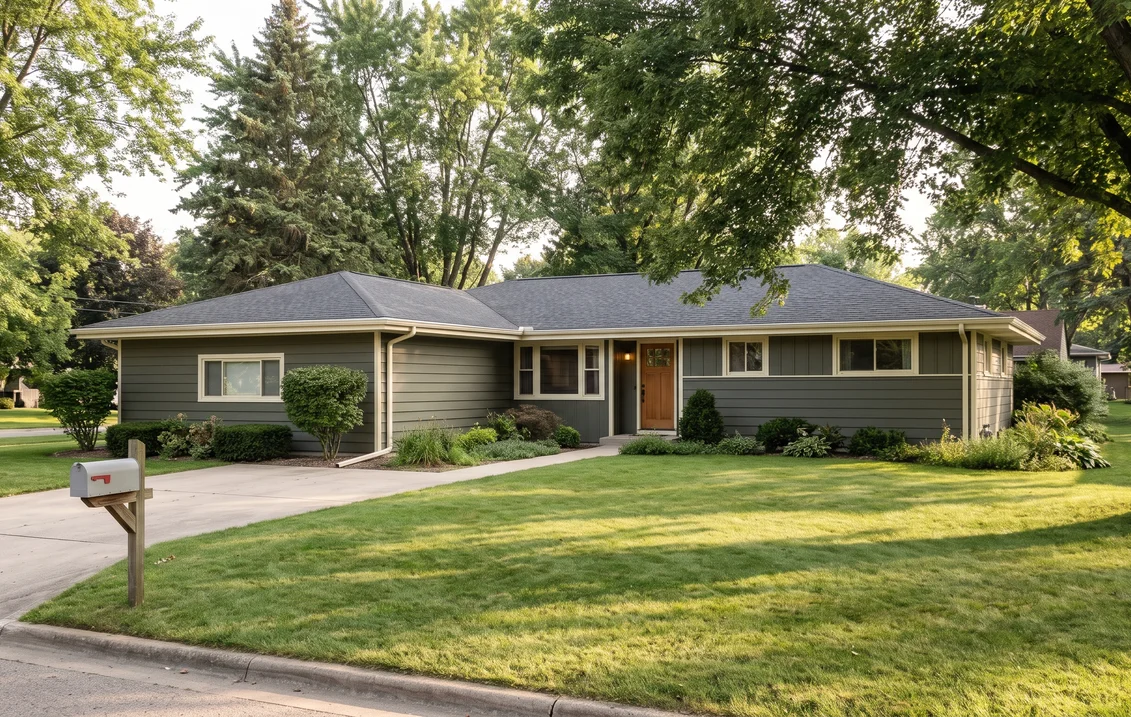

Sherwin-Williams Sage Green Light (SW 2851) is not a light color. Despite its name, it is a deep, muted olive-sage with a Light Reflectance Value (LRV) of about 16 and a screen rendering of #73705E (RGB 115, 112, 94). The "light" comes from its historic naming, where it was the lighter partner of a deeper sage. On a house it reads as a grounded gray-olive: earthy in sun, almost charcoal-green in shade. It suits mid-century ranches, bungalows and wooded lots, and it looks best with a creamy trim rather than a stark white.
The code, LRV, color family, collections and the coordinating colors come from the official Sherwin-Williams Sage Green Light SW 2851 page and the brand's public color data, read on 26/11/2026. Delta E 2000 distances to other colors are our own calculations from published screen values, and the exterior advice is our color reasoning, not a manufacturer statement. Deep greens change a lot between the chip and a sunny wall, so test a large sample before buying gallons.
Upload a photo of your home and preview SW 2851 on the siding in seconds. More options on our exterior paint visualizer page.
What Sherwin-Williams publishes for SW 2851
| Attribute | Sherwin-Williams Sage Green Light SW 2851 |
|---|---|
| Color name and code | Sage Green Light, SW 2851 |
| Light Reflectance Value | About 16 (16.08 in the brand's data) |
| Screen hex and RGB (approximate) | #73705E (RGB 115, 112, 94) |
| Color family | Historic Color |
| Collections | Historic Exterior Color Wall, Suburban Modern (1950s), Nurturer |
| Use | Interior and exterior |
| Coordinating colors listed by Sherwin-Williams | Roycroft Vellum SW 2833 (a warm cream) and Renwick Golden Oak SW 2824 (a golden wood brown) |
| Undertone reading (our analysis) | Olive and khaki: a yellow-green gray, no blue |
Try it on your house
- 1Your photoPhoto
- 2Your colorColor
- 3HD render in ~30 sHD render in ~30 s
Your photo is used only to create your preview. JPG, PNG, HEIC (iPhone)
LRV measures how much visible light a color reflects, from 0 (black) to 100 (perfect white). At about 16, Sage Green Light sits in the dark third of the scale, close to colors most people would call "deep" or "moody". For comparison, Sherwin-Williams' popular Evergreen Fog sits near 30, and Clary Sage near 41. So if you found Sage Green Light while searching for a pale sage, step back now: this is a body color for people who want a house with weight, not a soft pastel green.
Why the name says "light" when the color is dark
Sage Green Light belongs to Sherwin-Williams' historic palettes, the 2800-series colors built around American house styles. Those palettes often pair a color with a "light" or "dark" version of the same hue, and the names describe the position inside the pair, not the place on the full light-to-dark scale. The result confuses many buyers: the chip online looks like a gray-olive, the name promises something airy, and the wall ends up somewhere in between depending on the light.
The screen values explain the look. Red and green are almost level (115 and 112) and blue sits about 20 points lower. That pattern gives a warm, yellow-leaning gray-green: think of olive leaves, dried moss or the khaki of old canvas. The "sage" is real, but it is a dusky, mid-century sage, closer to the greens of 1950s ranch houses than to the minty sages of modern farmhouse kitchens. For the lighter sages people usually picture, our sage green exterior paint guide lists colors from pale to deep.
Sun, shade and facade orientation
| Facade exposure | How Sage Green Light tends to look | What to plan for |
|---|---|---|
| South-facing front | Lighter and clearly olive; the sage side comes forward | The most "green" version; dark colors also absorb more heat, so check your siding maker's guidance |
| North-facing front | Deep gray-green, close to a warm charcoal | A cream trim keeps the house from looking heavy |
| East-facing front | Fresh olive in the morning, darker after noon | Judge the sample when you see the house most |
| West-facing front | Gray at midday, golden khaki in late sun | Evening light warms it a lot; a good match for wood accents |
| Heavy tree cover | Blends into the foliage and reads almost black-green in deep shade | Lovely if you want the house to recede; add light trim if you want it to stand out |
Heat deserves a word. A color at LRV 16 absorbs much more sunlight than a mid-tone, and some vinyl siding makers restrict dark shades because the panels can warp. If you have vinyl siding, read the manufacturer's color guidance or use a paint line formulated for vinyl before choosing a deep color. Wood, fiber cement and stucco handle dark colors better, although they still show faster fading on south and west walls. Our guide to vinyl-safe colors from Sherwin-Williams covers that question in detail.
Sage Green Light next to Cocoon, Crooked River, Dried Thyme and Sharkskin
Several colors sit close to SW 2851, and some colors sold as "sage" are much further away than their names suggest. We calculated the Delta E 2000 distance from published screen values. Below about 1, two colors are very hard to tell apart; between 1 and 2 the difference shows side by side; between 2 and 5 it shows on a wall; above 5 most people see a different color.
| Color | Screen hex | LRV | Delta E 2000 to SW 2851 (our calc.) | How it differs |
|---|---|---|---|---|
| SW 2851 Sage Green Light (reference) | #73705E | about 16 | 0 | Deep olive-sage |
| BM 2139-30 Sharkskin | #6E6D5F | luminance about 15 (calc.) | 2.19 | The closest color we measured: a touch darker and grayer |
| BM 1490 Country Life | #6E6958 | luminance about 14 (calc.) | 2.82 | Slightly browner and darker |
| SW 6173 Cocoon | #726B5B | about 15 | 3.05 | The closest SW color: same depth, more khaki-brown |
| SW 9524 Crooked River | #797869 | about 18 | 3.45 | A little lighter and grayer |
| SW 6166 Eclipse | #6B6757 | about 14 | 3.50 | Slightly darker and warmer |
| SW 6186 Dried Thyme | #7B8070 | about 21 | 7.01 | Lighter and cooler, a clearer gray-green |
| SW 6208 Pewter Green | #5E6259 | about 12 | 7.52 | Darker and cooler, with less yellow |
| SW 9130 Evergreen Fog | #95978A | about 30 | 14.62 | Much lighter; not a substitute |
| SW 6178 Clary Sage | #ACAD97 | about 41 | 20.86 | A true light sage, more than twice as reflective |
| SW 9647 Soft Sage | #BCBCAE | about 50 | 25.01 | A pale sage-gray, the color many people expect from the name |
Two conclusions stand out. First, Benjamin Moore Sharkskin is the nearest cross-brand option we found, and Cocoon is the nearest color in the Sherwin-Williams deck, a little browner. Second, the sages that dominate search results (Clary Sage, Soft Sage, Evergreen Fog) are not close at all. If what you really want is a pale, airy sage, start with our Soft Sage SW 9647 guide or our Evergreen Fog undertones guide. If you want Sage Green Light's depth with a cooler, grayer feel, Dried Thyme is the next sample to try; the Dried Thyme vs Clary Sage comparison shows where it sits in the family.
Trim, door and roof pairings
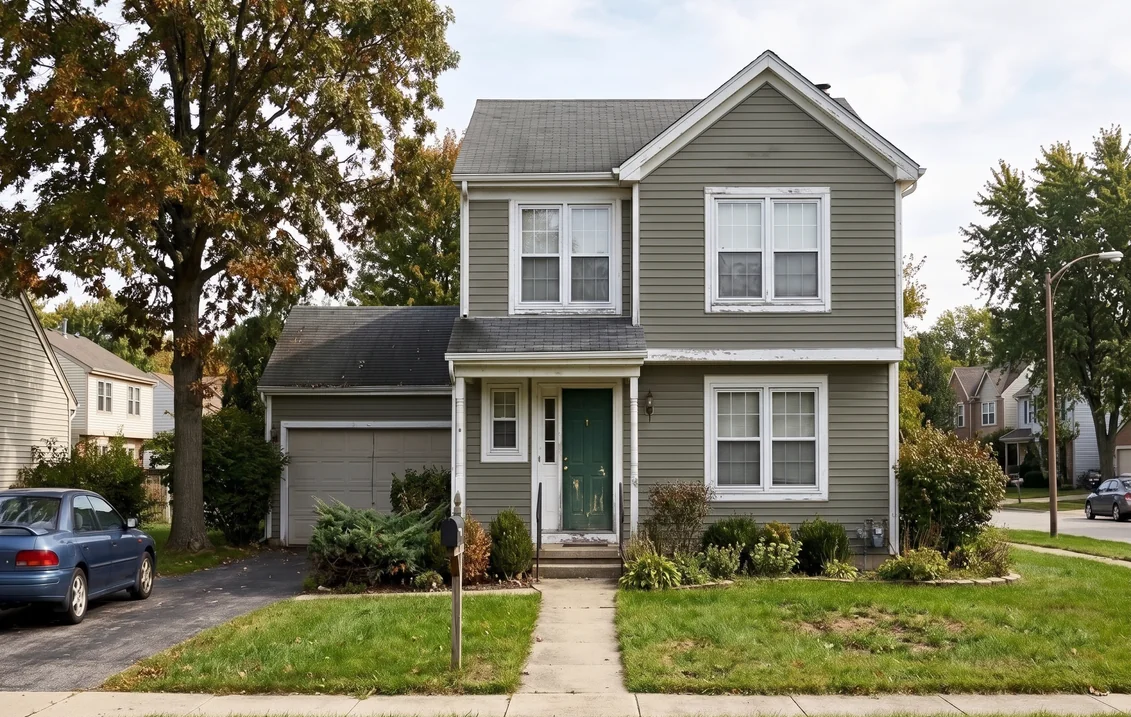
Sherwin-Williams pairs SW 2851 with two historic partners: Roycroft Vellum SW 2833, a warm cream with an LRV near 71, and Renwick Golden Oak SW 2824, a golden wood brown near 19. That pairing tells you how the color was meant to be used: olive body, creamy trim, wood-toned accents. A bright, blue-white trim can work on a modern house, but it makes the olive look darker and colder by contrast.
| Element | Pairing with SW 2851 | Result |
|---|---|---|
| Trim (historic) | Roycroft Vellum SW 2833 | The brand's coordinating cream: soft contrast, very period-correct |
| Trim (cleaner) | Alabaster SW 7008 or Shoji White SW 7042 | Warm whites that stay friendly next to an olive body |
| Accent, door or window sash | Renwick Golden Oak SW 2824 or a stained wood door | The brand's coordinating brown: warm, crafted, ties the olive to wood |
| Front door (bold) | A brick red, a mustard or a deep plum | Classic mid-century accents that pop against a muted green |
| Shutters | Urbane Bronze SW 7048 or black | Deeper anchors that keep the scheme earthy |
| Roof | Brown or weathered wood shingles, charcoal, dark bronze metal | Warm roofs echo the olive; charcoal gives a crisper, modern look |
| Stone and brick | Tan fieldstone, buff or red-brown brick | The yellow undertone makes warm masonry look intentional |
If your trim is factory white vinyl, hold a sample of Sage Green Light against it in daylight. The contrast will be strong; that can be a deliberate modern look, but if it feels harsh, paint wood trim in a cream and let the vinyl read as an accent. For a full scheme built around a green body with dark accents, see our sage green house with white trim and a black door, and for ideas on colors that sit next to sage, our colors that go with sage green page.
House styles and settings that suit Sage Green Light
- Mid-century ranches: the color appears in Sherwin-Williams' Suburban Modern (1950s) palette; with cream trim and a warm door it looks original to the house.
- Craftsman bungalows: olive bodies with cream and wood accents are a classic bungalow scheme; see our bungalow and craftsman revival colors for the wider palette.
- Cabins and wooded lots: the house blends into trees and stone instead of standing out.
- Modern farmhouses: paired with black windows and a black metal roof, it gives a moodier take on the usual white farmhouse.
- Outbuildings, garages and sheds: a good way to try the color on a smaller surface before committing on the main house.
- Less suitable: a small house deep in shade, where the color can look almost black, or a strict HOA palette limited to light neutrals.
Preparation and paint for a dark exterior color
Dark colors hide some faults and reveal others. They hide dirt and small stains better than whites, but they show uneven coverage, lap marks and patches of old primer. Plan two full coats over a sound, clean surface. Sherwin-Williams presents Emerald Exterior Acrylic Latex as its top exterior line; its product page and data sheet list coverage, application temperatures and sheens. A satin sheen is the usual siding choice; flat hides surface defects but holds dirt.
- Wash and repair first. Remove mildew, replace rotten boards and caulk gaps; deep colors make poor joints visible.
- Use a tinted primer. A gray or tinted primer under a deep olive helps the topcoat cover in two coats.
- Avoid painting in direct sun. Dark paint on a hot wall dries too fast and leaves lap marks.
- Keep the same batch. Deep colors are harder to touch up from a new batch; keep a labeled can.
If the house was built before 1978, old paint layers may contain lead. The US Environmental Protection Agency's Renovation, Repair and Painting program requires contractors who disturb paint in pre-1978 homes to be certified and to follow lead-safe practices. Scraping and sanding are the risky steps, so ask your painter about certification before work starts.
Three exterior schemes with Sage Green Light
| Scheme | Body | Trim | Door and accents | Roof |
|---|---|---|---|---|
| Mid-century original | Sage Green Light SW 2851 | Roycroft Vellum SW 2833 | Renwick Golden Oak SW 2824 door, brass hardware | Brown shingles |
| Craftsman earth | Sage Green Light SW 2851 | Shoji White SW 7042 | Stained oak door, brick red flower boxes | Weathered wood shingles |
| Moody modern | Sage Green Light SW 2851 | Alabaster SW 7008 | Black door, black window frames | Black standing-seam metal |
For the brand's wider exterior range, including the whites, grays and deep colors that combine with SW 2851, start with our Sherwin-Williams exterior paint guide.
How to test Sage Green Light outside
- Paint large boards. Two coats on boards of at least 2 by 2 feet; a deep color looks much darker on a small swatch held in your hand.
- Test sun and shade. One board on the sunniest wall, one on the shadiest, and look at both from the street.
- Add a neighbor. Put Cocoon (browner) or Dried Thyme (lighter, cooler) beside it to see which way you want to move.
- Hold the trim color next to it. Test Roycroft Vellum and your current white side by side.
- Check fixed elements. Roof, stone, brick and window frames will not change; the body color must work with them.
Preview Sage Green Light on your own house
A chip, an LRV and a hex code tell you how dark the color is and roughly how it looks on a screen. They cannot show whether the olive reads warm or almost charcoal on your facade, or how it sits with your roof. Upload a photo of your house and the visualizer shows SW 2851 on the siding, so you can compare it with Cocoon or Dried Thyme before buying samples.
If Sage Green Light is too deep for your siding, Rare Gray SW 6199 is a much lighter gray-green at an LRV of about 38.
Sources and references
- Sherwin-Williams, Sage Green Light SW 2851: code, LRV, screen rendering, color family, collections, coordinating colors (read 26/11/2026).
- Sherwin-Williams, Cocoon SW 6173: official page of the closest Sherwin-Williams color by our calculation.
- Sherwin-Williams, Emerald Exterior Acrylic Latex: product page and data sheet of the brand's premium exterior line.
- Benjamin Moore, Sharkskin 2139-30: official page of the closest Benjamin Moore color by our calculation.
- US Environmental Protection Agency, Lead Renovation, Repair and Painting Program: rules for disturbing paint in homes built before 1978.
Frequently asked questions
Is Sherwin-Williams Sage Green Light a light color?
What undertone does Sage Green Light SW 2851 have?
What trim color goes with Sage Green Light?
What is the closest Benjamin Moore color to Sage Green Light?
Is Sage Green Light the same as Clary Sage or Soft Sage?
Trademarks mentioned (Sherwin-Williams, Benjamin Moore, Behr, Caparol, Brillux, Sto, Alpina, Valspar, PPG, Glidden, Dulux, Crown Trade, Sandtex, Farrow & Ball, Johnstone's, Leyland) are property of their respective owners. FacadeColorizer is independent and not affiliated with any of them. Nominative fair use under Lanham Act §1125.