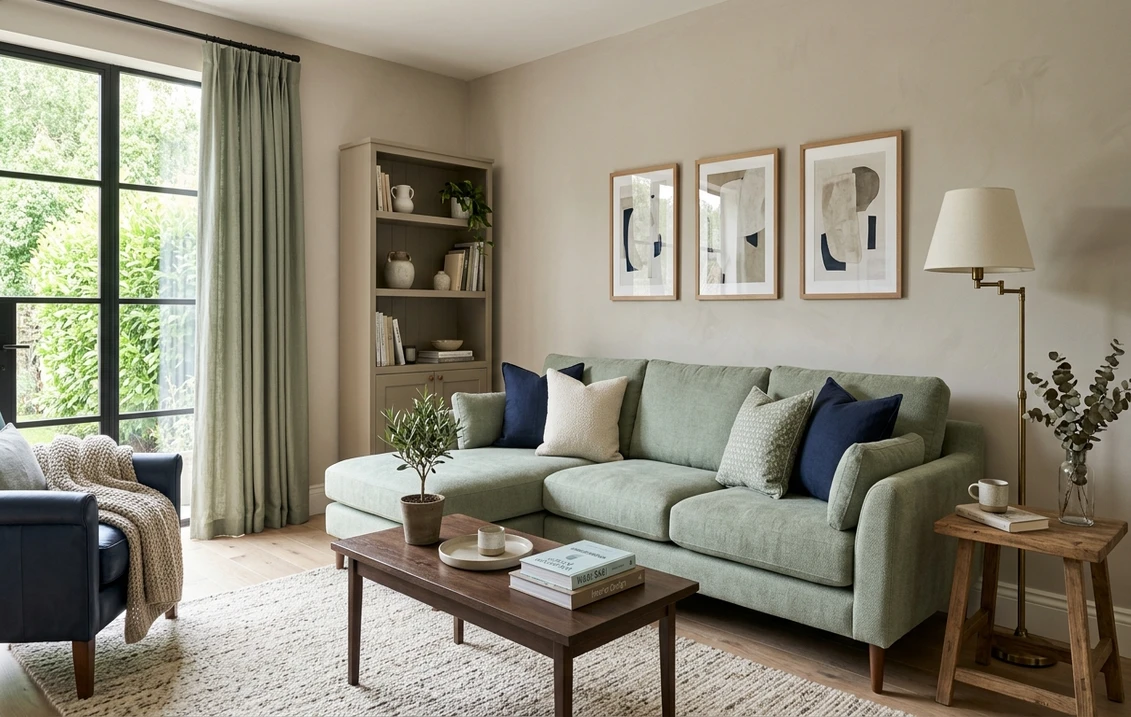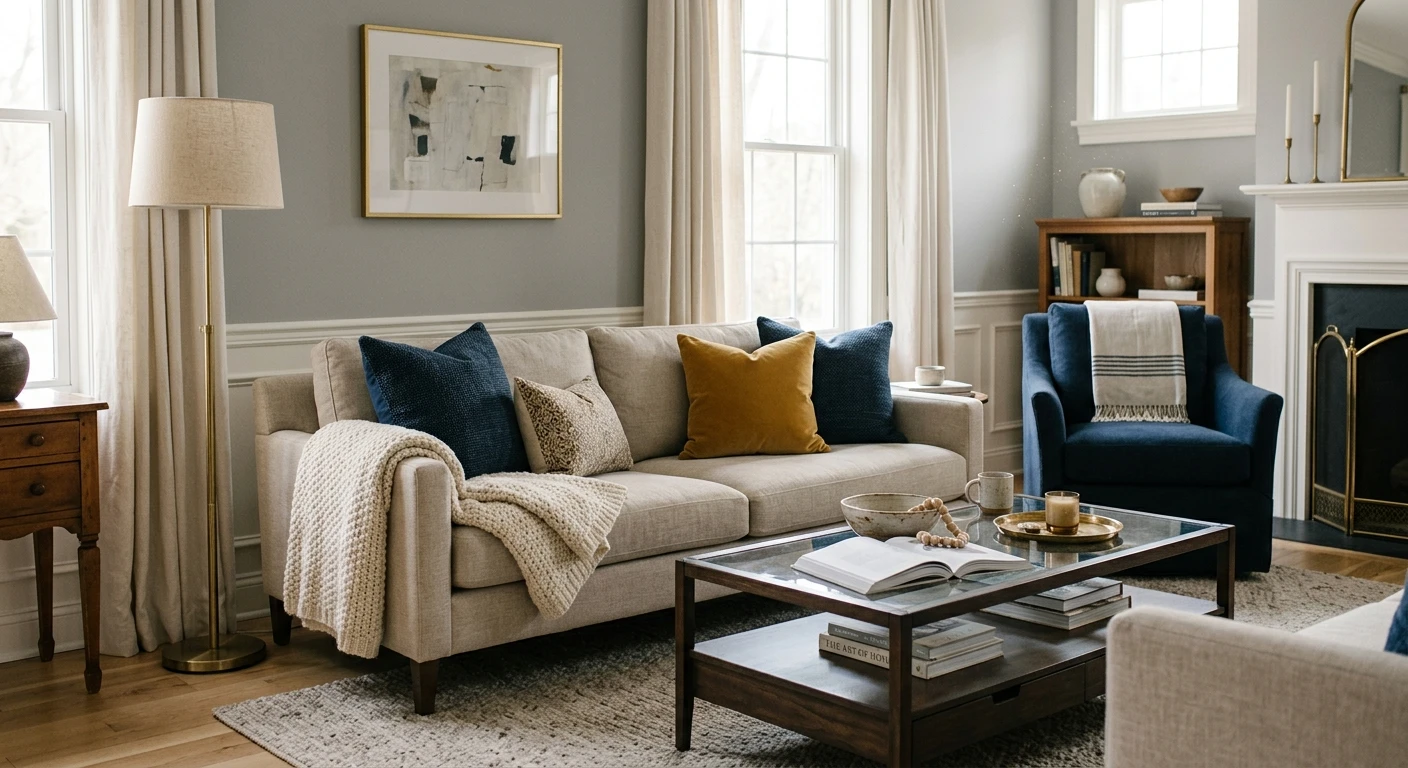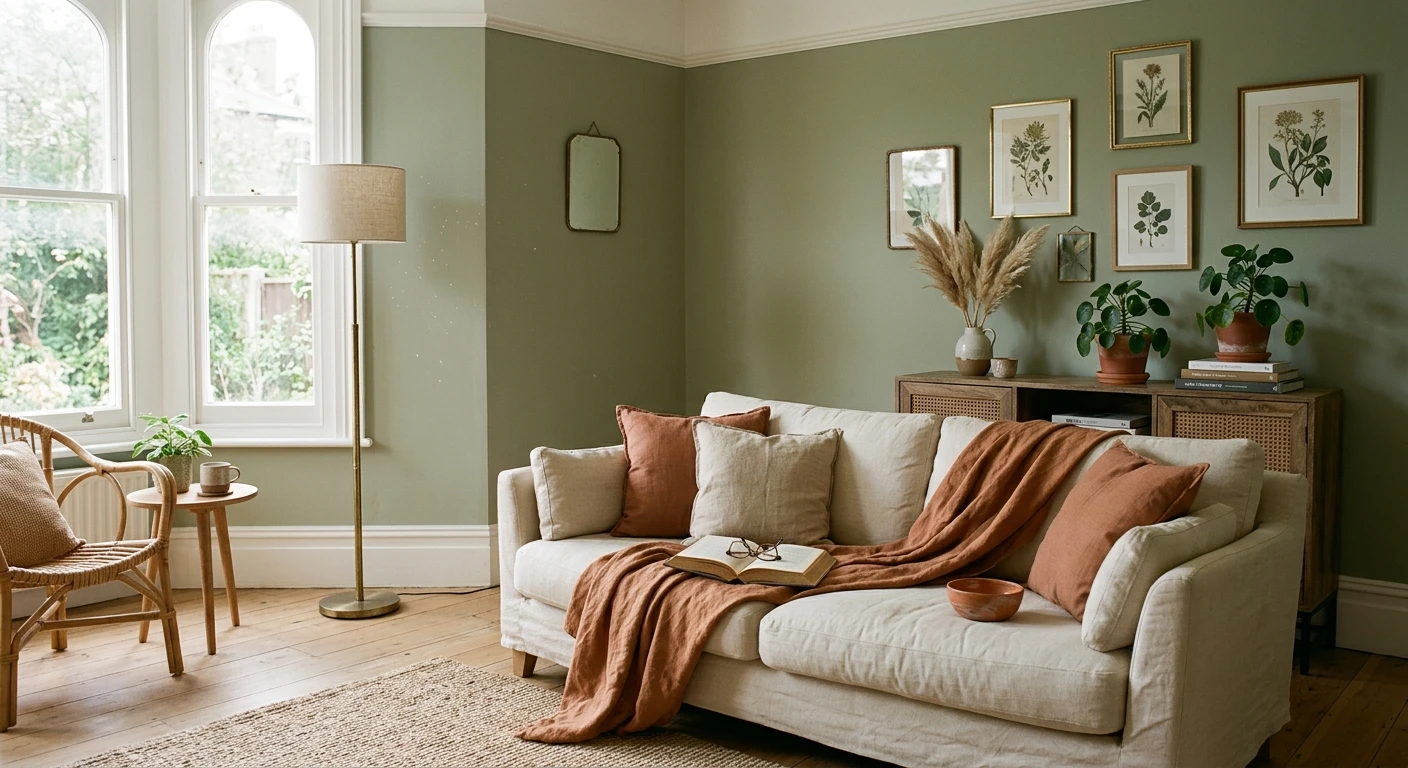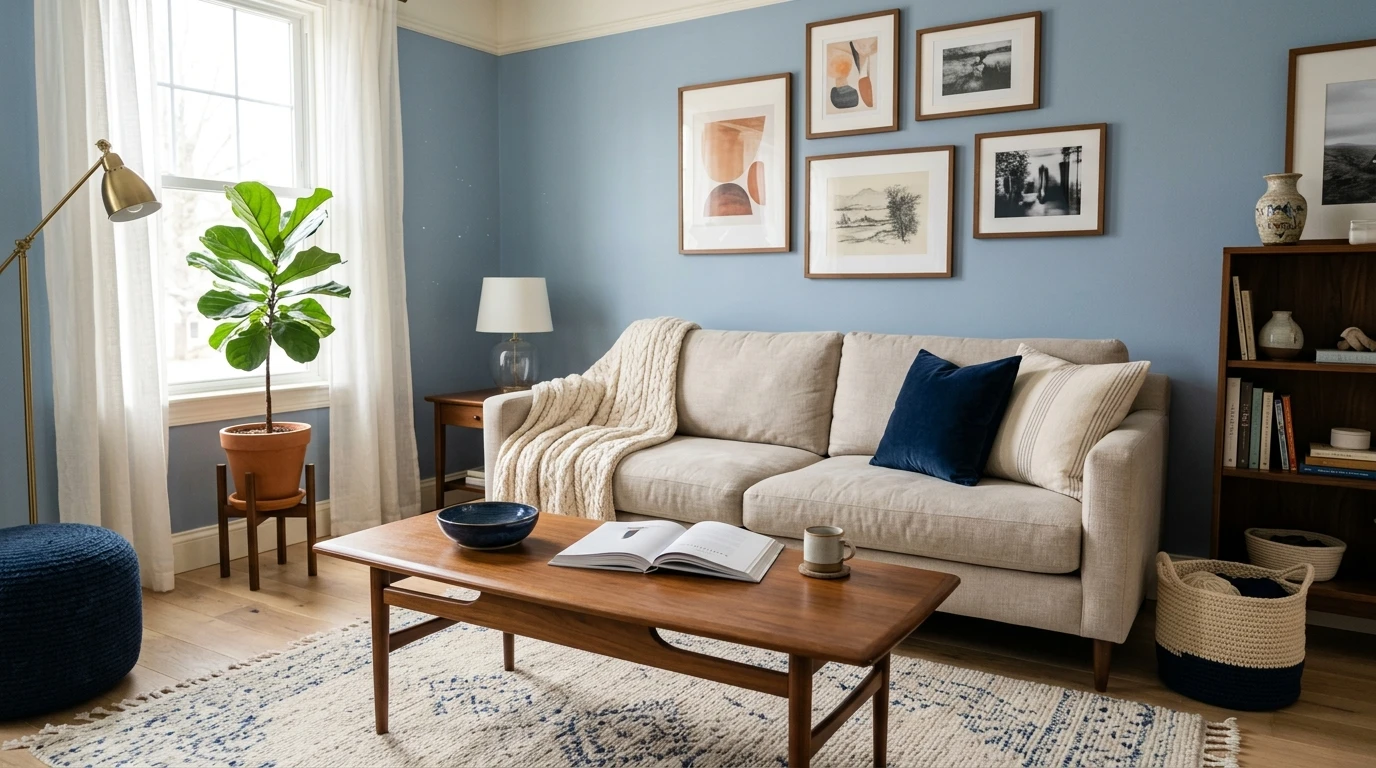
Try it on your room

The best interior door colors fall into three families: a white that matches the trim, such as Extra White SW 7006 (LRV 86) or Chantilly Lace OC-65 (LRV 90.04); a soft greige one step darker than the walls, such as Agreeable Gray SW 7029 (LRV 60) or Revere Pewter HC-172 (LRV 55.05); and a near-black or deep color for contrast, such as Tricorn Black SW 6258 (LRV 3), Iron Ore SW 7069 (LRV 6) or Hale Navy HC-154 (LRV 8.36). Pick the family from your home's style and hallway light, decide whether the door matches the trim or stands apart, then use a satin or semi-gloss enamel, the sheens Sherwin-Williams and Benjamin Moore both list for doors.
This page is about choosing the color. The method (prep, primer, brush or sprayer) is in our guide on how to paint interior doors, trim and baseboards, and if you have settled on black, black interior doors before and after shows that one color room by room. Doors belong to a whole-house palette, covered in our interior color schemes guide. Codes and LRVs were read on the Benjamin Moore color pages or taken from Sherwin-Williams' official color data on October 22, 2026.
The link opens the interior tool with "Doors" preselected as the surface to paint. How it works: our interior paint visualizer.
What color should interior doors be? Four answers that work
Start from what you want the doors to do: disappear into the trim, soften an all-white house, add depth without going dark, or become a feature.
| Goal | Door approach | Shades to sample (LRV) |
|---|---|---|
| Classic, works with any wall | Door in the same white as the trim | Extra White SW 7006 (86), Chantilly Lace OC-65 (90.04), White Dove OC-17 (83.16) |
| Soften a white-heavy house | Light greige door, white trim | Agreeable Gray SW 7029 (60), Pale Oak OC-20 (68.64), Edgecomb Gray HC-173 (63.09) |
| Depth without black | Mid-tone door | Universal Khaki SW 6150 (40), Saybrook Sage HC-114 (45.46), Chelsea Gray HC-168 (23.33) |
| Doors as a feature | Near-black or deep color | Tricorn Black SW 6258 (3), Iron Ore SW 7069 (6), Hale Navy HC-154 (8.36), Silhouette AF-655 (10.18) |
Try it on your house
No photo? Try a sample
A white door matched to the trim reads as part of the woodwork, so it survives every future change of wall color. A greige or mid-tone door is the quiet upgrade: paneled doors show their profiles against white casings without darkening the hall. A deep door works best when the house gives it a reason (black window frames, dark hardware, a modern or Craftsman character). Both 2026 colors of the year fit this list: Sherwin-Williams chose Universal Khaki SW 6150, a mid-tone neutral with a slight yellow undertone, and Benjamin Moore chose Silhouette AF-655, a burnt umber with charcoal notes that its launch page shows on an interior door in Aura Interior Semi-Gloss.
Interior door colors by home style
The style of the house sets the trim profile, the hardware and the door type (raised panel, shaker, flush slab), so it narrows the field faster than any trend list.
Modern farmhouse
Black hardware and black window frames make dark doors look intentional. Tricorn Black SW 6258 (LRV 3) is the deepest option here; Iron Ore SW 7069 (LRV 6) is a softer charcoal that keeps panel shadows visible. Pair either with Alabaster SW 7008 (LRV 82) or Pure White SW 7005 (LRV 84) trim. If black feels like too much, Agreeable Gray SW 7029 (LRV 60) doors keep the farmhouse warmth with far less contrast. Our black and white interior color scheme guide covers the walls and furniture around them.
Traditional and Colonial
Six-panel doors and wide casings read as one piece of millwork, so the classic move is doors in the trim white, in a semi-gloss that catches the panel edges. A study or dining room door can take one deep accent: Hale Navy HC-154 (LRV 8.36) or Newburyport Blue HC-155 (LRV 10.31) with White Dove OC-17 trim. Our Hale Navy HC-154 review shows how that navy shifts between north and south light.
Craftsman and bungalow
Stained wood Craftsman doors are worth keeping. When the doors are already painted, earthy deep colors suit the heavy casings: Urbane Bronze SW 7048 (LRV 8), Pewter Green SW 6208 (LRV 12) or Silhouette AF-655 (LRV 10.18), with a warm white such as White Dove OC-17 (LRV 83.16) on the trim.
Mid-century modern
Flush slab doors have no panels to show off, so color does the work. One saturated door (Naval SW 6244, LRV 4) or a muted green such as Evergreen Fog SW 9130 (LRV 30) fits the period better than a whole dark hallway. Our mid-century modern color palette lists the wall colors that sit behind those doors.
Contemporary and minimalist
Two routes work: color drenching (walls, trim and door in one color, so the door disappears) or a graphic dark door in Iron Ore SW 7069, Black Fox SW 7020 (LRV 7) or Kendall Charcoal HC-166 (LRV 14.61) with plain casings. Near-white doors on slightly different white walls tend to read as a mismatch rather than a choice.
Coastal and cottage
Light houses want light doors: Pale Oak OC-20 (LRV 68.64) or Sea Salt SW 6204 (LRV 63) keep the airy feel. For one accent, a navy bedroom or bath door fits the palette in our coastal color palette guide.
The interior door color table: 24 shades with codes and LRVs
LRV (light reflectance value) is the most useful number on a door chip. Sherwin-Williams' room orientation guide defines a 0 to 100 scale, zero reflecting no light and 100 reflecting all of it. Benjamin Moore values keep the two decimals of each color page; Sherwin-Williams values come from the brand's official color data, rounded to whole numbers.
| Shade | Code | LRV | Best door role |
|---|---|---|---|
| Chantilly Lace | BM OC-65 | 90.04 | Crisp white, matched to trim |
| Extra White | SW 7006 | 86 | Bright white, matched to trim |
| Pure White | SW 7005 | 84 | Soft white, door and trim |
| White Dove | BM OC-17 | 83.16 | Warm white, traditional |
| Alabaster | SW 7008 | 82 | Warm white, farmhouse |
| Pale Oak | BM OC-20 | 68.64 | Light greige, coastal |
| Sea Salt | SW 6204 | 63 | Pale green-gray, coastal |
| Edgecomb Gray | BM HC-173 | 63.09 | Light greige, white trim |
| Agreeable Gray | SW 7029 | 60 | Greige, soft contrast |
| Accessible Beige | SW 7036 | 58 | Warm greige |
| Revere Pewter | BM HC-172 | 55.05 | Greige, traditional |
| Saybrook Sage | BM HC-114 | 45.46 | Mid-tone sage |
| Universal Khaki | SW 6150 | 40 | Mid-tone, SW 2026 Color of the Year |
| Dorian Gray | SW 7017 | 39 | Mid-tone greige |
| Evergreen Fog | SW 9130 | 30 | Muted green, mid-century |
| Chelsea Gray | BM HC-168 | 23.33 | Deep gray |
| Kendall Charcoal | BM HC-166 | 14.61 | Charcoal, contemporary |
| Pewter Green | SW 6208 | 12 | Deep green, Craftsman |
| Silhouette | BM AF-655 | 10.18 | Deep brown, BM 2026 Color of the Year |
| Hale Navy | BM HC-154 | 8.36 | Navy accent |
| Urbane Bronze | SW 7048 | 8 | Brown-charcoal, Craftsman |
| Black Fox | SW 7020 | 7 | Warm near-black |
| Iron Ore | SW 7069 | 6 | Soft charcoal, farmhouse |
| Tricorn Black | SW 6258 | 3 | Black, maximum contrast |
Two whites a few LRV points apart can still clash on a door and its casing if one leans warm and the other cool, which is why door and trim are paired first.
Should interior doors be the same color as the trim?
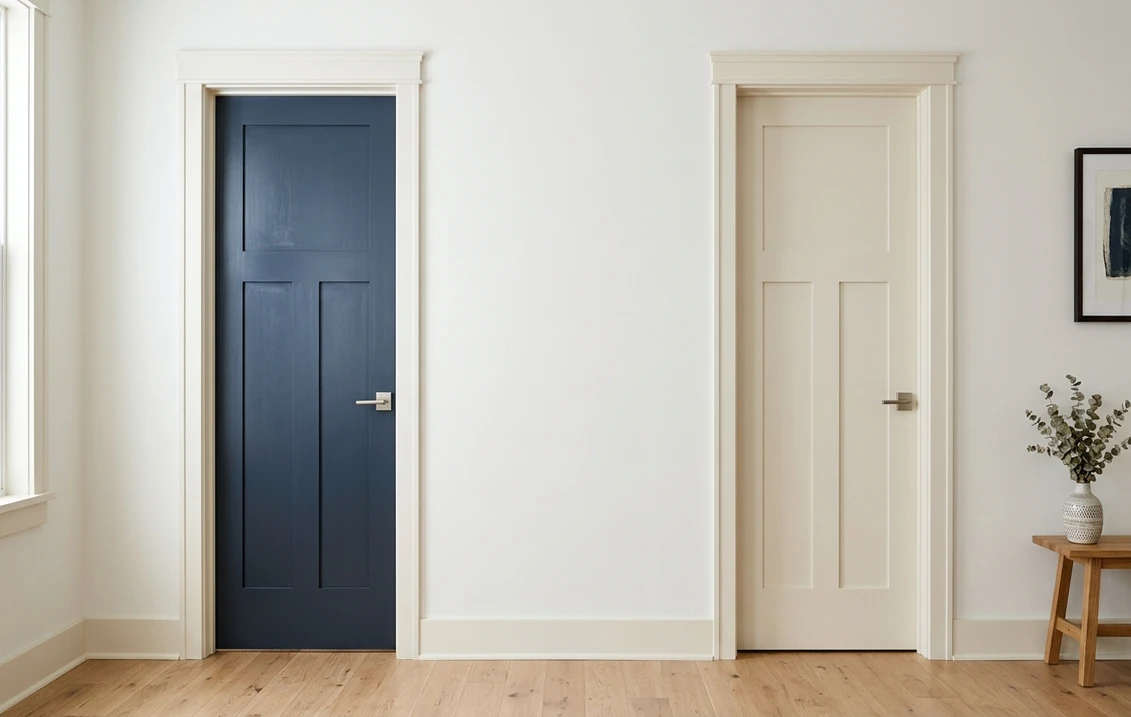
Not necessarily. There are three coherent systems, and the mistake is mixing them in one sightline.
- Match: door and trim in the same white and sheen. The door reads as woodwork and the wall color carries the room; the easiest system to repaint later.
- Tonal or color-drenched: walls, trim and doors in one color, or the door one step deeper. Sherwin-Williams' article on painting walls, doors and trim the same color suggests flat walls, satin trim and gloss doors, and notes that one sheen everywhere makes the room read as one continuous color.
- Contrast: a dark door inside white casings. In LRV terms, Tricorn Black (3) in Extra White trim (86) is close to maximum contrast, while Agreeable Gray (60) in the same trim is a soft step.
Undertone matters as much as depth. A bright, cool white such as Chantilly Lace (90.04) can make a warm greige door look muddy, while a warmer white such as White Dove (83.16) or Alabaster (82) flatters greige, khaki and brown doors. Our LRV guide explains why the same chip looks lighter or darker depending on the light that reaches it.
Should all interior doors in a house be the same color?
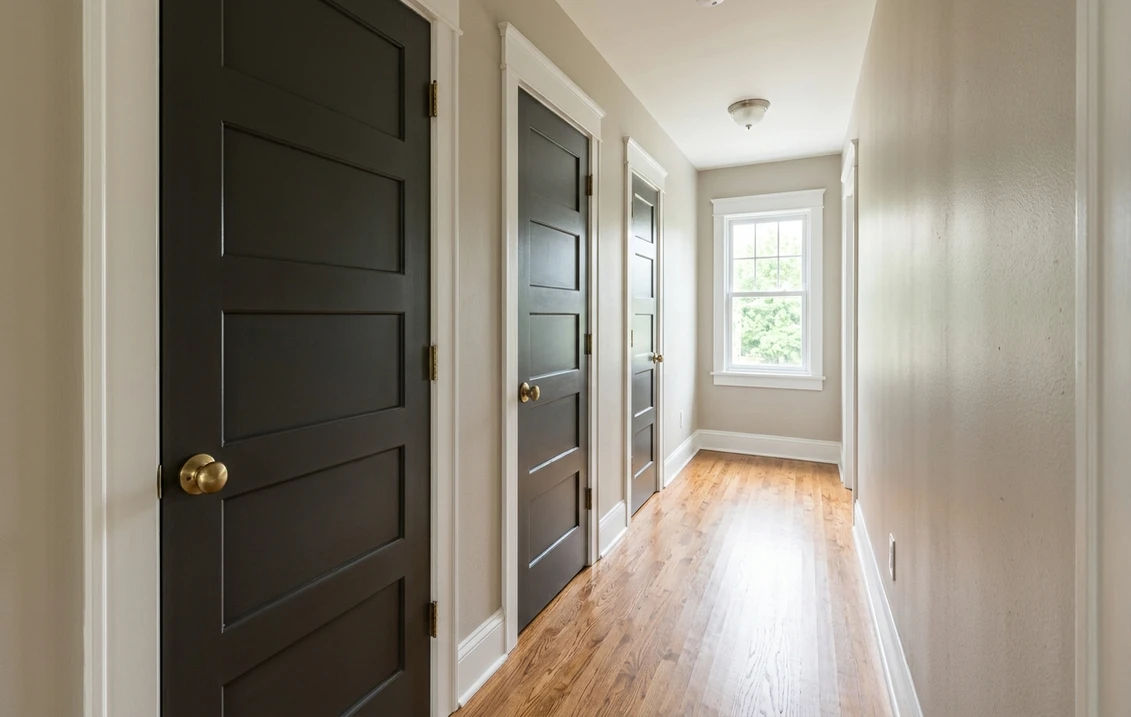
Doors you see at the same time, along a hallway or around a landing, look best in one color: four doors in four colors read as unfinished. The exceptions are single doors with their own identity (pantry, office, powder room, laundry), which can take an accent when they are not lined up with the others.
A door can also carry two colors, one per face, when a bedroom has its own palette. The usual convention for the edges follows what you see when the door is open: the latch edge takes the color of the face that swings into the room, and the hinge edge takes the color of the other face. Closet doors normally follow the room they belong to, matched either to the trim or to the walls.
Light or dark doors: what LRV tells you before you paint
A windowless hallway lives on the light from open doorways and a few fixtures. Doors in the 80s, such as Extra White or Pure White, send much of it back into the corridor; doors under 10, such as Iron Ore or Hale Navy, absorb most of it. Sherwin-Williams advises looking at higher-LRV colors for north-facing rooms, and the same logic applies to a dim hall. In a bright, south-facing space, a deep door is easier to live with because daylight keeps the panels and shadows readable.
Dark doors also show fingerprints near the knob and scuffs at the bottom rail, one more reason to pair a deep color with a washable sheen. If you are torn between two greiges, our greige paint colors guide compares the warm neutrals that sit between white and gray.
Best paint finish for interior doors, according to the makers
Doors are handled, kicked and closed against a stop every day, so the finish matters as much as the color. Both big brands name doors in their sheen guidance.
| Sheen | What the makers say about doors | When to choose it |
|---|---|---|
| Satin | Benjamin Moore: highlights windows, shutters, trim "and even interior doors" | Dented older doors, dark colors, low shine |
| Semi-gloss | Benjamin Moore: dimension on millwork, trim and doors; Sherwin-Williams: great for trim, moldings and closet doors | Default for light doors matched to trim |
| Gloss / high gloss | Sherwin-Williams: striking look and durability, such as doors; Benjamin Moore: gloss accentuates blemishes | Perfectly smooth doors, lacquer-style colors |
The quotes come from the Sherwin-Williams paint sheen guide and Benjamin Moore's how to choose a paint finish page. Keep flat and matte wall finishes off doors: they mark easily and take repeated wiping around a knob less well.
Door and trim enamels level out and cure harder than wall paint. Benjamin Moore's ADVANCE Interior Semi-Gloss is a waterborne alkyd listed for doors, trim and cabinets, with a published coverage of 400 to 500 square feet per gallon, a 16-hour recoat time and an application range of 50 to 90°F. Sherwin-Williams' Emerald Urethane Trim Enamel is a water-based urethane-modified alkyd in satin, semi-gloss and gloss, recommended for cabinets, doors and trim, with what the maker calls excellent blocking resistance. Blocking is two fresh paint films sticking together: on a door, the edge gluing itself to the stop when it is closed too soon. For how the sheens behave across a whole room, see our interior paint finish guide.
How much paint do you need for interior doors?
Measure one door and the rest is arithmetic. The example below is a 30 by 80 inch flat slab (measure yours: widths vary).
One face is 2.5 ft x 6.67 ft, about 16.7 square feet, so two coats on both faces come to about 67 square feet per door, plus a little for the edges. At the low end of ADVANCE's published coverage (400 square feet per gallon), one gallon paints about six such doors; at 500, about seven and a half.
| Doors (30 x 80 in, 2 coats, both faces) | Area to cover | Paint at 400 sq ft/gal | What to buy |
|---|---|---|---|
| 1 | 67 sq ft | 0.17 gal | 1 quart |
| 3 | 200 sq ft | 0.5 gal | 2 quarts |
| 6 | 400 sq ft | 1.0 gal | 1 gallon + 1 quart |
| 10 | 667 sq ft | 1.67 gal | 2 gallons |
| 15 | 1,000 sq ft | 2.5 gal | 3 gallons |
Paneled doors carry more surface than a flat slab, so round up and keep the extra quart for touch-ups. If the casings get the same color, add them to the estimate: our paint coverage calculator covers trim and walls in the same way. White to a deep color can take more than two coats: ask the paint counter about a tinted primer first.
Older doors: check for lead before you sand
Repainting old doors usually starts with sanding, which is where a pre-1978 house needs care. The EPA page on reducing the risk of lead exposure at home states that a home built before 1978 is more likely to have lead-based paint, and singles out surfaces subject to constant friction, such as doors and window sills. Its advice: hire a certified lead-based paint inspector or risk assessor (or assume lead is present), wet the area before any sanding you must do, sand the minimum and clean up thoroughly. Anyone paid to disturb paint in pre-1978 housing must be certified in lead-safe work practices, so ask your painter for proof.
Preview the door color before you buy a gallon
A small chip held against a casing says little about a full door at the end of a dim hallway. A photo test is quicker than a sample board per candidate:
- Photograph the hallway with every door closed, in daylight, from where you usually stand.
- Open the interior tool, choose "Doors", and test two or three shades from the table, one per family (white, greige, deep).
- Compare against your real trim. If the door and casing whites fight, change the door shade first.
- Buy a sample of the winner only and brush it on the back of one door for a final check at night.
Free to start: see a door color on your own hallway photo before buying a quart.
Doors sit between a wall color and a trim color. For the wall side of that pairing, our interior color combinations guide lists wall and trim pairs that already work, and the interior paint visualizer tests the full set on one photo.
Sources and references
- Benjamin Moore color pages (code and LRV, read on October 22, 2026): Chantilly Lace, White Dove, Pale Oak, Edgecomb Gray, Revere Pewter, Saybrook Sage, Chelsea Gray, Kendall Charcoal, Silhouette, Hale Navy, Newburyport Blue.
- Sherwin-Williams color pages (codes; LRV from the brand's official color data, rounded): Extra White, Pure White, Alabaster, Sea Salt, Agreeable Gray, Accessible Beige, Universal Khaki, Dorian Gray, Evergreen Fog, Pewter Green, Urbane Bronze, Black Fox, Iron Ore, Tricorn Black, Naval.
- Sherwin-Williams, Color of the Year 2026: Universal Khaki SW 6150. Benjamin Moore, Color of the Year 2026: Silhouette AF-655, shown on a door in Aura Interior Semi-Gloss.
- Sherwin-Williams, How to Choose Paint Colors Based on Room Direction: LRV scale, higher LRV for north-facing rooms.
- Sherwin-Williams, Paint Sheen Guide and Benjamin Moore, How to Choose a Paint Finish: sheens listed for doors and trim.
- Sherwin-Williams blog, Painting Walls, Doors and Trim the Same Color: sheen split for a one-color room.
- Benjamin Moore, ADVANCE Interior Paint, Semi-Gloss: resin, uses, coverage, recoat, temperature. Sherwin-Williams, Emerald Urethane Trim Enamel: resin, sheens, uses, blocking resistance.
- U.S. EPA, Reduce the Risk of Lead Exposure at Home: pre-1978 homes, doors as friction surfaces, sanding precautions, certified professionals.
Frequently asked questions
What is the best color for interior doors?
Should interior doors be the same color as the trim?
Should all interior doors in a house be the same color?
What sheen should interior doors be painted?
How much paint do I need to paint an interior door?
Trademarks mentioned (Sherwin-Williams, Benjamin Moore, Behr, Caparol, Brillux, Sto, Alpina, Valspar, PPG, Glidden, Dulux, Crown Trade, Sandtex, Farrow & Ball, Johnstone's, Leyland) are property of their respective owners. FacadeColorizer is independent and not affiliated with any of them. Nominative fair use under Lanham Act §1125.