
Sherwin-Williams ProClassic (often typed "Pro Classic") is not one paint but a family of three interior enamels for trim, doors and cabinets: ProClassic Waterborne Interior Acrylic Enamel (satin, semi-gloss, gloss, high gloss), ProClassic Interior Waterbased Acrylic-Alkyd (satin, semi-gloss) and the oil-based ProClassic Alkyd Interior Enamel (satin, semi-gloss). All three were in the brand's catalog on November 15, 2026, with data sheets revised in June 2026. Every sheet gives 350 to 400 sq ft per gallon. The two water-based versions recoat in 4 hours and stay under 50 g/L VOC (the High Gloss is the exception, at 122 g/L); the oil version needs 24 hours between coats and runs from 360 to 458 g/L. List prices on Sherwin-Williams' site that day: $106.99 to $112.99 a gallon for the Waterborne Acrylic, $120.49 to $121.49 for the Acrylic-Alkyd and $106.49 to $108.49 for the Alkyd, against $130.49 to $132.49 for Emerald Urethane Trim Enamel.
How this page works: every figure comes from Sherwin-Williams' product data sheets, product pages and Cabinet Refinishing guide, Benjamin Moore's data sheet for Advance, South Coast AQMD and the EPA, read on November 15, 2026. Calculations and readings are ours and labeled as such. No paint was applied for this page.
Opens the interior tool. How it works: our interior paint visualizer.
The three ProClassic enamels at a glance
Sherwin-Williams' own ProClassic Interior Enamels sell sheet (2020) names three products, "Acrylic, Acrylic-Alkyd and Alkyd", with satin and semi-gloss in all three and gloss and high gloss in the acrylic only. The figures below come from the nine data sheets linked in each section.
| Spec | Waterborne Interior Acrylic Enamel | Interior Waterbased Acrylic-Alkyd | Alkyd Interior Enamel |
|---|---|---|---|
| Resin ("vehicle type") | Styrene acrylic (satin, semi-gloss); acrylic (gloss, high gloss) | Acrylic-alkyd hybrid | Alkyd, oil-based |
| Sheens | Satin, Semi-Gloss, Gloss, High Gloss | Satin, Semi-Gloss | Satin, Semi-Gloss |
| Coverage | 350 to 400 sq ft per gallon | Same | Same |
| Touch dry (77°F, 50% RH) | 1 hour | Tack free in 20 to 40 minutes, touch in 1 to 2 hours | 4 to 6 hours |
| Recoat | 4 hours | 4 hours | 24 hours |
| VOC | Under 50 g/L; High Gloss 122 g/L | Under 50 g/L | 360, 438 or 458 g/L depending on the sheet |
| Cleanup | Soap and warm water | Soap and warm water | Cleanup solvent |
| Where | "For interior use only" | Interior, plus exterior doors, trim and other small areas of wood or metal | Same as the hybrid |
| List price per gallon, sherwin-williams.com, Nov 15, 2026 | $106.99 to $112.99 | $120.49 to $121.49 | $106.49 to $108.49 |
Try it on your room
- 1Your photoPhoto
- 2Your colorColor
- 3HD render in ~30 sHD render in ~30 s
Your photo is used only to create your preview. JPG, PNG, HEIC (iPhone)
ProClassic Waterborne Interior Acrylic Enamel, sheen by sheen
This is the version most people mean by "ProClassic paint": the product page lists four sheens, each with its own data sheet: Satin, Semi-Gloss, Gloss and High Gloss, all dated 06/2026.
| Sheen (sheet) | Gloss at 60° | Dry film per coat | Volume solids | VOC | Bases |
|---|---|---|---|---|---|
| Satin, B20 (101.16A) | 10 to 20 units | 1.2 mils | 30% ± 2 | Under 50 g/L | Extra White, Deep Base |
| Semi-Gloss, B31 (101.36B) | 35 to 45 units | 1.2 mils | 30% ± 2 | Under 50 g/L | High Reflective White, Extra White, Deep Base |
| Gloss, B21 (101.41A) | 70 units and up | 1.6 mils | 40% ± 2 | Under 50 g/L | High Reflective White, Extra White |
| High Gloss, B21W00351 (101.43) | 80 units and up (55 and up at 20°) | 1.4 mils | 35% ± 2 | 122 g/L | Extra White |
What the four sheets add, beyond the table:
- The finish claim is the manufacturer's. Each sheet describes "a durable, non-yellowing finish" and flow and leveling that give a finish "equal to an alkyd enamel coating". No test figure backs either phrase on the sheet.
- Deep colors stop at semi-gloss. The Gloss and High Gloss sheets list white bases only, tinted with 5 oz of colorant per gallon at most. Our reading: whites and light tints in gloss, the full color range in satin and semi-gloss.
- High Gloss is a different formula. At 122 g/L it is the only water-based ProClassic above 50 g/L, and its compliance table reads "No" for South Coast AQMD, whose Rule 1113 table of standards sets nonflat coatings at 50 g/L. The same sheet insists that a high-quality primer is "VERY important" under High Gloss, so the finish can develop its gloss.
- A rag warning, even on a water-based paint. The Satin and Semi-Gloss sheets say soaked rags and sanding residue "may spontaneously catch fire if improperly discarded" and belong in a sealed, water-filled metal container.
ProClassic Interior Waterbased Acrylic-Alkyd: the hybrid
The second ProClassic is a water-based paint whose sheets give "Acrylic-Alkyd Hybrid" as the vehicle type. A Sherwin-Williams trade article on water-based acrylic alkyds dates its release to 2010. Two sheets: Satin (103.25A) and Semi-Gloss (103.35A).
- Gloss: 27 to 37 units in Satin, 45 to 55 in Semi-Gloss. Our reading: at the same sheen name, the hybrid is shinier than the Waterborne Acrylic (10 to 20 and 35 to 45).
- Film: 1.4 mils dry per coat, 34% volume solids; it is tack free in 20 to 40 minutes.
- Tools: a nylon-polyester brush; "Do not use China bristle brush". For spraying, the sheet prefers a fine finish tip of .010 to .014 inch.
- Bases: Extra White and Deep Base in Semi-Gloss; Extra White only on the Satin sheet.
- Warranty: a Lifetime Limited Warranty (text dated 7/9/2021): replacement paint or a refund for the original residential buyer, for as long as that buyer owns the home; labor is excluded.
On yellowing, the two sheets say nothing. Sherwin-Williams' Cabinet Refinishing guide describes the hybrid as "non-yellowing compared to other conventional alkyds": a comparison with oil paint, not a measured value.
ProClassic Alkyd Interior Enamel: the oil-based version
Is the oil ProClassic still sold? On November 15, 2026 both the ProClassic Alkyd Interior Enamel page and the page of the B34W01151 semi-gloss, which calls it "a high-performance oil-based enamel", were live, with three sheets revised in June 2026.
| Sheet | Gloss at 60° | Dry film per coat | Volume solids | VOC |
|---|---|---|---|---|
| Satin B33W00221 (103.24), Extra White | 30 to 55 units | 1.8 mils | 44% ± 2 | 438 g/L |
| Semi-Gloss B34W00051 (103.30), Extra White and Deep Base | 65 to 85 units | 1.6 mils | 41% ± 2 | 458 g/L |
| Semi-Gloss B34W01151 (103.38), Extra White, "High Solids" on its product page | 70 to 80 units | 2.1 mils | 53% ± 2 | 360 g/L |
- One coat a day, with oil tools: a natural bristle brush, a woven roller cover, solvent for cleanup.
- Availability is not national. On all three sheets, every row of the compliance table (OTC, South Coast AQMD, CARB, Canada, LEED) reads "No". Our reading: whether a store can sell it depends on local VOC rules, so ask first.
- Solvent precautions. The sheet calls the contents combustible and the vapor harmful, and repeats the rag warning. The EPA's page on volatile organic compounds and indoor air gives two rules for any product that emits VOCs: increase ventilation, and "meet or exceed any label precautions".
What is ProClassic used for?
The "Project Uses" block is nearly identical on the nine sheets: trim and molding; cabinets, doors and windows; kitchens, baths and laundry rooms; high traffic areas. "Use On" lists drywall and plaster, paneling and wood, metal, concrete and masonry. The product page sums it up as a choice "for doors and trim, as well as cabinets and furniture".
Our reading: ProClassic is an enamel for woodwork and other surfaces that get handled, not a wall paint, even if drywall is on the list. For walls, the brand's wall lines are covered in our Sherwin-Williams Emerald interior paint review and our Cashmere review; sheen names are explained in our interior paint finish guide. The brushing order for a paneled door is in our guide on how to paint interior doors, trim and baseboards.
Is ProClassic good for kitchen cabinets?
Cabinets are named on every ProClassic sheet. Sherwin-Williams' Cabinet Refinishing guide (2019) is more precise, and ranks its three cabinet enamels in one product guide:
- Emerald Urethane Trim Enamel: "The best choice for the most durable results."
- ProClassic Interior Waterbased Acrylic-Alkyd: alkyd performance characteristics "with acrylic properties".
- ProClassic Waterborne Interior Acrylic Enamel: "A good choice for cabinetry in an area with low traffic."
The same page shows a scratch test run in the brand's own labs on semi-gloss panels, under loads of 300, 600, 900 and 1,200 grams. It publishes photos, not scores: the Emerald panel shows no visible line, the Acrylic-Alkyd panel a short mark at 1,200 grams, the Waterborne Acrylic panel lines at 600, 900 and 1,200 grams. It is a manufacturer's test from 2019, and the brand's current kitchen cabinet how-to names Emerald Urethane only.
Our reading: yes for cabinets, in the order Sherwin-Williams writes itself: the hybrid for a busy kitchen, the Waterborne Acrylic for a laundry room, a guest bath vanity or built-ins. Other brands are compared in best paint for kitchen cabinets, the sheen question in semi-gloss paint for kitchen cabinets, and the full method in how to paint kitchen cabinets step by step.
Two coats of enamel on every door: settle the color first
Upload a photo of your kitchen and compare cabinet colors on your own doors before the first quart is tinted.
Try cabinet colors on my kitchen photo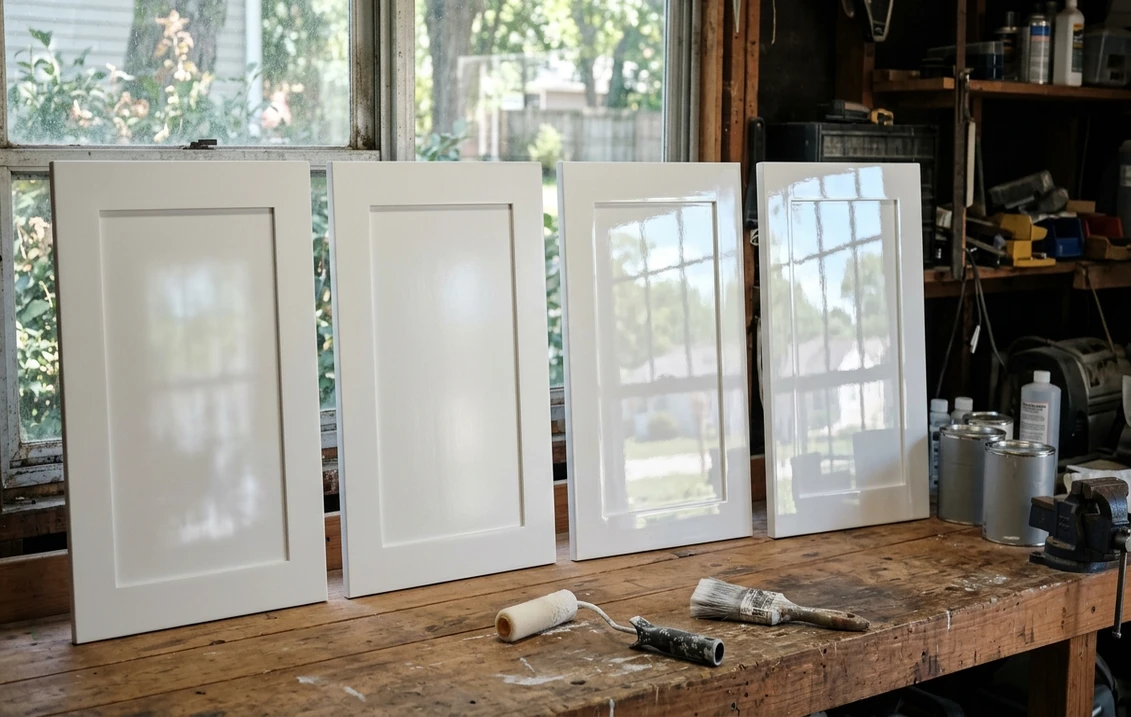
Primers and prep the ProClassic sheets ask for
Each sheet specifies one coat of primer and two coats of ProClassic. The primers named on the Waterborne Acrylic sheets:
| Surface | Primer on the sheet |
|---|---|
| Wood, composition board, drywall | Premium Wall & Wood Primer |
| Wood that bleeds (tannin, knots) | ProBlock Premium All-Purpose Water Based Primer |
| Steel, aluminum, galvanized metal | All Surface Enamel Latex Primer |
| Plaster, masonry block | Loxon Concrete & Masonry Primer |
| Any surface, for hide and color development | The recommended "P-Shade" primer: ask the store |
- Glossy surfaces "should be sanded dull". Old trim enamel and factory cabinet finishes fall under that line. For laminate or previously painted cabinets, the Cabinet Refinishing guide names a bonding primer, covered in our Extreme Bond Primer guide.
- Wash, rinse, dry before anything else, and seal stains from water, smoke, ink or grease "with the appropriate primer-sealer". Our interior primer guide sorts the stain blockers.
- Old paint and lead. Every sheet opens its prep section with a lead warning. In a home built before 1978, follow the EPA's lead-safe practices for do-it-yourselfers before sanding trim.
Dry time, recoat, and what no ProClassic sheet publishes
The times in the first table are given at 77°F and 50% relative humidity, and the sheets add that they depend on temperature, humidity and film thickness. All three versions go on above 50°F, and the sheets say no reduction is needed. In practice the water-based versions allow two coats in a day; the oil version does not.
Three figures are missing from all nine sheets: a full cure time, a block resistance rating (whether a door sticks to its stop) and a scrub or washability count. Our reading: the 4 hour recoat says when the next coat can go on, not when shelves can be loaded. Benjamin Moore's sheet for a comparable enamel, quoted further down, makes the gap explicit: up to 30 days to reach optimum hardness. Dry, recoat and cure are separated in our interior paint drying time guide.
How much is a gallon of ProClassic?
The product pages show no price unless you sign in. The figures below are the "List Price" ranges displayed per gallon on Sherwin-Williams' interior paint catalog page on November 15, 2026. The page does not say which sheen or base sits at each end of a range; stores set their own prices, and quart prices were not shown.
| Enamel | List price per gallon, Nov 15, 2026 | Paint per sq ft, one coat (our calculation) |
|---|---|---|
| ProClassic Alkyd Interior Enamel | $106.49 to $108.49 | 27 to 31 cents |
| ProClassic Waterborne Interior Acrylic Enamel | $106.99 to $112.99 | 27 to 32 cents |
| ProClassic Interior Waterbased Acrylic-Alkyd | $120.49 to $121.49 | 30 to 35 cents |
| Emerald Urethane Trim Enamel | $130.49 to $132.49 | 33 to 38 cents |
The cost per square foot divides the low price by 400 sq ft and the high price by 350. Three examples at two coats (our calculations; flat areas, panel profiles and edges not counted):
| Job | Area per coat | Two coats at 350 to 400 sq ft per gallon |
|---|---|---|
| One room: a 30 by 80 inch door (both faces), its 2.25 inch casings, 50 ft of 5.25 inch baseboard | About 61 sq ft | 0.31 to 0.35 gallon: 2 quarts |
| One floor: 10 doors, their casings, 300 ft of baseboard | About 525 sq ft | 2.6 to 3.0 gallons: 3 gallons |
| Medium kitchen: 20 doors, 8 drawer fronts (both faces), face frames, 2 end panels | About 177 sq ft | 0.89 to 1.01 gallons: 1 gallon and 1 quart |
For the whole floor of trim, three gallons of Waterborne Acrylic come to $321 to $339 at list price before tax (our calculation). Measure your own trim with our interior paint coverage calculator guide; labor and whole-home budgets are in our interior house painting cost guide.
Is ProClassic better than Emerald Urethane Trim Enamel?
Semi-gloss against semi-gloss, from the ProClassic sheets above and the Emerald Urethane Trim Enamel Semi-Gloss sheet (dated 03/2026). A comparison of sheets, not of painted doors.
| Spec | ProClassic Waterborne Acrylic | ProClassic Acrylic-Alkyd | Emerald Urethane Trim Enamel |
|---|---|---|---|
| Resin | Styrene acrylic | Acrylic-alkyd hybrid | Urethane modified alkyd, waterbased |
| Dry film, volume solids | 1.2 mils, 30% | 1.4 mils, 34% | 1.3 mils, 33% |
| Touch / recoat | 1 h / 4 h | 1 to 2 h / 4 h | 1 h / 4 h |
| Semi-gloss at 60° | 35 to 45 units | 45 to 55 units | 60 to 70 units (55 to 65 in deep bases and black) |
| Exterior doors and trim | No, interior only | Small areas | Small areas (interior-exterior product) |
| Bases | Two whites, Deep Base | Extra White, Deep Base | Two whites, Deep, Ultradeep, Black |
On the figures the sheets share, nothing separates them: the same 350 to 400 sq ft per gallon, the same 4 hour recoat, the same VOC ceiling of under 50 g/L. What Emerald Urethane adds on paper is a urethane modified alkyd resin, ultradeep and black bases, an exterior rating for doors and trim, and the top rank in Sherwin-Williams' own cabinet guide. What ProClassic offers in return: $9 to $12 less per gallon for the hybrid and $17.50 to $25.50 less for the Waterborne Acrylic at list price (our calculation), a true High Gloss, and a much flatter satin.
That last point matters when you order. The Emerald Urethane Satin sheet gives 35 to 45 gloss units, the range of ProClassic Waterborne Semi-Gloss, while ProClassic Waterborne Satin sits at 10 to 20. Since no sheet publishes cure, block or scrub figures, the sheets alone cannot say which enamel wears better; the only published evidence is the brand's 2019 scratch photos, which favor Emerald.
And Benjamin Moore Advance? The Advance Semi-Gloss data sheet describes a waterborne alkyd at 400 to 500 sq ft per gallon, 4 to 6 hours to touch, 16 hours to recoat, 43.2 g/L and 50 to 60 gloss units. Against the ProClassic hybrid, the difference on paper is the schedule: 4 hours between coats instead of 16. Details in our Benjamin Moore Advance cabinet paint review.
Which ProClassic should you buy?
- White or colored trim and doors, two coats in a day, lowest price: Waterborne Acrylic. Semi-Gloss has the widest choice of bases; Satin is the flattest ProClassic, at 10 to 20 units.
- A glossy white door or built-in: Waterborne Acrylic Gloss or High Gloss, whites and light tints only, over the careful priming the High Gloss sheet demands.
- Kitchen cabinets and the busiest doors: the Acrylic-Alkyd, or a step up to Emerald Urethane, following the brand's own ranking.
- A black or very dark door: ProClassic has no ultradeep or black base on its sheets; Emerald Urethane does. Colors in our interior door colors guide and our black interior doors before and after.
- Oil-based Alkyd: only if your store sells it and you accept 24 hours between coats, solvent cleanup and up to 458 g/L of VOC.
The enamel is the last decision. The first is the color, and how it sits next to your walls, floor and counters. Our kitchen cabinet colors guide lists the options for cabinets.
See the trim, door or cabinet color before you buy the enamel
Upload one photo of your room, pick a color and compare finalists side by side in about 30 seconds.
Preview my room in a new colorSources and references
- Sherwin-Williams, ProClassic Waterborne Interior Acrylic Enamel: product page; sheets 101.16A, 101.36B, 101.41A, 101.43.
- Sherwin-Williams, ProClassic Interior Waterbased Acrylic-Alkyd: product page; sheets 103.25A, 103.35A; warranty; trade article.
- Sherwin-Williams, ProClassic Alkyd Interior Enamel: product page, B34W01151 page; sheets 103.24, 103.30, 103.38.
- Sherwin-Williams, ProClassic Interior Enamels sell sheet (2020) and Cabinet Refinishing: A Complete Guide (2019).
- Sherwin-Williams, Emerald Urethane Trim Enamel sheets Satin and Semi-Gloss; kitchen cabinet how-to; interior paint catalog page (list prices, November 15, 2026).
- Benjamin Moore, Advance Waterborne Interior Alkyd Semi-Gloss 793, technical data sheet.
- South Coast AQMD, Rule 1113 table of standards.
- U.S. EPA, Lead-Safe Renovations for DIYers and Volatile Organic Compounds' Impact on Indoor Air Quality.
Frequently asked questions
What is Sherwin-Williams ProClassic used for?
Is ProClassic oil based or water based?
Is ProClassic good for kitchen cabinets?
How much is a gallon of ProClassic?
Is ProClassic better than Emerald Urethane Trim Enamel?
How long does ProClassic take to dry between coats?
Do you need a primer under ProClassic?
Trademarks mentioned (Sherwin-Williams, Benjamin Moore, Behr, Caparol, Brillux, Sto, Alpina, Valspar, PPG, Glidden, Dulux, Crown Trade, Sandtex, Farrow & Ball, Johnstone's, Leyland) are property of their respective owners. FacadeColorizer is independent and not affiliated with any of them. Nominative fair use under Lanham Act §1125.