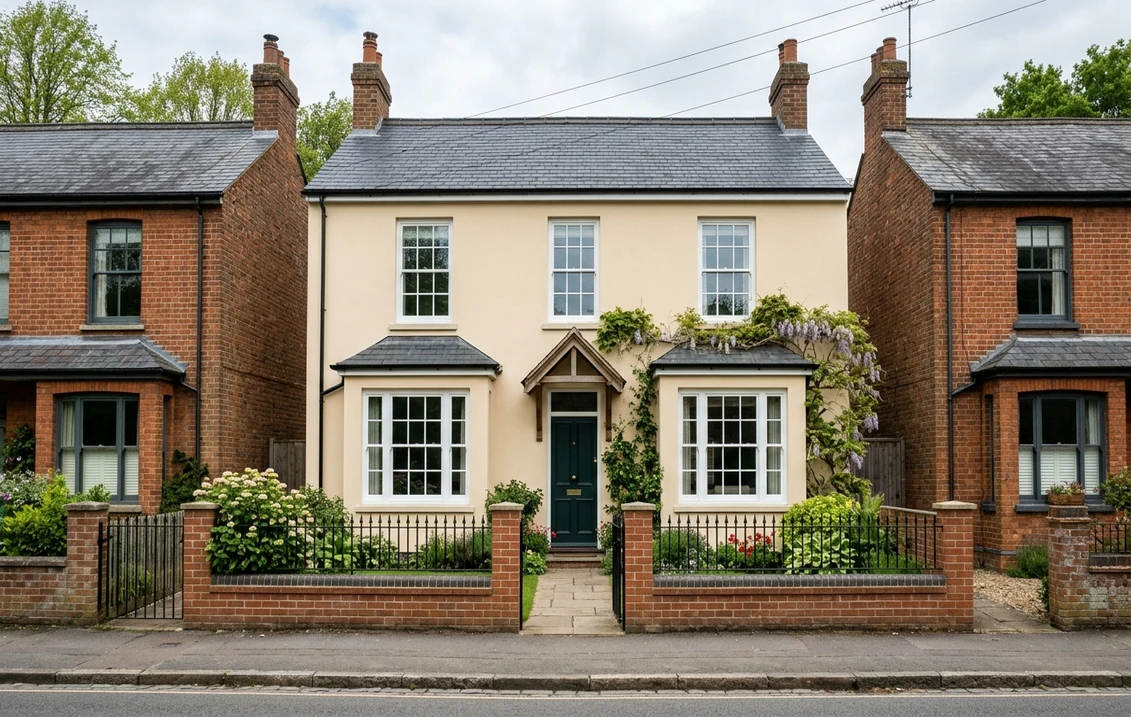
Try it on your house

Dulux Classic Cream is a pale cream that Dulux files in its White colour family and shows on screen as #F5E8D2. It is one of the 19 Weathershield masonry colours, and on 9 November 2026 Dulux listed it in two masonry paints, both smooth: Weathershield All Weather Protection Smooth (5 litre tin, selected stores) and the mixed-in-store Weathershield Smooth Masonry at £53 for 5 litres. No textured masonry paint was listed in Classic Cream, and the colour is not on the Dulux Trade masonry colour guide. By our calculation from Dulux's screen values it is almost a twin of Magnolia and much less yellow than Cornish Cream. In England, repainting a house is normally permitted development, unless an Article 4 direction or listed status applies.
Facts were read on 9 November 2026 on the Dulux and Dulux Trade sites, in planning law and guidance and in two council colour guides. Dulux publishes no light reflectance value (LRV) for Classic Cream, so we quote none; figures built from screen hex values are our own calculation.
See Classic Cream on your own walls first
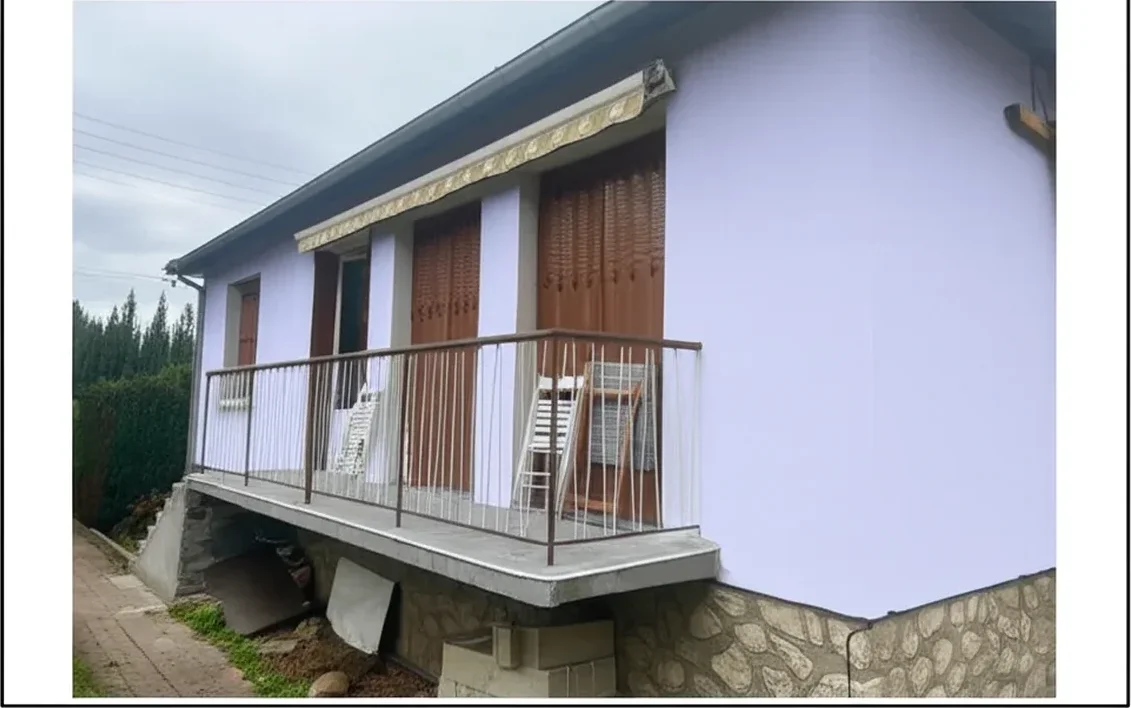
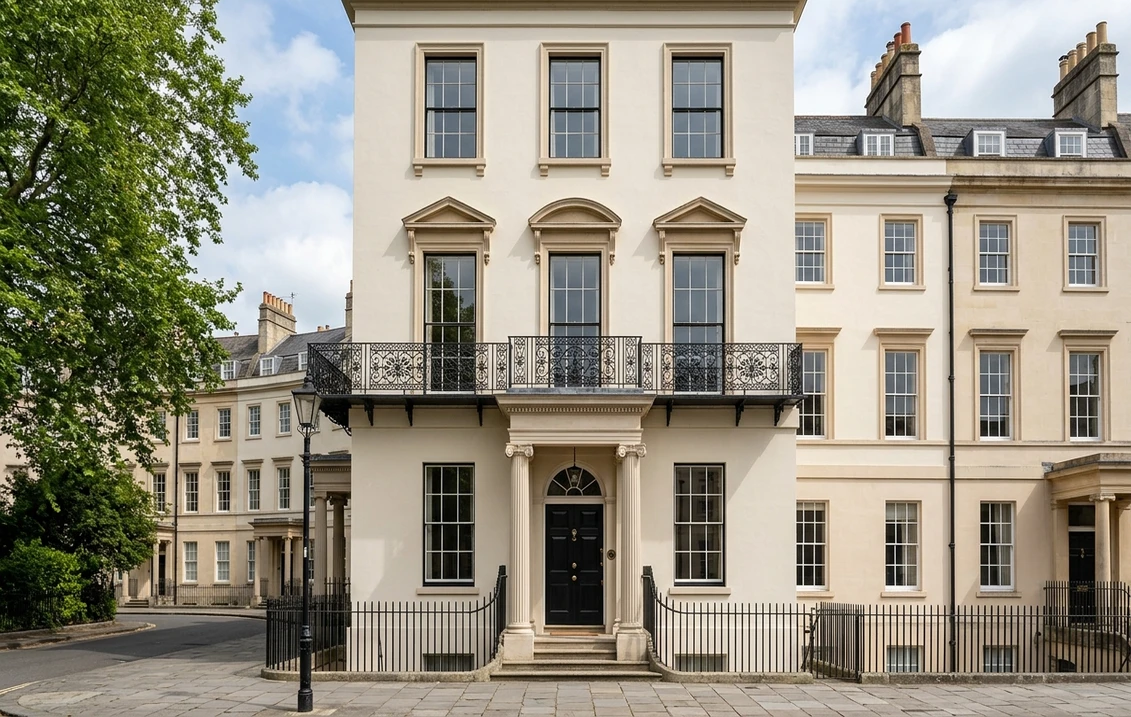
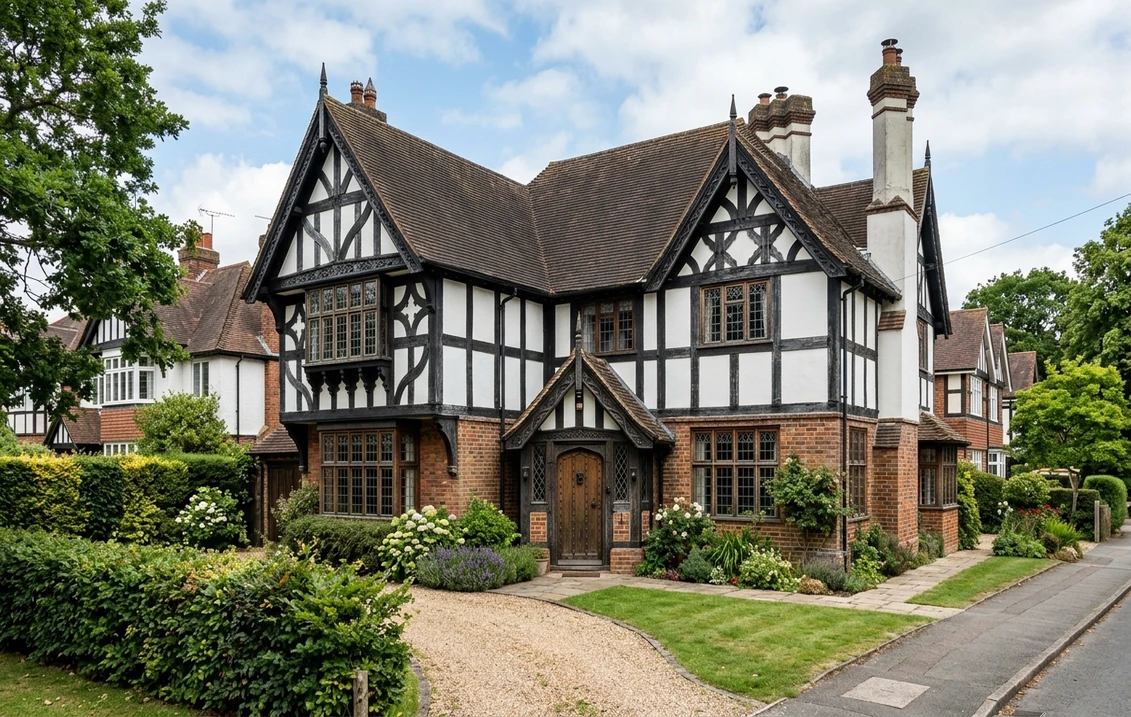
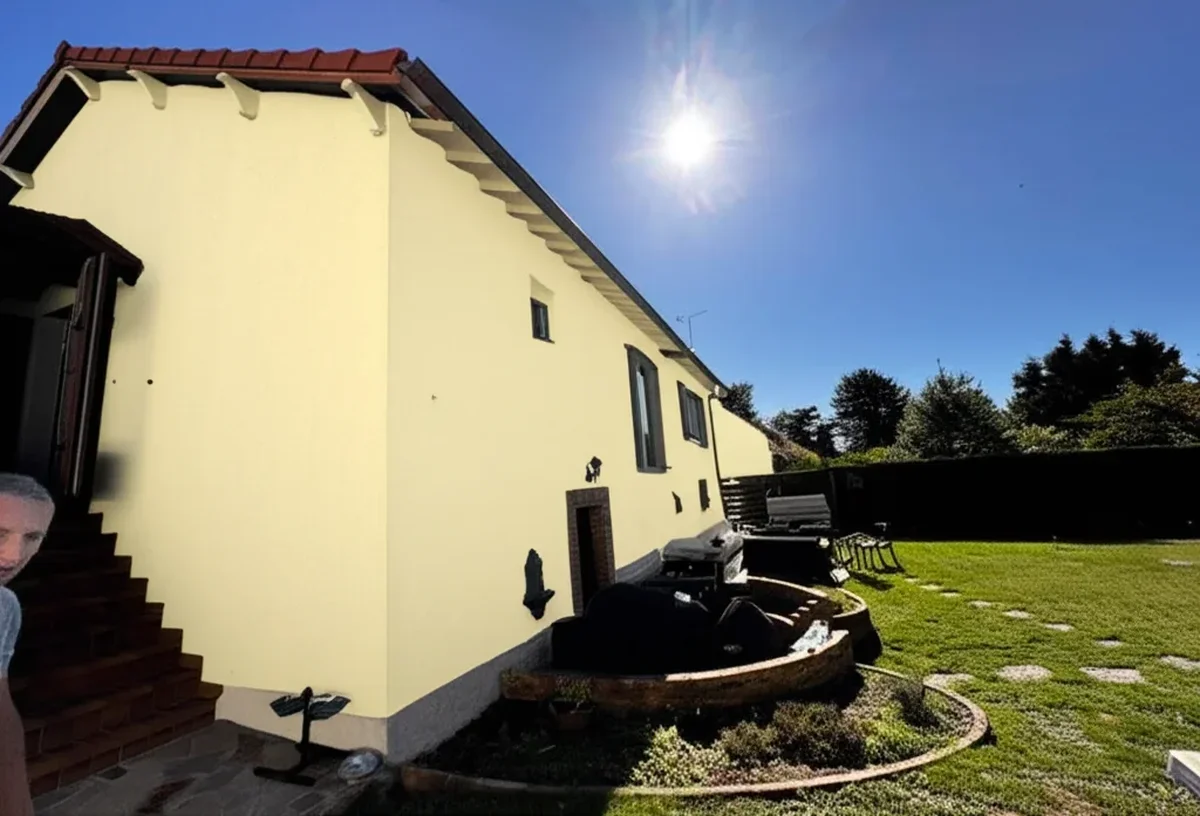
Classic Cream and Magnolia look alike on a chart, and a whole elevation exaggerates any warmth. Upload a photo of your house and compare the creams before you buy a 5 litre tin.
Try Classic Cream on my houseWhat colour is Dulux Classic Cream?
The Classic Cream colour page says little: the page title puts it in the White family, a tester costs £2.90, the swatch is rendered as #F5E8D2, and there is no LRV. The family label is a weak guide: Dulux also files Cornish Cream under White, while Magnolia sits in Orange and Gardenia in Yellow.
So we converted Dulux's screen hex values into CIELAB and measured the CIEDE2000 colour difference (ΔE) from Classic Cream. Roughly, a ΔE near 1 is hard to see side by side and above 3 most people notice it. The b* column measures yellowness.
| Dulux colour | Screen hex (Dulux) | Dulux family | Yellowness b* (our calculation) | ΔE from Classic Cream (our calculation) | Dulux Trade masonry list |
|---|---|---|---|---|---|
| Classic Cream | #F5E8D2 | White | 12.3 | 0 | No |
| Magnolia | #F4E7D4 | Orange | 10.8 | 1.2 | Yes |
| Gardenia | #F1E8D4 | Yellow | 10.8 | 1.7 | Yes |
| Buttermilk | #F0DFBC | Yellow | 19.3 | 4.6 | Yes |
| Cornish Cream | #F4E6C0 | White | 20.3 | 5.2 | No |
| County Cream | #E8CDA5 | Orange | 23.4 | 8.6 | Yes |
| Jasmine White | #F2EFE5 | Orange | 5.2 | 5.7 | Yes |
| Timeless | #F0EDE4 | Warm Neutral | 4.7 | 5.8 | Yes |
| Pure Brilliant White | #EDECE7 | White | 2.5 | 7.6 | No |
Try it on your house
No photo? Try a sample
Two readings stand out. Classic Cream and Magnolia are near neighbours (ΔE 1.2): Classic Cream carries slightly more yellow (b* 12.3 against 10.8) and slightly less red (a* 0.8 against 1.3), so beside Magnolia it should look a shade more buttery and less peachy. Cornish Cream is a different colour, not a variant: about two thirds more yellowness, and closer to Buttermilk (ΔE 2.2). Screens shift creams easily, so decide from a painted tester outdoors.
Is Dulux Timeless white or cream?
Dulux calls it neither: its colour page files Timeless in the Warm Neutral family. On screen it is #F0EDE4, with a yellowness of 4.7 by our calculation, right next to Jasmine White (ΔE 0.6) and close to Pure Brilliant White (ΔE 1.9), but 5.8 away from Classic Cream. On a wall, Timeless reads as a soft warm white. Outside, it is on the Dulux Trade masonry list and in the consumer mixed-in-store masonry paint, but not among the 19 consumer Weathershield colours. Choosing between Timeless and Classic Cream means choosing between a white house and a cream one; our Dulux Jasmine White masonry paint guide covers the white side of that choice.
Which Weathershield masonry paints come in Classic Cream?
The Weathershield colour guide lists 19 masonry colours, and Classic Cream sits there with the other creams and off-whites: County Cream, Cornish Cream, Buttermilk, Magnolia, Gardenia and Jasmine White. The list of Dulux products in Classic Cream held 14 products on 9 November 2026. Two of them are masonry paints, both smooth:
| Product | Size and price read | Coverage | Drying | Application limit | Durability claim |
|---|---|---|---|---|---|
| Weathershield All Weather Protection Smooth | 5 L; no usable online price | Up to 15 m²/L | 4 hours, and between coats; 2 coats | Dry, above 10°C, no bad weather forecast | 15 years' protection |
| Paint Mixing Weathershield Smooth Masonry | 5 L at £53.00 | About 15 m²/L on smooth render | 2 to 4 hours; 2 coats | None printed | 15 years guaranteed |
Selected stores, 5 litre tins. Both pages say the paint is not for online sale and can only be bought from selected stores, and both showed Classic Cream in a 5 litre tin only, not 10 litres. Stock varies by branch, so ring first. For several tins, the All Weather Protection page advises mixing the cans together in a larger container, or finishing at a corner before opening a new can.
No textured version. The textured All Weather Protection page offered one colour, Pure Brilliant White (up to 9 m²/L, £33 for 5 litres), although the Weathershield FAQs still speak of six textured shades. Magnolia also has a masonry option that Classic Cream lacks, Weathershield Ultimate Protection Smooth. Our smooth masonry paint guide explains the two finishes, and the Dulux Weathershield colours guide covers the range.
If your decorator buys Dulux Trade. The Dulux Trade masonry colour guide also shows 19 colours, without Classic Cream or Cornish Cream; Magnolia, Gardenia, Buttermilk, County Cream, Ivory and Timeless are on it. Dulux Trade Weathershield Smooth claims up to 16 m²/L and 15 years (BBA approved), and must not be applied below 7°C, in rain or fog, or above 80% relative humidity. By our calculation, Magnolia (ΔE 1.2) and Gardenia (ΔE 1.7) are the nearest trade names to Classic Cream; test both before agreeing a swap.
What type of paint is it, and what can it go on?
A water-based paint that the FAQs describe as micro-porous and breathable. Dulux lists brick, masonry, render, concrete and pebbledash as suitable, but not common or Fletton bricks, and it would not recommend Weathershield on lime render, pointing to a mineral silicate paint instead; on a solid-walled older house, read our comparison of limewash and masonry paint on solid walls first. Preparation, per the mixed-in-store page: remove flaking paint, treat mould, lichen, algae or moss, fill cracks, seal a still powdery surface with Weathershield Stabilising Primer (never a sound, new or bare one), and thin the first coat on bare masonry with up to 1 part water to 5 parts paint. Our masonry primer guide explains when a primer is worth it.
Classic Cream, Magnolia or Cornish Cream outside?
All three are on the consumer Weathershield masonry list, so the choice is about how much yellow you want from the pavement. Our view:
- Magnolia is the easiest to buy: three Dulux masonry paints, the Dulux Trade list, ready-mixed emulsions. It reads as a pale, slightly peachy cream. Council guides also use the name, as British Standard 08 B 15 Magnolia; we have found no official statement that the BS and Dulux colours match.
- Classic Cream is Magnolia's near-twin with a touch more yellow. Choose it if Magnolia looks slightly pink against your red brick plinth or clay tiles.
- Cornish Cream is clearly yellower and reads as butter rather than cream on a whole elevation. Our Cornish Cream paint guide looks at that shade across several brands.
For something deeper, the stone shades take over: our stone masonry paint colours guide compares them across Dulux, Sandtex and others, and the best exterior paint colours for UK homes sets cream against the rest of the palette.
What colours go with Classic Cream?
Dulux's colour page suggests Frosted Dawn as the white, Morning Oats and Calming Meadow as neutrals, Celtic Cream and Citrus Zing as tonal colours, Boutique Cream and Evening Barley as harmonising colours, and Lilac Fancy and Heather Climb as a designer's choice. Those pairings are built for rooms; only Celtic Cream appears in the Weathershield exterior wood and metal list. Outside, the partners that matter are the door, the window frames and the rainwater goods.
Front doors. The Weathershield guide lists 19 exterior wood and metal colours in satin and gloss. To show how strongly each stands out against Classic Cream, we computed the luminance contrast ratio of the screen values with the W3C contrast ratio formula, which runs from 1:1 (none) to 21:1 (black on white).
| Weathershield door colour | Screen hex (Dulux) | Contrast with Classic Cream (our calculation) |
|---|---|---|
| Rich Black | #2C2B2B | 11.7:1 |
| Heathland (green) | #263B37 | 9.8:1 |
| Hazelnut Truffle (brown) | #583229 | 9.1:1 |
| Oxford Blue (Weathershield) | #154367 | 8.5:1 |
| Monarch (red) | #833532 | 6.9:1 |
| Indigo Shade (blue) | #315368 | 6.8:1 |
| Buckingham (green) | #30673F | 5.5:1 |
| Gallant Grey | #686D70 | 4.3:1 |
| Teal Voyage | #5A8487 | 3.4:1 |
Our reading: above about 8:1 the door reads as a dark block from across the street, the traditional look on a cream Victorian or Edwardian front. Between 5:1 and 7:1 it still stands out but carries more colour than weight. Below 4:1 door and wall begin to blend, which can suit a modern rendered house and look washed out on a period one. For more shades, see our guides to green front doors, blue front doors and red front doors.
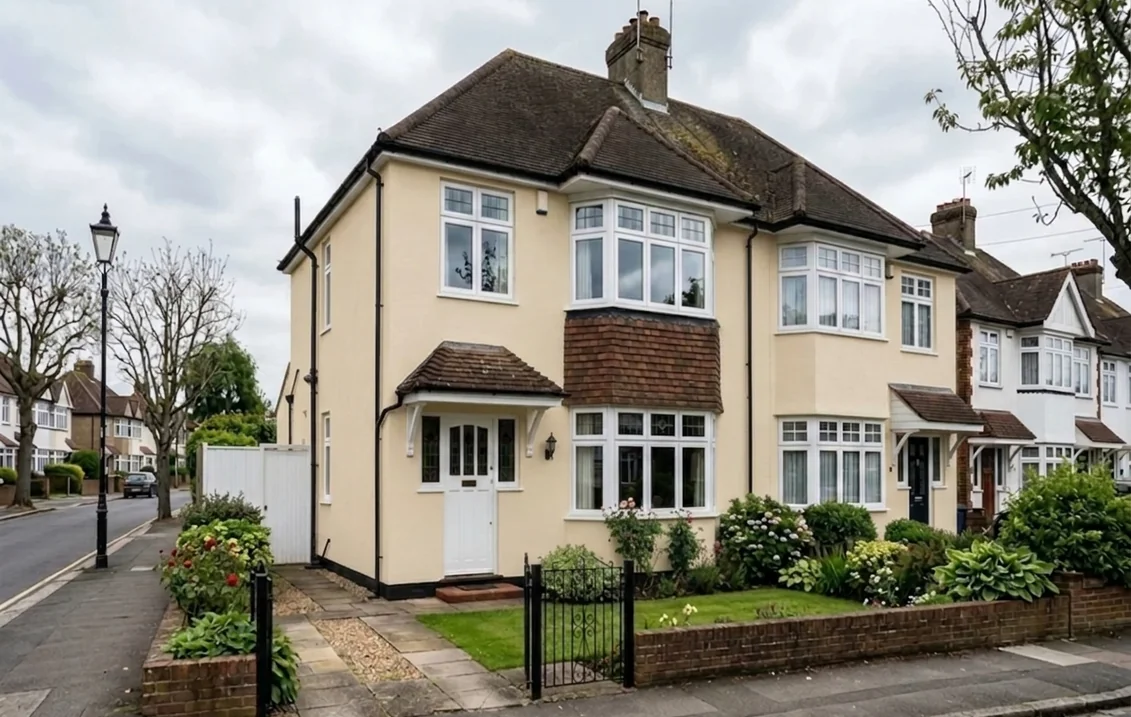
Windows. Pure Brilliant White sits 7.6 from Classic Cream by our ΔE calculation, so white uPVC frames will read clearly whiter than the walls: the crisp edge usual on a 1930s semi. For a softer edge, Almond White (#EFE7DA, ΔE 3.5) is in the Weathershield wood and metal list and in Weathershield Multisurface Quick Dry Satin, which Dulux presents as suitable for uPVC without a primer. Chesterfield's town centre colour guide asks for windows outside the shop fronts, and those above the ground floor, to take a softer colour that follows the brick or render rather than contrasting with it. Our guide to repainting window frames covers the paint systems.
Roof and rainwater goods. With its trace of red and clear yellow cast, Classic Cream in our view sits comfortably with red-brown clay tiles and a red brick plinth, and looks warmer under grey slate. The Chesterfield guide advises against painting gutters and downpipes the wall colour, suggesting restrained dark colours such as BS 14 C 40 Moss Green, 08 B 29 Bitter Chocolate or 00 E 53 Black.
Classic Cream on terraces and semis
On a pair of semis or a terrace, your wall is always seen next to your neighbour's. Our practical advice:
- Stop on a line: end the cream at a clear vertical break, usually a downpipe or the party line in the render. A ragged join is what makes a half-painted pair look unfinished.
- Look at the other half: beside unpainted red brick, Classic Cream makes a strong contrast; beside a white neighbour it can look slightly dirty. Hold a painted card against both houses, and show your neighbour.
- Leave the details alone: tile hanging, brick plinths and stone sills were not meant to share one colour with the render.
- Pebbledash takes more paint: Dulux's coverage figures are for smooth surfaces. Our pebbledash paint colour ideas show how creams behave there.
If your house is Edwardian, our Edwardian house exterior colours guide covers the joinery colours of the period, and the render colour ideas page widens the shortlist beyond Dulux.
Do you need permission to paint a house Classic Cream?
In England, usually not (Wales, Scotland and Northern Ireland have their own systems).
- An ordinary house. Class C of the GPDO 2015 makes painting the exterior of any building permitted development and defines painting as any application of colour. The Planning Portal counts painting your house as a minor improvement needing no application.
- An Article 4 direction. Government planning practice guidance explains that a council can withdraw permitted development rights over an area with an article 4 direction, after which the work needs a planning application. West Oxfordshire's Design Guide 19 gives an example: in the Great Tew Conservation Area, paint colours on all buildings are under planning control, and only listed colours escape it. For windows those are creamy whites (BS 08 B 15, 10 B 15, 10 B 31, Magnolia, Gardenia, Buttermilk), and brilliant white should not be used.
- A listed building. The Planning Portal says listed building consent is needed for any significant works, internal or external. Our guides to painting in a conservation area and painting a listed building explain how to approach the council.
Brand names versus BS codes. Councils that control colour speak in British Standard codes. Chesterfield's guide suggests 08 B 15 Magnolia, 10 B 15 Creamy White and 10 C 31 Ivory for existing rendered walls and calls textured coatings generally inappropriate. Classic Cream has no BS code on its colour page and no official BS match that we know of, so take a painted card to the conservation officer rather than arguing from the name.
Rain, algae and what paint cannot fix
Weathershield's rainproof claim is about the paint film, not the wall. Approved Document C says in paragraph 5.22 that the weather-resisting part of a cladding system does not include paint, and its Diagram 12 maps UK exposure to driving rain. Repair cracked render and failed pointing first: a cream coat hides them for a season, it does not cure them. Pale creams also show algae and dirt runs sooner than a stone shade, so check the weather side each spring. The Weathershield Promise in the FAQs returns the value of a replacement product if the paint peels, flakes or grows mould within the film, provided you register and apply it within six months of purchase; it does not pay for labour.
How much Classic Cream masonry paint for a semi?
Worked example, with our own arithmetic: the front and side of a semi, 70 m² of smooth render once windows and doors are deducted, in two coats, is 140 m². At 15 m²/L that is 9.3 litres: two 5 litre tins on paper, three with a sensible margin, or £159 for three tins of the mixed-in-store paint at the price read on 9 November 2026. Dulux says coverage varies with the surface and suggests a small test area first; on pebbledash, measure and add a generous margin. Labour and access usually cost more than the paint: our masonry paint cost guide breaks the bill down.
Timing matters in November: the All Weather Protection page asks for dry weather above 10°C, and the trade product stops at 7°C. Our guide to the minimum temperature for painting outside in the UK shows which months usually meet those limits. Use the winter to choose: a £2.90 tester painted on card and moved around the house settles Classic Cream against Magnolia better than any chart.
A quick way to decide
- A soft cream that still looks fresh: Classic Cream in Weathershield Smooth, white frames, a dark door.
- Your decorator uses Dulux Trade: test Magnolia and Gardenia instead.
- You need a textured finish: not listed in Classic Cream.
- You want a white, not a cream: Timeless or Jasmine White.
- You want an unmistakably yellow cream: Cornish Cream or Buttermilk.
Our paint visualiser includes the Dulux UK colours, so you can put Classic Cream, Magnolia and Cornish Cream on a photo of your own house, then confirm the winner with a tester.
Compare Classic Cream with Magnolia and Cornish Cream
Upload a photo of the front of your house and see the three creams on your own walls, with your own windows and door, before you order testers.
Upload a photo of my houseSources and references
- Dulux, Classic Cream, Magnolia, Cornish Cream and Timeless colour pages: family, screen hex, tester price, pairings.
- Dulux, Weathershield colour guide (19 masonry colours, 19 exterior wood and metal colours, Multisurface range) and products available in Classic Cream, read on 9 November 2026.
- Dulux, Weathershield All Weather Protection Smooth, Paint Mixing Weathershield Smooth Masonry, All Weather Protection Textured and Weathershield FAQs: sizes, prices, coverage, drying, temperatures, surfaces, Weathershield Promise.
- Dulux Trade, Weathershield Smooth Masonry Paint and masonry colour guide: product data and the 19 trade masonry colours.
- W3C, Web Content Accessibility Guidelines 2.2, definition of contrast ratio: the formula behind our door contrast table.
- legislation.gov.uk, GPDO 2015, Schedule 2, Part 2, Class C. Planning Portal, External walls. GOV.UK, When is permission required? (article 4 directions).
- GOV.UK, Approved Document C (2013 edition): paragraph 5.22 on paint and weather resistance, Diagram 12 on driving rain exposure.
- West Oxfordshire District Council, Design Guide 19: Traditional Paint Colours. Chesterfield Borough Council, Town Centre Conservation Area colour scheme guide: BS 4800 colours for render, windows and rainwater goods.
Frequently asked questions
What colour is Dulux Classic Cream?
Is Dulux Classic Cream available in Weathershield masonry paint?
What colours go with Dulux Classic Cream?
Is Dulux Timeless white or cream?
Is Classic Cream the same as Magnolia?
What is the difference between Classic Cream and Cornish Cream?
Do I need planning permission to paint my house Classic Cream?
Trademarks mentioned (Sherwin-Williams, Benjamin Moore, Behr, Caparol, Brillux, Sto, Alpina, Valspar, PPG, Glidden, Dulux, Crown Trade, Sandtex, Farrow & Ball, Johnstone's, Leyland) are property of their respective owners. FacadeColorizer is independent and not affiliated with any of them. Nominative fair use under Lanham Act §1125.