Try it on your room

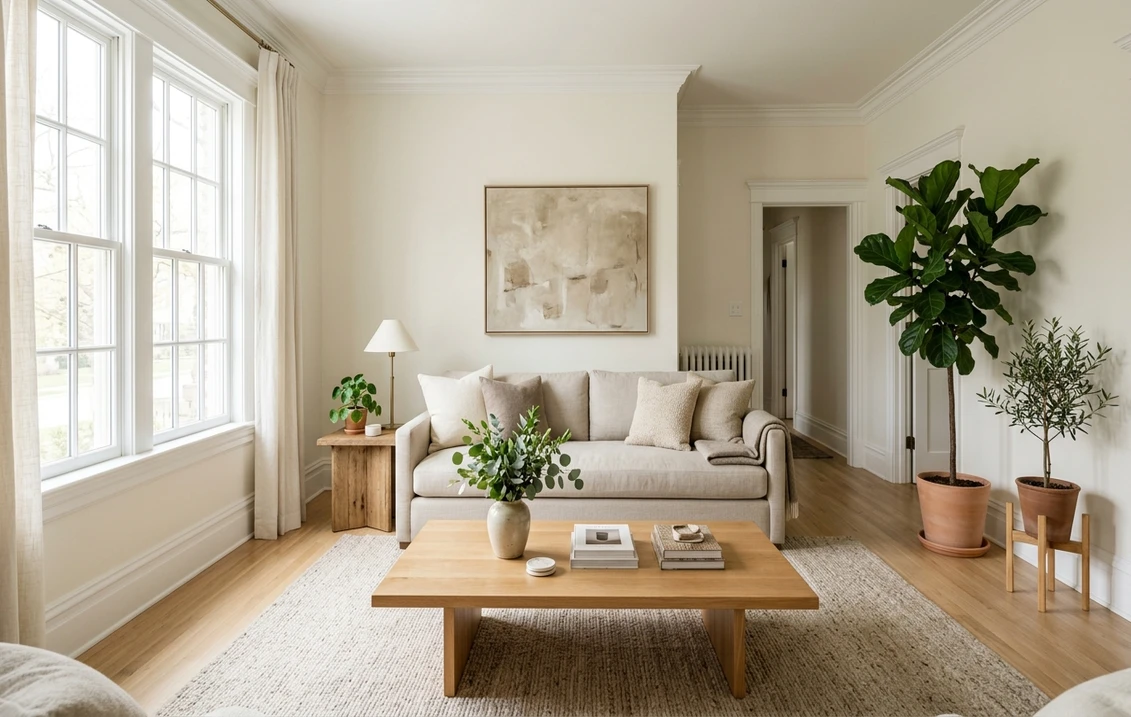
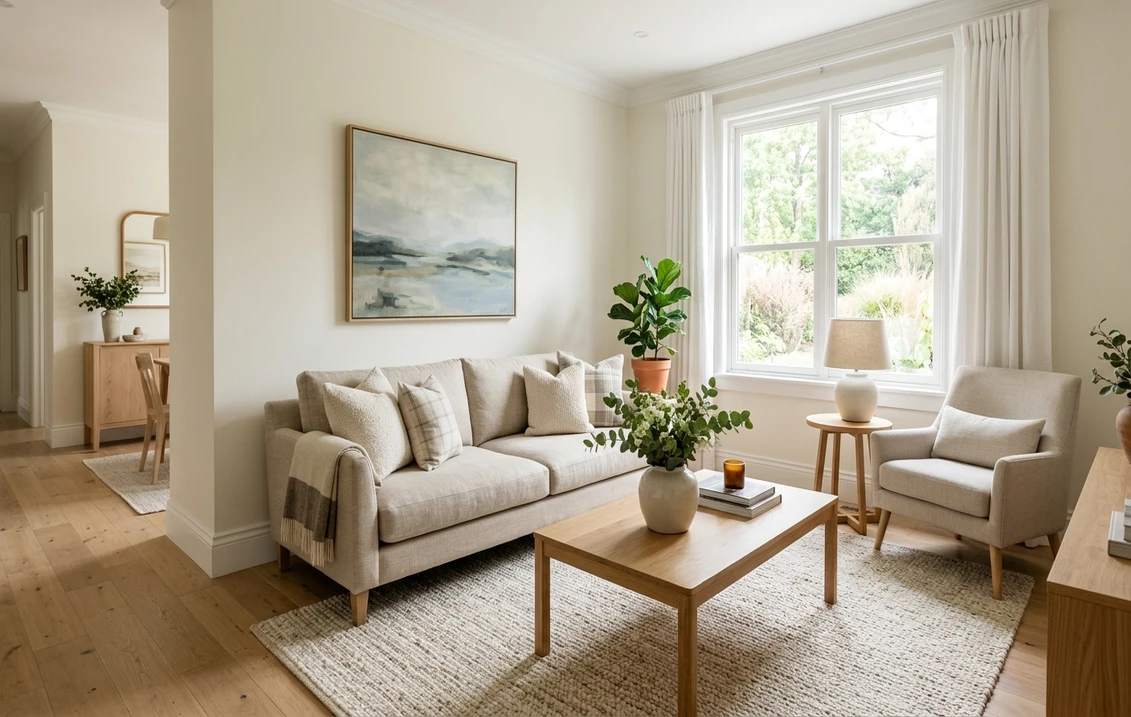
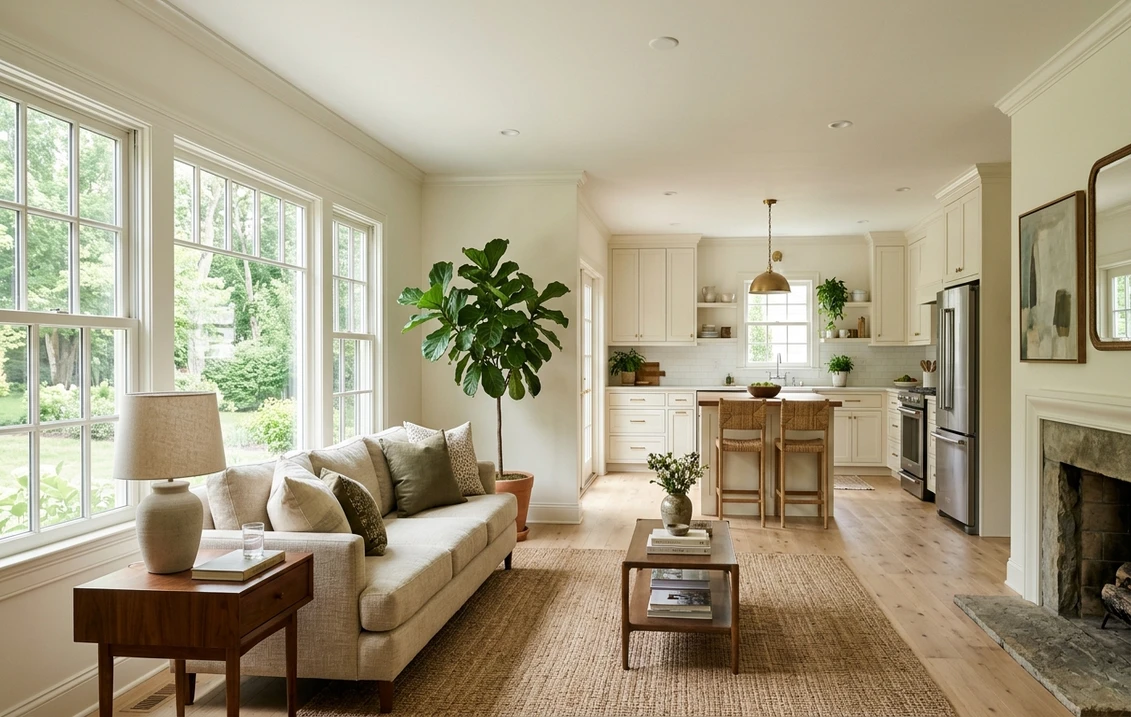
Benjamin Moore Steam AF-15 is a soft off-white with a slight warm cast. Its color page describes "a widely appealing white paint color that offers a clean yet soft look", lists a light reflectance value (LRV) of 84.2 and the hex code F0EFE6 (RGB 240, 239, 230), and files it in the Affinity Color Collection and the White family. A wall in Steam sends back about 84 percent of the light that reaches it, so indoors it reads as white, not cream, with just enough warmth to avoid a stark look. It works on walls, trim, ceilings and kitchen cabinets, and it sits one small step above White Dove OC-17: the same undertone, about one LRV point lighter.
One limit first: the color page names no undertone. The undertone readings in this guide are ours, calculated from the published RGB values, and each one is marked as such. The US color page lists Steam for both interior and exterior use; this guide covers the interior.
Upload a photo of your room and preview Benjamin Moore AF-15 on the walls before you buy a sample.
What Benjamin Moore publishes for Steam AF-15
The Steam color page gives the number AF-15, an LRV of 84.2 and the value tag "Light". Its interior project tags are bathroom, cabinet, ceiling, kitchen, living room and trim. It lists four coordinating colors in two pairs: Metropolitan AF-690 with Pashmina AF-100, and Morning Dew OC-140 with Harbor Town 493. Its similar colors are Cloud White 967 and Icicle 2142-70. For the wider set of Benjamin Moore interior colors we cover, start with the Benjamin Moore interior paint colors guide.
| Figure | Value for Steam AF-15 | Source |
|---|---|---|
| LRV | 84.2 (value tag: Light) | Color page |
| Hex / RGB | F0EFE6 / 240, 239, 230 | Color page data |
| Collection / family | Affinity Color Collection / White | Color page |
| Use | Interior and exterior | Color page tags |
| Coordinating colors | Metropolitan AF-690, Pashmina AF-100, Morning Dew OC-140, Harbor Town 493 | Color page |
| Undertone | Not printed | Our reading, see below |
Try it on your room
No photo? Try a sample
How bright is 84.2? The Wikipedia entry on light reflectance value describes LRV as a measure of the visible light a surface reflects, from 0 (no reflected light) to 1 (complete reflection). Benjamin Moore prints it on a 0 to 100 basis. Its brightest popular whites sit near 90 (Chantilly Lace OC-65 at 90.04, Simply White OC-117 at 89.52), so Steam is about six points below them, in the middle of the off-white group.
What "Affinity" means. Benjamin Moore's page about the collection says it offers 144 colors formulated to harmonize, and that whichever Affinity color you choose, any other Affinity color will work well with it. That is the manufacturer's claim; two of Steam's four coordinating colors, Metropolitan and Pashmina, come from the same collection.
Steam's undertone: warm or cool?
Because Benjamin Moore prints no undertone for Steam, the RGB values are the best clue. Red is 240, green 239 and blue 230. Red and green are almost equal and both sit about 10 points above blue. Equal red and green with less blue is yellow, so Steam is a white with a very small amount of yellow in it: a hue of about 54 degrees by our calculation, where 60 is pure yellow and 30 is orange.
Warm, but barely. The saturation is about 0.04 on a 0 to 1 scale (our calculation). That is why the color page can call Steam "clean yet soft": too little yellow to read as cream, enough that it does not look icy next to wood or warm bulbs. Steam is a warm white, on the restrained end of warm.
No pink, a faint gray softness. Because red and green are level, Steam has no pink or peach lean. The softness in Steam comes from its depth: every channel is 15 to 25 points below pure white (255), which reads as a touch of gray.
Steam vs White Dove: what is the difference?
This is the comparison most people ask about, and the published numbers give a clear answer. White Dove OC-17 is listed at LRV 83.16 with the hex code EFEEE5 (RGB 239, 238, 229). Steam is 240, 239, 230. Each channel differs by exactly one point, and the spacing between the channels is identical, so by our calculation the two have the same hue (about 54 degrees) and the same saturation (about 0.04). The one measurable difference is depth: Steam reflects 1.04 points more light.
In practice, Steam should read as White Dove with a little less weight; White Dove's own color page lists Steam among its similar colors, along with Swiss Coffee, Glacier White and Cloud White. Three things separate them when you choose:
- Depth. In a dim room or a north-facing hallway, the extra point of reflectance is a small argument for Steam.
- Collection. White Dove belongs to the Off White Collection, Steam to Affinity. If the rest of your palette is Affinity colors, Steam is the white Benjamin Moore built to sit with them.
- Do not mix them on one surface. Steam walls with White Dove trim (or the reverse) gives a one-point difference that looks like a touch-up mistake, not a contrast. Use one of them for both, in two sheens.
Our White Dove OC-17 review covers that color room by room, and the White Dove vs Cloud White comparison covers the next white up the scale.
Steam next to other Benjamin Moore whites
LRV, hex and collection come from each color's page; hue and saturation are our calculations from the published RGB values. The list runs from brightest to deepest.
| Color | LRV | Hex | Collection | Hue / saturation (our calculation) |
|---|---|---|---|---|
| Chantilly Lace OC-65 | 90.04 | F4F6F1 | Off White | 84 / 0.02 |
| Simply White OC-117 | 89.52 | F6F6ED | Off White | 60 / 0.04 |
| Cloud White 967 (also OC-130) | 85.05 | F2F1E6 | Classics / Off White | 55 / 0.05 |
| Steam AF-15 | 84.2 | F0EFE6 | Affinity | 54 / 0.04 |
| White Dove OC-17 | 83.16 | EFEEE5 | Off White | 54 / 0.04 |
| Icicle 2142-70 | 82.04 | EDEDE3 | Color Preview | 60 / 0.04 |
| Swiss Coffee OC-45 | 81.91 | EEECE1 | Off White | 51 / 0.05 |
Steam vs Cloud White. Cloud White is 0.85 points lighter and slightly more saturated (its blue value is the same 230, with red and green two points higher), so it should read a touch creamier and brighter. Our Cloud White review covers it in detail.
Steam vs Chantilly Lace and Simply White. Both are five to six points brighter. Chantilly Lace has half of Steam's saturation, which makes it the crisp white of the group; the Chantilly Lace review explains where that helps. Simply White is as warm as Steam but much brighter, as the Simply White review shows.
Steam vs Swiss Coffee. Swiss Coffee is 2.29 points deeper and its hue sits closer to orange (about 51 degrees), which is the creamier direction. Benjamin Moore describes it as having "just the right amount of warmth". If Steam looks too plain on your sample board, Swiss Coffee is the next step warmer; the White Dove vs Swiss Coffee comparison covers that step.
Steam vs Sherwin-Williams Alabaster
The Alabaster SW 7008 color page lists an LRV of 82.215 and the hex code EDEAE0 (RGB 237, 234, 224). Against Steam, three things differ:
- Depth. Alabaster is about 2 points deeper (82.215 against 84.2).
- Warmth. Alabaster's red value sits 13 points above its blue, against 10 for Steam, and its saturation is about 0.055 against 0.04 by our calculation.
- Direction. Alabaster's hue is about 46 degrees, closer to orange than Steam's 54. In plain words, Alabaster leans toward cream and beige, Steam toward a quieter yellow-white.
Side by side, we would expect Alabaster to look creamier and Steam cleaner. For the Sherwin-Williams side, read the Alabaster undertones guide and the Alabaster vs White Dove comparison, which applies almost unchanged to Steam.
The closest Sherwin-Williams match to Steam
Neither brand publishes an official equivalent, and no Sherwin-Williams white has Steam's exact values. The two candidates below are the closest we found by comparing the published LRV and RGB figures; "closest" is our calculation, not a manufacturer statement.
| Color | LRV | Hex / RGB | LRV gap to Steam | Hue / saturation (our calculation) |
|---|---|---|---|---|
| BM Steam AF-15 | 84.2 | F0EFE6 / 240, 239, 230 | 0 | 54 / 0.04 |
| SW Pure White SW 7005 | 83.957 | EDECE6 / 237, 236, 230 | -0.24 | 51 / 0.03 |
| SW Greek Villa SW 7551 | 84.223 | F0ECE2 / 240, 236, 226 | +0.02 | 43 / 0.06 |
Pure White SW 7005 is the closest overall. Its color page lists an LRV of 83.957, a quarter of a point below Steam, and the same blue value (230). Its red and green are three points lower, so it has a little less yellow: expect Pure White to read slightly cooler and grayer than Steam.
Greek Villa SW 7551 matches the brightness. Its color page lists an LRV of 84.223, practically the same as Steam, but its hue is about 43 degrees and its saturation is higher, so it is the creamier of the two candidates.
So the honest answer is a choice: Pure White if you want to stay on the clean side of Steam, Greek Villa if you would rather err warm. Either way, compare samples on your own wall. Our Pure White undertones guide and the Benjamin Moore equivalent of Pure White page look at the same question from the Sherwin-Williams side.
How light direction changes Steam
Steam is one of the few whites Benjamin Moore names in its own lighting advice. In the guide to south-facing rooms, a "Pro Tip Spotlight" lists three favorites of its color and design experts, described as neutral hues with versatile undertones and flexibility in a large swath of exposures, including rooms with multiple directions. The off-white on that list is Steam AF-15, next to Kendall Charcoal HC-166 and Hush AF-95.
South-facing rooms. The same guide describes southern light as strong, with a warmer tone, and says a white with a hint of gray or blue will counterbalance the naturally amber cast of southern exposure. Applied to Steam: expect its yellow to show most on a sunny afternoon in a south room. If that is too warm for you, the guide's trim and ceiling pick for south rooms, Chantilly Lace, is the cleaner option (our reading).
North-facing rooms. The guide to north-facing rooms says northern light can be muted and toned down, and suggests countering it with a clean, fresh white that has a hint of yellow. Steam fits that description by its numbers. The guide names White Dove for the trim and ceiling of a north-facing room, and Steam is White Dove's closest neighbor, one point lighter. In a north room, expect Steam to read as a soft, slightly gray white (our reading).
Sample protocol. Benjamin Moore's guide to paint color samples says to brush out at least two coats for the most accurate color, notes that an 8 oz. sample covers about a 2' x 2' area in two coats, suggests a white foam core board you can move around the room, and recommends testing from morning to evening under natural and artificial light. Hold the board against your trim, counters and floor.
Steam on walls, trim and ceilings
Benjamin Moore tags Steam for living rooms, kitchens, bathrooms, trim and ceilings. How to use it on each is our suggestion.
Walls. At LRV 84.2, Steam is a light, quiet backdrop for open plans, hallways and rooms with wood floors. Benjamin Moore's guide to paint finishes suggests matte for living rooms, dining rooms and bedrooms, and eggshell or satin for high-traffic walls.
Trim. Two approaches work. The first is Steam on walls and trim together, with the sheen doing the work: matte walls and semi-gloss trim in one color read as two close whites, and you never have to match two off-whites. The finish guide lists pearl, satin and semi-gloss as common choices for trim and doors. The second is Steam trim around a colored wall: with its coordinating colors Metropolitan (LRV 49.96) and Pashmina (44.2), the gap is 34 to 40 points. Our Pashmina AF-100 review covers that wall color.
Ceilings. Benjamin Moore's guide to painting a ceiling says white is the common choice but a ceiling can be almost any color, and that a lighter shade or a slight variation of the wall color adds depth while keeping the scheme unified. It describes Waterborne Ceiling Paint as an ultra flat finish available in all of the brand's 3,500+ colors, which includes Steam. Steam on the ceiling above Steam walls removes the line where two whites meet. Our Waterborne Ceiling Paint review covers the product.
Colors that go with it. The four coordinating colors on Steam's page each have their own page: Morning Dew OC-140 (LRV 69.33), described as "a soothing, cool gray with a touch of green"; Harbor Town 493 (56.47), a grayish green; Metropolitan AF-690 (49.96), "a stylish gray with cool undertones"; and Pashmina AF-100 (44.2), "perfectly balanced between warm and cool". All four are muted, which is why a quiet white suits them better than a bright one (our reading).
For a dark accent, the south-facing guide lists Kendall Charcoal HC-166 on the same expert shortlist as Steam; our Kendall Charcoal review covers it.
Steam on kitchen cabinets
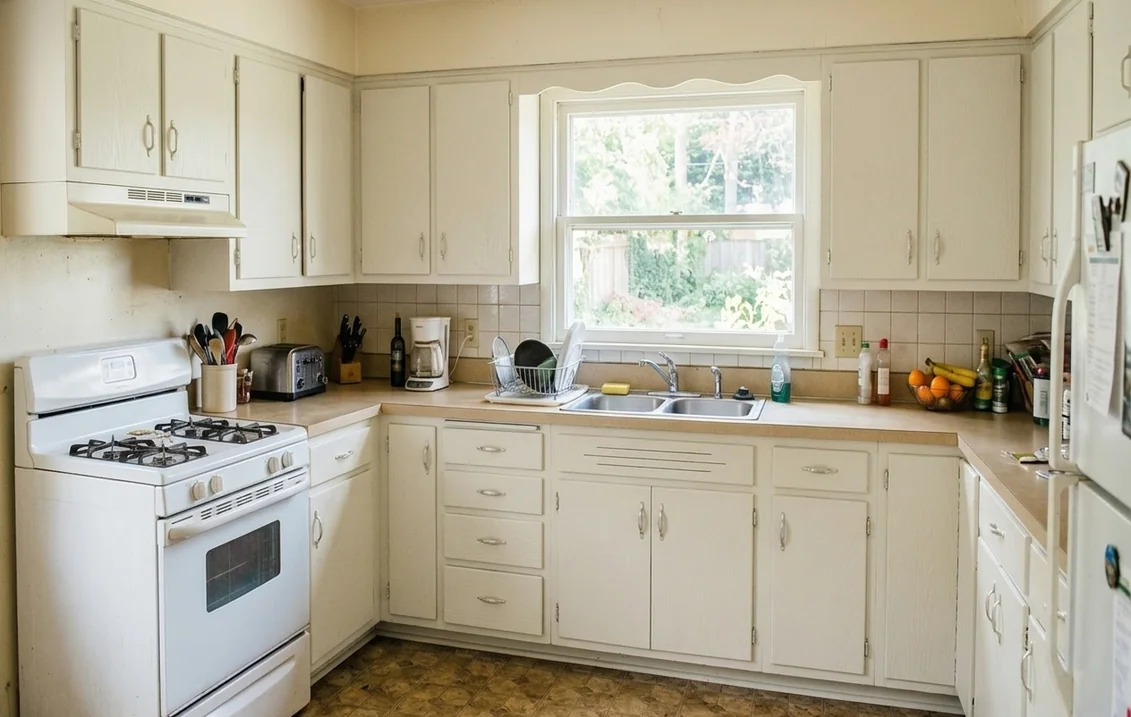
Steam carries the cabinet tag on its color page, and it appears in the grid of whites on Benjamin Moore's white kitchen cabinets page. That page says lighting plays a key role in how paint colors cast: if whites look gray or blue in your kitchen, it recommends warmer off-whites such as White Dove or Simply White, and if a white looks too warm, cooler ones such as Decorator's White or White Heron. Steam sits in the first group, right next to White Dove.
What to check before choosing it. Cabinets are judged against fixed surfaces. Next to a bright, cool white counter or tile, a warm off-white can look slightly yellow by comparison; next to butcher block, brass or cream tile, it looks intentional. Hold a painted sample board against the counter and backsplash (our suggestion).
The product matters more than the color. The white kitchen cabinets page calls a durable, high-end paint a must for cabinets and points to Advance. The Advance Interior Paint product page describes a waterborne alkyd in satin, semi-gloss and high gloss, tagged for doors, trim and cabinets. It lists a recoat time of 16 hours, coverage of 400 to 500 square feet per gallon and an application range of 50 to 90°F, and says it cures to a hard, furniture-quality finish, which is the manufacturer's description. Our Advance cabinet paint review covers the product, and the White Dove kitchen cabinets guide covers prep and pairings that carry over to Steam.
Older homes. Repainting original cabinets, doors or trim means sanding, and the EPA's lead-safe renovation guidance for do-it-yourselfers says a home built before 1978 may have lead-based paint. It recommends testing by a certified lead inspector or risk assessor, containing the work area and cleaning up with a HEPA vacuum.
Is Steam the right white for you?
- Choose Steam if you want a soft white that stays white: warmer than Chantilly Lace, less creamy than Swiss Coffee or Alabaster, and a point lighter than White Dove.
- Look at Chantilly Lace instead if your counters, tile or appliances are a bright, cool white and you want the paint to match them.
- Look at Swiss Coffee or Alabaster instead if you want the wall to read clearly creamy.
- Stay with White Dove if it is already on your trim: the two are too close to combine.
Preview Steam in your own room
One LRV point between two whites is hard to picture from a chip. Upload a photo of your room and the visualizer shows Benjamin Moore AF-15 on the walls or the cabinets, next to your own floor, counters and window light. The interior paint visualizer does the same for every white compared above.
Sources and references
- Benjamin Moore, Steam AF-15 color page (description, LRV, hex and RGB, collection, tags, coordinating and similar colors): benjaminmoore.com
- Benjamin Moore color pages for the compared whites (LRV, hex, collection): White Dove OC-17, Cloud White 967, Icicle 2142-70, Swiss Coffee OC-45, Simply White OC-117, Chantilly Lace OC-65
- Benjamin Moore color pages for the coordinating colors (LRV, hex, description): Metropolitan AF-690, Pashmina AF-100, Morning Dew OC-140, Harbor Town 493
- Benjamin Moore, About the Affinity Color Collection (144 colors formulated to harmonize): benjaminmoore.com
- Benjamin Moore, Best Paint Colors for South-Facing Rooms (Steam AF-15 on the experts' shortlist, warm strong light, Chantilly Lace for trim and ceilings): benjaminmoore.com
- Benjamin Moore, Best Paint Colors for North-Facing Rooms (muted light, a white with a hint of yellow, White Dove for trim and ceiling): benjaminmoore.com
- Benjamin Moore, How to Use Paint Color Samples (two coats, foam core board, natural and artificial light): benjaminmoore.com
- Benjamin Moore, guide to paint finishes (finishes for walls, trim, doors and cabinets): benjaminmoore.com
- Benjamin Moore, How to Paint a Ceiling (ceiling color, Waterborne Ceiling Paint in all colors): benjaminmoore.com
- Benjamin Moore, White Kitchen Cabinets (warm and cool off-whites by lighting, Advance for cabinets): benjaminmoore.com
- Benjamin Moore, Advance Interior Paint, Satin (sheens, recoat time, coverage): benjaminmoore.com
- Sherwin-Williams color pages (LRV, hex, RGB): Alabaster SW 7008, Pure White SW 7005, Greek Villa SW 7551
- U.S. Environmental Protection Agency, Lead-Safe Renovations for DIYers (homes built before 1978, testing, cleanup): epa.gov
- Wikipedia, Light reflectance value (definition of LRV only, secondary support): en.wikipedia.org
Frequently asked questions
What is the LRV of Benjamin Moore Steam AF-15?
What undertone does Benjamin Moore Steam have?
Is Steam AF-15 warm or cool?
What is the difference between Steam and White Dove?
What is the Sherwin-Williams equivalent of Benjamin Moore Steam?
How does Steam compare with Sherwin-Williams Alabaster?
Is Steam a good color for kitchen cabinets?
Can you use Steam on walls, trim and ceilings together?
What colors go with Benjamin Moore Steam?
Trademarks mentioned (Sherwin-Williams, Benjamin Moore, Behr, Caparol, Brillux, Sto, Alpina, Valspar, PPG, Glidden, Dulux, Crown Trade, Sandtex, Farrow & Ball, Johnstone's, Leyland) are property of their respective owners. FacadeColorizer is independent and not affiliated with any of them. Nominative fair use under Lanham Act §1125.