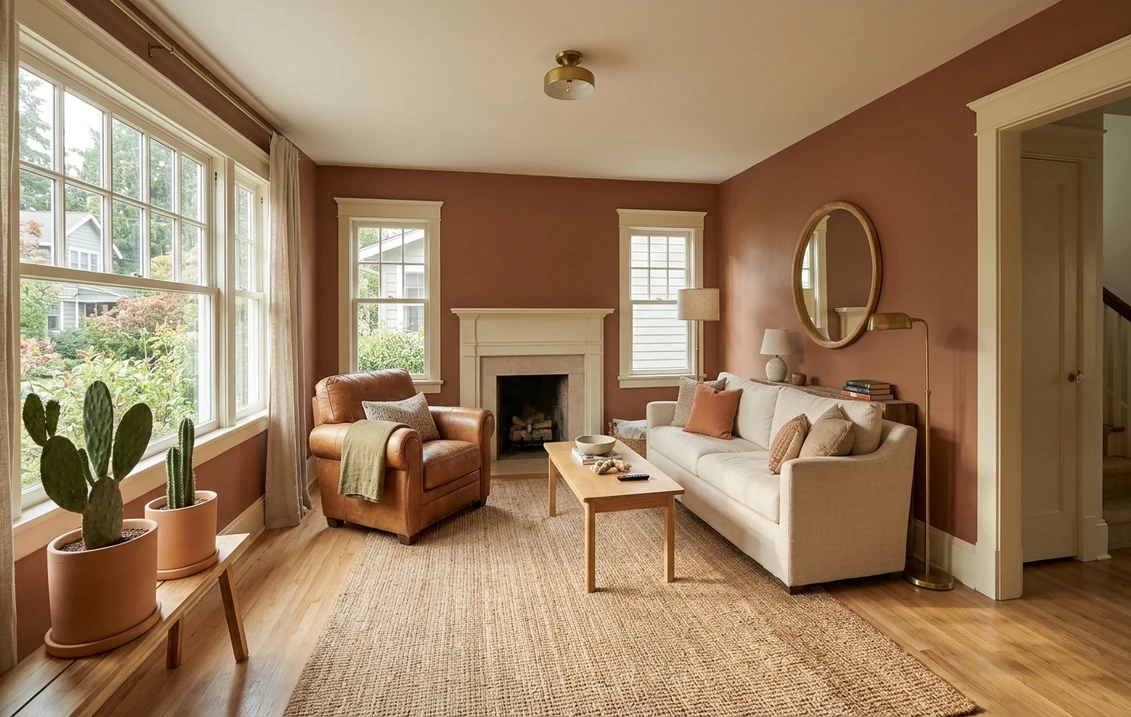
Try it on your room

Sherwin-Williams Cavern Clay SW 7701 is a mid-dark terracotta: a muted red-orange with enough brown in it to read as fired clay and not as a bright orange. Its color page gives an LRV of 19.938 and the hex code AC6B53, which is RGB 172, 107, 83. Sherwin-Williams named it its 2019 Color of the Year, the color is still active for interior and exterior use, and the page lists three coordinating colors: Creamy SW 7012, Ligonier Tan SW 7717 and Slate Violet SW 9155. Indoors, the low LRV makes it a color for a dining room, a well-lit living room or a single accent wall. It will not brighten a dim space.
One limit first: the color page prints no undertone, labels no trim color and says nothing about room orientation. The rooms and pairings that Sherwin-Williams did publish come from its 2019 Color of the Year material. Everything else below is ours, built on the published numbers and on the brand's general guides.
Upload a photo of your room and preview SW 7701 on the walls before you buy a sample.
What Sherwin-Williams publishes for SW 7701
The figures below come from the Cavern Clay color page and from the public color data behind it. For the wider family of interior colors we cover, start with the Sherwin-Williams interior paint colors guide.
| Figure | Value for SW 7701 | Source |
|---|---|---|
| LRV | 19.938 | Color page |
| Hex and RGB | AC6B53 (172, 107, 83) | Color page |
| Usage | Interior and exterior | Color page |
| Color family | Timeless Color; the current website files the page under orange paint colors | Color data, website |
| Strip locator | 290-C6 | Color page data |
| Coordinating colors | Creamy SW 7012, Ligonier Tan SW 7717, Slate Violet SW 9155 | Color page |
| Status | Active, not archived | Color data, November 13, 2026 |
Try it on your room
No photo? Try a sample
Lightness. LRV is the light reflectance value. The Wikipedia entry on light reflectance value describes it as a measure of the visible light a surface reflects, and Sherwin-Williams' orientation guide gives the scale as 0 (reflecting no light) to 100 (reflecting all light). At 19.938, Cavern Clay sends back roughly a fifth of the light that reaches it. That is a clearly dark wall, about 61 points below a white trim such as Creamy. Most articles round it to 20.
Color of the Year 2019: what the title covers
Sherwin-Williams announced Cavern Clay as its 2019 Color of the Year in a press release dated September 12, 2018. The release calls it "a warm terracotta color with ancient, elemental roots" and ties it to a look it names desert modern: midcentury modern lines with the warmth of the American Southwest. It was the ninth official Color of the Year, drawn from the Wanderer palette of the 2019 Colormix Color Forecast.
The company's Color of the Year 2019 page is still online and is the only place where Sherwin-Williams names rooms for this color. It suggests a dining room or a kitchen, with bright tiles, warm stone and sculptural greenery, across a whole room or as an accent. For pairings it names warm grays and deep browns in general, then five colors that appear in the pairing table further down.
A Color of the Year title is a trend statement, not a technical rating. What matters in 2026 is that SW 7701 is still in the active range. The pick that followed it for 2020 was Naval SW 6244; our Naval undertones guide covers that one.
Red, orange or brown? Reading the undertone
Because Sherwin-Williams prints no undertone, the RGB values are the most reliable clue. Cavern Clay has its highest value in red (172), a much lower value in green (107) and its lowest in blue (83). On the color wheel, where 0 degrees is red, 30 is orange and 60 is yellow, that gives a hue of 16.2 degrees, about halfway between red and orange, with a saturation of about 0.52 on a scale from 0 to 1.
Sherwin-Williams' color data also stores a Lab reading, in which one axis (a) runs from green to red and another (b) from blue to yellow. For Cavern Clay, a is about 23.3 and b about 24.3. The two are almost equal, which is why the color reads as a balanced red-orange with no pink cast and no mustard cast. Two neighbors show what a tilt looks like: Rojo Dust SW 9006 has more red than yellow (23.9 and 18.4) and reads rosier, while Brandywine SW 7710 has more yellow than red (19.0 and 28.2) and reads closer to caramel. How far those gaps show on a wall is our interpretation.
In plain words: Cavern Clay is a terracotta, not a brown and not a coral. The brown people see in it comes from its depth more than from its hue: in weak or cool light the wall looks like dark clay, and in strong warm light it looks distinctly orange.
Light: window direction and bulb temperature
Sherwin-Williams' guide to color by room orientation does not mention Cavern Clay or terracotta. The points below apply its general rules to SW 7701, and each application is our reading.
North-facing rooms get the least daylight, and that light is cool. The guide says to avoid cool undertones, including for a bold, dark color, and to look at colors with a higher LRV. Cavern Clay passes the first test and fails the second. At 19.938 it makes a dim room dimmer, and the wall reads as deep brownish clay with little orange left. There it suits one wall, or a room you want enclosed on purpose. Our guide to paint colors for north-facing rooms lists lighter warm options.
South-facing rooms get warm light for most of the day. The guide says most colors work there, with one warning that applies directly here: avoid a color that is too warm. This is where Cavern Clay looks most orange. With large south windows, test a big sample at midday before committing to four walls.
East- and west-facing rooms change through the day, and the guide's advice is to choose by when you use the room most. A west-facing dining room used in the evening shows Cavern Clay at its warmest. An east-facing bedroom shows it glowing early and flatter, browner, by evening.
Bulbs. For rooms that rely on artificial light, the guide says to choose as for a south-facing room under warm lighting and as for a north-facing room under white or cool lighting. The ENERGY STAR light bulb purchasing guide explains the number printed on the box: a lower Kelvin figure means warmer, yellowish light and a higher one cooler, bluer light, on a range it shows from 2200K to 6500K. It places soft white and warm white at the warm end and daylight at the cool end. Our expectation for SW 7701: warm-white bulbs keep the wall red-orange and soft, while daylight bulbs pull it toward a flatter brown. Judge the sample at night under the bulbs you own.
Cavern Clay room by room
Sherwin-Williams names two rooms, the dining room and the kitchen. The rest of this list is ours.
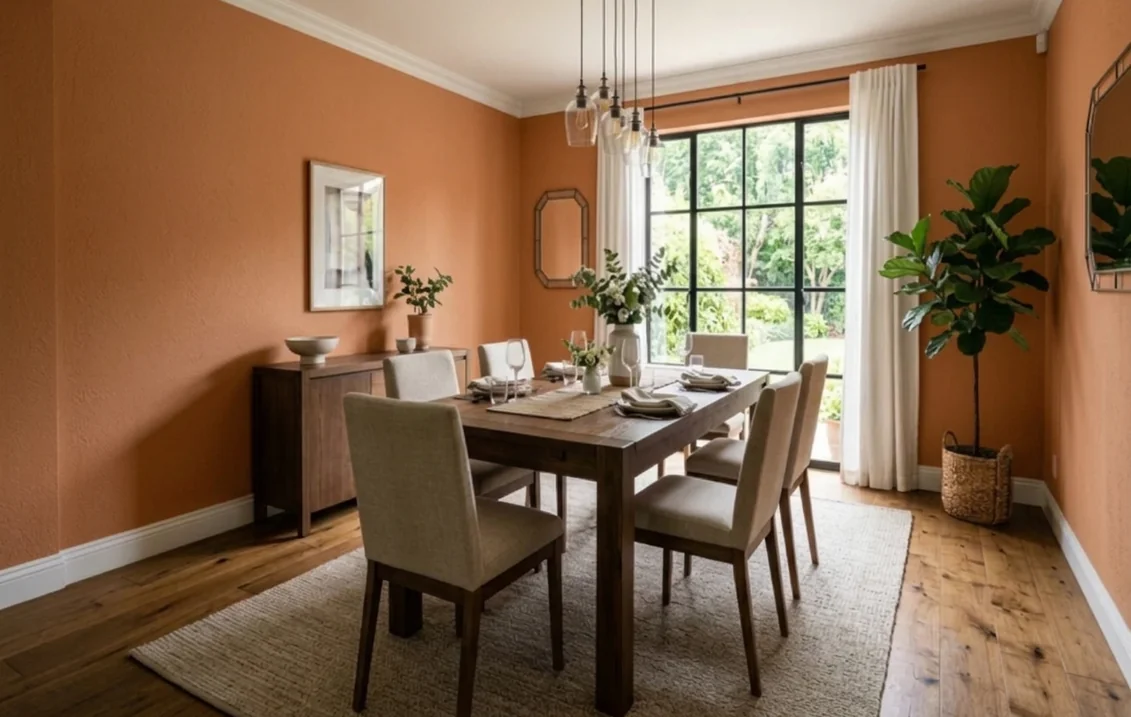
- Dining room. The strongest case for all four walls: the room is used mostly in the evening under warm bulbs, where a dark warm wall is an asset. Sherwin-Williams' sheen guide lists matte for dining rooms and credits that finish with hiding surface imperfections. For other directions, see our dining room paint colors guide.
- Kitchen. Cabinets, backsplash and appliances leave little open wall, so a dark color arrives in a small dose. It needs light counters and white or pale wood cabinets to keep the room bright. Our small kitchen color schemes page covers the cabinet side.
- Living room. All four walls work with south or west light and a white ceiling. With one window, keep it to the fireplace wall or the wall behind the sofa. The terracotta living room ideas page compares it with other clay shades.
- Bedroom. A bedroom is seen mostly under lamps, so the bulb matters more than the window. The usual placement is the wall behind the headboard, in eggshell or satin as the sheen guide suggests for bedrooms. More options are in our terracotta bedroom ideas.
- Accent wall. Pick a wall that receives light, beside or opposite the window; a wall that contains the window is backlit and looks darker than the sample. Our accent wall colors room by room guide helps choose the wall.
- Bathroom. We cover Cavern Clay in small bathrooms, with the other bold options for that room, in colorful small bathroom ideas.
Where it is a weaker fit: a hallway without daylight, a low basement room, and any room whose fixed finishes are cool gray. For the broader family, the earthy warm interior colors guide sets terracotta beside ochres, browns and olive greens.
What colors go with Cavern Clay: trim, ceiling and pairings
Two official lists exist: three coordinating colors on the color page, and five more on the Color of the Year 2019 page. Neither labels a trim color; in the color data, Creamy is the coordinate stored as the white. LRV and hex are the published values. The roles are our suggestions.
| Color | LRV | Hex | Possible role (our suggestion) |
|---|---|---|---|
| Creamy SW 7012 (coordinating) | 81.191 | EFE8DB | Trim, ceiling, adjoining walls |
| Ligonier Tan SW 7717 (coordinating) | 47.268 | D2B18F | Other walls or the next room; same strip (290-C1) |
| Slate Violet SW 9155 (coordinating) | 29.084 | 989192 | Cool gray counterweight: built-ins, a hallway |
| Origami White SW 7636 (2019 page) | 75.999 | E5E2DA | Softer, grayer white for trim or other walls |
| Moth Wing SW 9174 (2019 page) | 29.104 | A0907F | Warm gray for cabinets, doors or a second accent |
| Haven SW 6437 (2019 page) | 42.489 | A3B48C | Green for an adjoining room or painted furniture |
| Distance SW 6243 (2019 page) | 15.191 | 5D6F7F | Blue on an island, a door or a bookcase |
| Dark Clove SW 9183 (2019 page) | 5.064 | 4C3D31 | Deep brown for interior doors or beams; interior use only |
Trim. Creamy sits about 61.3 points of LRV above Cavern Clay and Origami White about 56.1 (our subtraction), so either gives a sharp edge on baseboards and casings. Both lean warm, the safer side for a red-orange wall. Brighter whites also work on paper: Alabaster SW 7008 (LRV 82.215), Pure White SW 7005 (83.957) and Extra White SW 7006 (85.861). Extra White is the coolest of the group, and beside a terracotta wall a cool white can look faintly blue, so test it first. The Creamy undertones guide and the Alabaster guide cover the two warm candidates.
Ceiling. With walls this dark, keep the ceiling white, in a flat finish as the sheen guide suggests for ceilings.
Neutrals, browns, blues and greens. Moth Wing (a warm gray) and Slate Violet (a cool gray with a faint violet cast) have nearly the same LRV, about 29, and show the two ways to go: stay warm, or add a quiet cool contrast. For a deep brown that is also listed for exteriors, Turkish Coffee SW 6076 (LRV 4.664) is the one we cover in our Turkish Coffee guide. Distance and Haven are the brand's two color partners, which it describes as a dusty denim blue and a fresh avocado green.
Cavern Clay beside nearby terracottas
Sherwin-Williams' color data lists ten similar colors for SW 7701, among them Red Cent, Reynard, Spiced Cider and Brandywine. LRV and hex below are the published values. Hue and saturation are our calculation from the RGB values.
| Color | LRV (Sherwin-Williams) | Hex | Hue, saturation (our calculation) |
|---|---|---|---|
| Redend Point SW 9081 | 29.747 | AE8E7E | 20.0 degrees, 0.28 |
| Baked Clay SW 6340 | 25.581 | C1785C | 16.6 degrees, 0.52 |
| Spiced Cider SW 7702 | 23.436 | B0785C | 20.0 degrees, 0.48 |
| Reynard SW 6348 | 20.173 | B46848 | 17.8 degrees, 0.60 |
| Cavern Clay SW 7701 | 19.938 | AC6B53 | 16.2 degrees, 0.52 |
| Red Cent SW 6341 | 18.63 | AD654C | 15.5 degrees, 0.56 |
| Rookwood Terra Cotta SW 2803 | 13.939 | 975840 | 16.6 degrees, 0.58 |
Cavern Clay and Baked Clay. These two share almost the same hue and the same saturation. Baked Clay is the same idea about 5.6 points lighter. Choose it when Cavern Clay looks too heavy on the sample board.
Cavern Clay and Spiced Cider. Spiced Cider is the next chip up on the same store strip (290-C5). It is about 3.5 points lighter, a little less saturated and a few degrees closer to tan: the gentlest step away from SW 7701.
Cavern Clay and Redend Point. Redend Point, the brand's 2023 Color of the Year, is about 9.8 points lighter and has roughly half the saturation. It is a clay-tinted beige where Cavern Clay is a true terracotta, and the easier choice for all four walls in average light. Our Redend Point undertones guide covers it room by room.
Reynard, Red Cent and Rookwood Terra Cotta. Reynard and Red Cent sit within about 1.3 points of Cavern Clay, so the depth is the same and only the character changes: Reynard is more saturated and reads as copper, Red Cent is slightly redder. Rookwood Terra Cotta, from the historic colors, has the same hue about 6 points darker and suits a single wall.
A Benjamin Moore neighbor. Benjamin Moore's Audubon Russet HC-51 page gives an LRV of 20.95, about one point above Cavern Clay, and describes the color as a rich terra-cotta. The page publishes no hex code, so we do not compare hue. Treat it as a starting point in the other fan deck and compare real samples.
Sheen, product and how much paint to buy
The color page names no sheen. The Sherwin-Williams paint sheen guide works by room: matte for dining rooms, satin or eggshell for living rooms and bedrooms, semi-gloss for kitchens and flat for ceilings.
Cavern Clay is a color, not a product, so it can be tinted into the brand's interior lines. The Emerald Interior Acrylic Latex page lists four sheens (flat, matte, satin and semi-gloss). The Emerald Interior Latex Matte data sheet (K36 series, 08/2026) gives the working figures: 350 to 400 square feet per gallon at 4 mils wet, dry to the touch in 1 hour and recoat after 4 hours at 77°F and 50% relative humidity. Three of its notes matter for a dark, saturated color:
- Use the recommended shaded primer to optimize hide and color development; when a repaint involves a drastic color change, a coat of primer improves the hiding of the topcoat. Ask the store which primer shade it recommends for SW 7701.
- When rolling, finish off in one direction, especially for dark colors.
- Touch-ups blend better with the same application method and the same batch. Buy all the paint for the room in one order.
Quantity, our arithmetic. Take a dining room 12 by 14 feet with 8-foot ceilings. The walls measure 416 square feet; subtract about 50 for a door and a window and 366 remain. Two coats make 732 square feet, which at 350 to 400 square feet per gallon is 1.8 to 2.1 gallons: plan on two gallons. Read the data sheet of the exact line and sheen you buy. Our Emerald interior paint review compares the line with the brand's others.
Whatever the shade, ventilate. The U.S. Environmental Protection Agency states that paints, varnishes and wax all contain organic solvents, and advises increasing ventilation when using products that emit volatile organic compounds (VOCs).
Cavern Clay on an exterior, in short
The color page lists SW 7701 for exterior use as well. Two points before taking it outside. Vinyl siding has its own rule: the Duration Exterior Acrylic data sheet says not to paint vinyl with a color darker than the original or with an LRV below 56 unless a VinylSafe color is used, and Cavern Clay is at 19.938. And Dark Clove, one of the 2019 pairings, is listed for interior use only, so choose another dark brown for exterior trim. For stucco, see our stucco color options guide and the Spanish Colonial paint colors page.
Preview Cavern Clay in your own room
An LRV and a hex code do not show how a color sits next to your floor, your sofa or your window light, and with a color this strong the difference between one wall and four is hard to imagine from a chip. Upload a photo of your room and the visualizer shows SW 7701 on the walls, so you can compare it with Baked Clay or Redend Point in the same photo before you order samples. The interior paint visualizer works the same way for any color above.
Sources and references
- Sherwin-Williams, Cavern Clay SW 7701 color page (LRV, hex, RGB, usage, strip locator, coordinating colors): sherwin-williams.com. Read on November 13, 2026. Sherwin-Williams' public color data supplied the Lab values, the similar colors and the figures of the other Sherwin-Williams colors.
- Sherwin-Williams color pages: Creamy SW 7012, Ligonier Tan SW 7717, Slate Violet SW 9155, Baked Clay SW 6340, Redend Point SW 9081
- Sherwin-Williams via PR Newswire, press release of September 12, 2018 (2019 Color of the Year, Wanderer palette): prnewswire.com
- Sherwin-Williams, Color of the Year 2019: Cavern Clay (rooms, materials, five named pairings): sherwin-williams.com
- Sherwin-Williams, guide to color by room orientation and paint sheen guide: orientation, sheen
- Sherwin-Williams, Emerald Interior Acrylic Latex product page and Matte data sheet (K36, 08/2026), Duration Exterior Acrylic Satin data sheet (K33, vinyl rule): product page, Emerald data sheet, Duration data sheet
- Benjamin Moore, Audubon Russet HC-51 color page (LRV 20.95): benjaminmoore.com
- ENERGY STAR, Light Bulb Purchasing Guide (Kelvin scale, warm and cool light): energystar.gov
- U.S. Environmental Protection Agency, Volatile Organic Compounds' Impact on Indoor Air Quality: epa.gov
- Wikipedia, Light reflectance value (definition only, secondary support): en.wikipedia.org
Frequently asked questions
What colors go with Cavern Clay?
What is the LRV of Sherwin-Williams Cavern Clay SW 7701?
Is Cavern Clay orange, red or brown?
Was Cavern Clay a Sherwin-Williams Color of the Year?
What white trim goes with Cavern Clay?
Which rooms suit Cavern Clay?
Can Cavern Clay be used on an exterior?
Is Cavern Clay lighter than Baked Clay?
Trademarks mentioned (Sherwin-Williams, Benjamin Moore, Behr, Caparol, Brillux, Sto, Alpina, Valspar, PPG, Glidden, Dulux, Crown Trade, Sandtex, Farrow & Ball, Johnstone's, Leyland) are property of their respective owners. FacadeColorizer is independent and not affiliated with any of them. Nominative fair use under Lanham Act §1125.