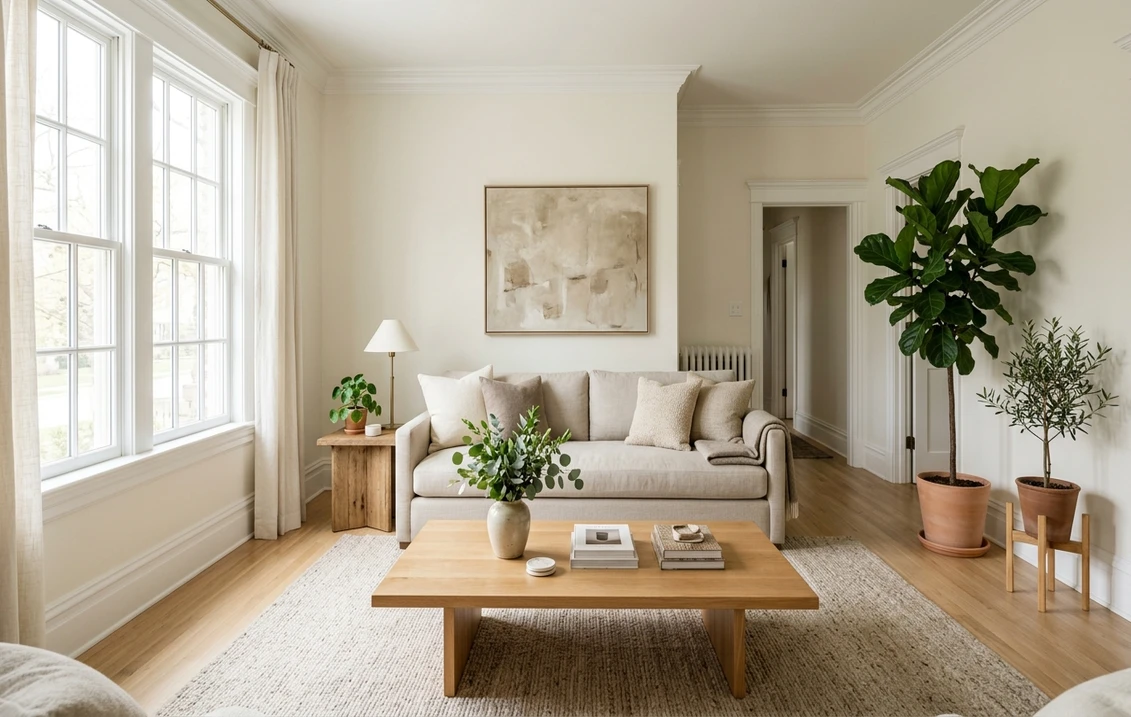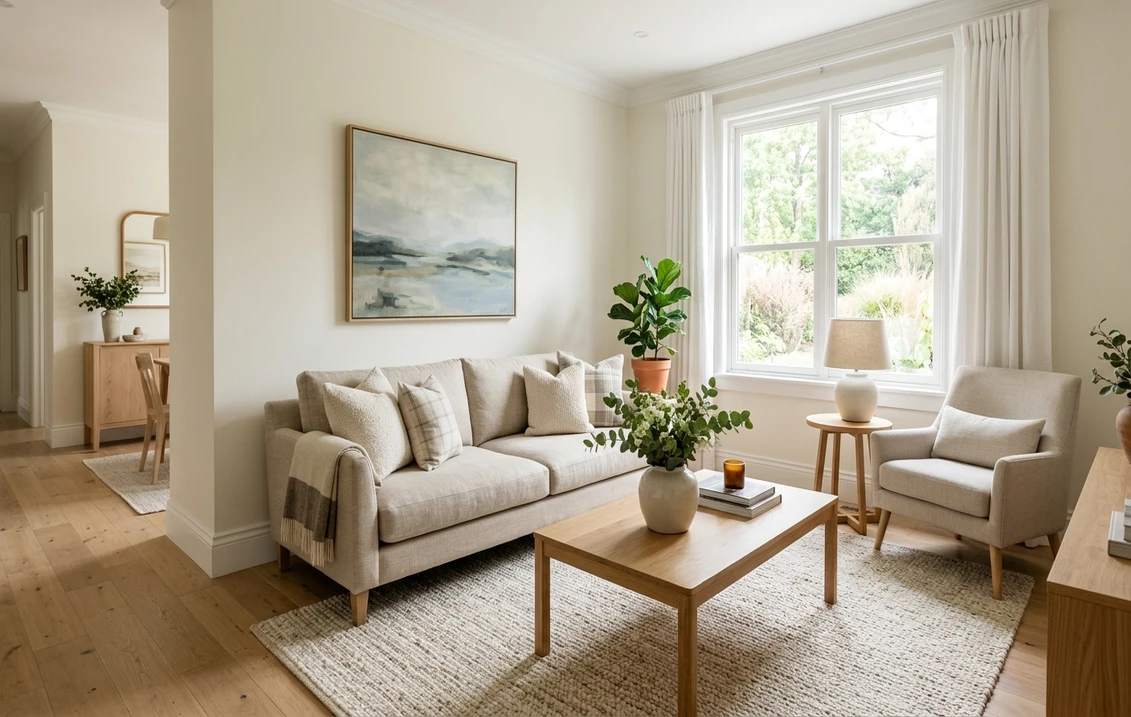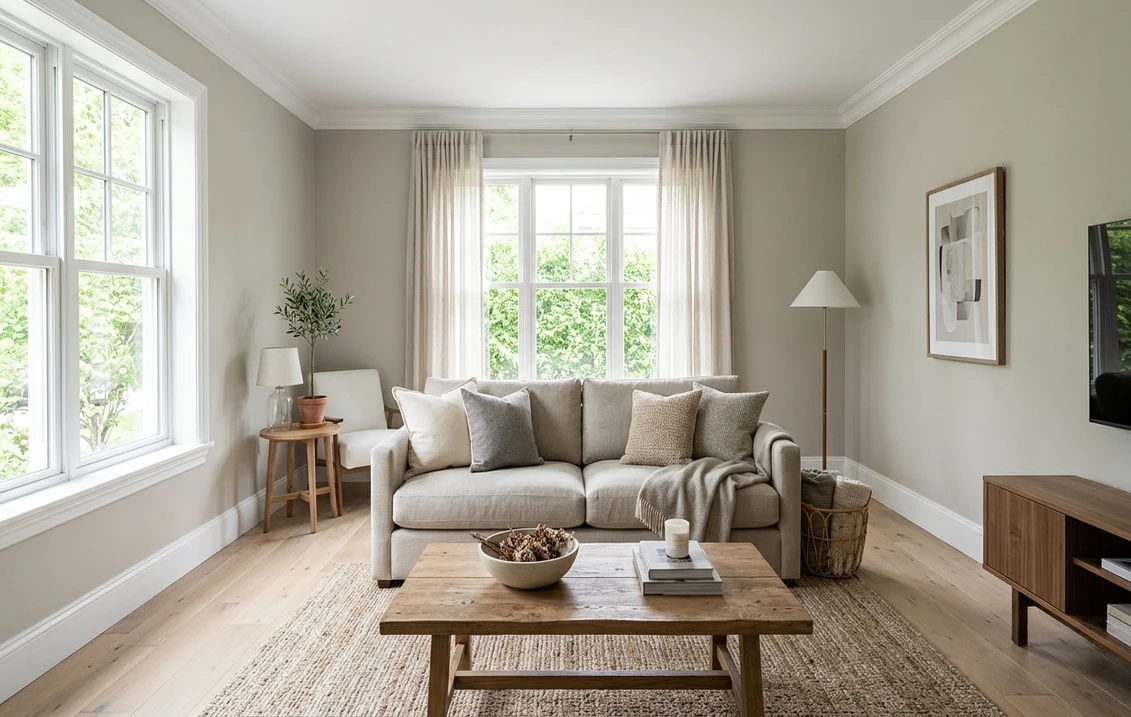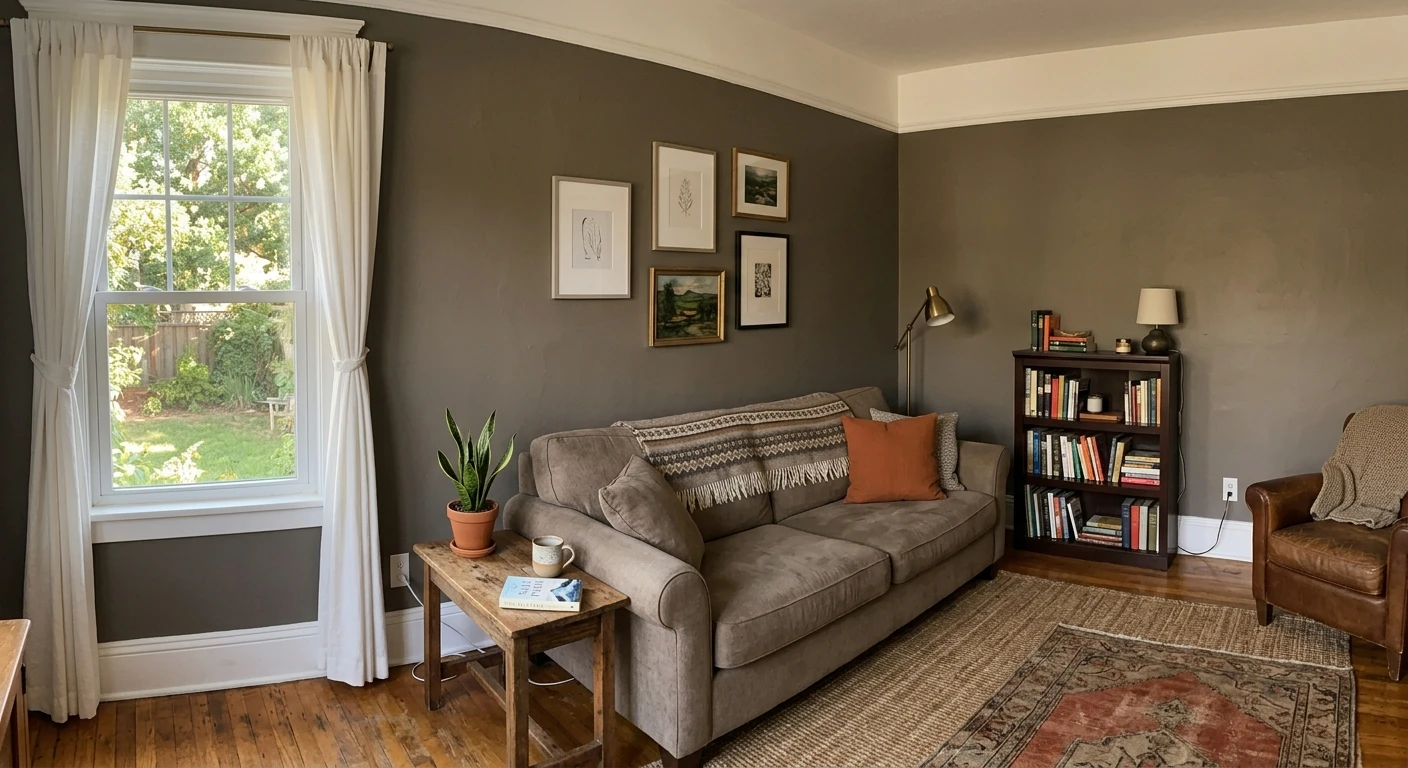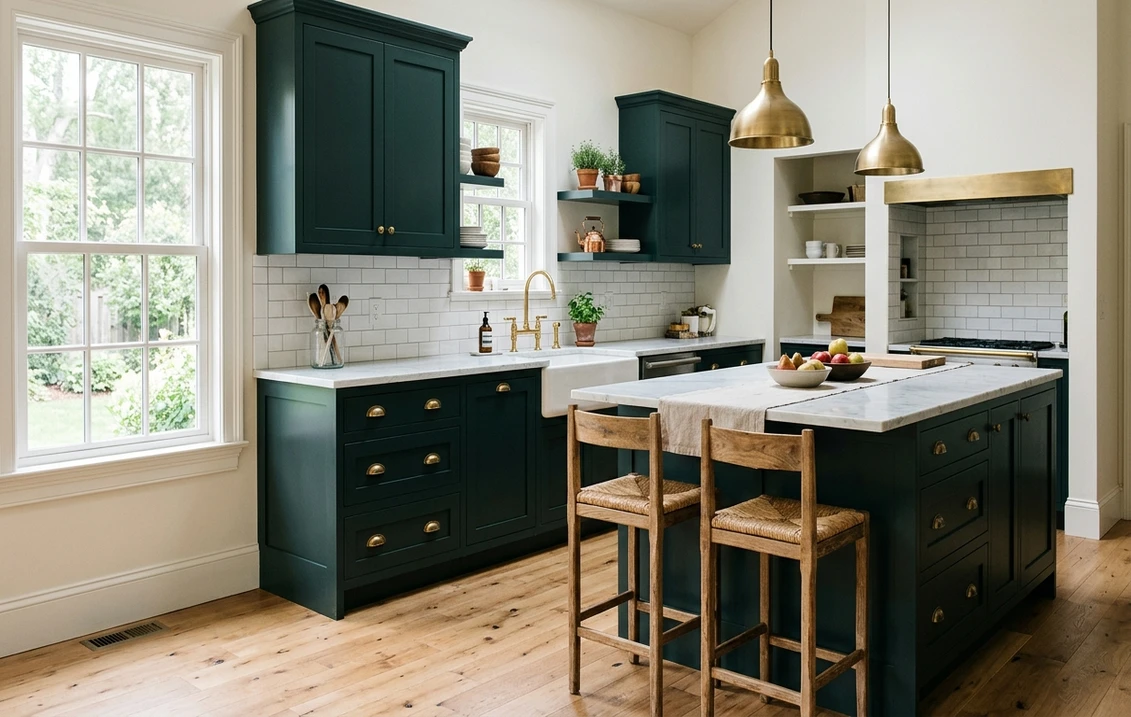

Benjamin Moore Salamander 2050-10 is a very dark teal that sits close to black. The brand describes it as "A deep, dark mix of black, blue, and green" and publishes an LRV of 5.72. The data behind its color page stores the hex code 2F3E3E, which is RGB 47, 62, 62: green and blue are equal and red is the lowest, so the color sits exactly between green and blue before it is darkened almost to black. Benjamin Moore files it in the Green family, and it is the darkest chip of the 2050 strip in the Color Preview collection. Indoors it reads as a soft black on a dim wall and as a blackened blue-green wherever daylight or a lamp reaches it.
One limit first: the color page names no sheen, no room and no Sherwin-Williams equivalent. The undertone readings, room suggestions and cross-brand comparison below are ours, built on the published numbers; where the brand states something, we say so and link to it.
Upload a photo of your room and preview 2050-10 on the walls before you buy a sample.
What Benjamin Moore publishes for Salamander 2050-10
The Salamander color page shows three things in plain view: the description ("A deep, dark mix of black, blue, and green, this color is an intriguing chameleon."), an LRV of 5.72 and the collection, Color Preview. It files the color under the brand's best-selling colors. The page explains LRV as the percentage of light reflected from a surface, from 0 (absolute black) to 100 (pure white).
The data the page carries adds the rest: hex and RGB, the Green family, the tags Blue, Green and Teal, and a list of projects that includes cabinets, front doors, living rooms and offices. Benjamin Moore warns that screen colors may differ, so judge the paint on a physical chip, not on the hex. For the brand's wider palette, start with the Benjamin Moore interior paint colors guide.
| Figure | Value for 2050-10 | Where it comes from |
|---|---|---|
| LRV | 5.72 | Color page |
| Collection and family | Color Preview; Green (tags: Blue, Green, Teal) | Color page and its data |
| Hex and RGB | 2F3E3E; 47, 62, 62 | Color page data |
| Use | Interior and exterior; also a Woodluxe exterior stain color | Color page and its data |
Try it on your room
- 1Your photoPhoto
- 2Your colorColor
- 3HD render in ~30 sHD render in ~30 s
Your photo is used only to create your preview. JPG, PNG, HEIC (iPhone)
What color is Salamander? Green, blue or black
Salamander is a blackened teal. In its RGB values, green and blue are both 62 and red is 47. On the color wheel, green is at 120 degrees, cyan at 180 and blue at 240; Salamander's hue is 180 degrees, the exact midpoint, with a saturation of about 0.14 on a scale from 0 to 1 (our calculation). That saturation is low: most of what you see is a very dark gray, tinted evenly with green and blue.
Green or blue? The brand files 2050-10 in its Green family and tags it Blue, Green and Teal. Neither side wins on paper. Which one you see depends on the light and on what surrounds it, which is the sense of the word "chameleon" in the description. Next to a houseplant it looks bluer; next to navy fabric or blue tile it looks green (our reading).
How close to black? Very close. Benjamin Moore's Black HC-190 has an LRV of 4.56, only 1.16 points below Salamander. The difference is the tint, not the depth: Black HC-190 is RGB 49, 49, 50, a neutral, while Salamander has 15 points less red than green and blue. In a dim room that tint can disappear.
LRV 5.72 and the 2050 strip
An LRV of 5.72 means the color reflects under 6 percent of the light that reaches it. Salamander is the last of seven chips numbered 2050; its page lists the six lighter ones as shades to explore. The LRV values are Benjamin Moore's; the gaps are our subtraction.
| Chip | Color | LRV (Benjamin Moore) | Points lighter than Salamander |
|---|---|---|---|
| 2050-70 | Blue Bonnet | 81.8 | 76.1 |
| 2050-60 | Arctic Blue | 70.86 | 65.1 |
| 2050-50 | Waterfall | 55 | 49.3 |
| 2050-40 | Florida Keys Blue | 35.4 | 29.7 |
| 2050-30 | Newport Green | 16.76 | 11.0 |
| 2050-20 | Dollar Bill Green | 8.69 | 3.0 |
| 2050-10 | Salamander | 5.72 | 0 |
The names move from blue at the top to green at the bottom, and Salamander closes the column with both. Dollar Bill Green, one step up, is "touched with blue undertones" in Benjamin Moore's words; with RGB 50, 86, 84 it is nearly twice as saturated as Salamander by our calculation (about 0.26 against 0.14). If Salamander looks too black on your sample board, try that chip.
Light and bulbs: when the green and the blue show
Benjamin Moore's Color Handbook gives general rules: direct midday sun will brighten up any hue, and artificial light adds a warm glow to wall color. It does not mention Salamander; applied to a color this dark, in our reading:
- Direct daylight is where the teal is visible: a cabinet run beside a window reads blue-green.
- Weak or indirect daylight leaves a soft black with a cool cast.
- Warm evening lamps add yellow, which pulls an even blue-green toward green-black.
For bulbs, the U.S. Department of Energy's guide to purchasing energy-efficient light bulbs lists typical color temperatures from warm at 2,700 K to cool at 4,100 K: the warm end shows Salamander at its greenest and the cool end at its bluest (our reading). The Handbook's sampling advice applies here: paint a board, move it around the room and watch it through the day.
Essex Green vs Salamander and other close Benjamin Moore darks
The table lists the LRV, hex and family that Benjamin Moore publishes, from darkest to lightest. Hue and saturation are our calculation from the RGB values.
| Color | LRV (Benjamin Moore) | Hex | Family | Hue, saturation (our calculation) |
|---|---|---|---|---|
| Black Forest Green HC-187 | 4.85 | 242E2C | Neutral | 168°, 0.12 |
| Essex Green HC-188 | 5.64 | 27362E | Green | 148°, 0.16 |
| Salamander 2050-10 | 5.72 | 2F3E3E | Green | 180°, 0.14 |
| Pacific Sea Teal 2049-10 | 5.93 | 274043 | Blue | 186°, 0.26 |
| Regent Green 2136-20 | 6.16 | 364042 | Blue | 190°, 0.10 |
| Hunter Green 2041-10 | 6.39 | 2A453D | Green | 162°, 0.24 |
What is the difference between Essex Green and Salamander?
Depth is not the difference. The Essex Green HC-188 page gives an LRV of 5.64, which is 0.08 points below Salamander, a gap no one will see on a wall. The difference is the blue. Essex Green's values are 39, 54, 46: green is clearly the highest and blue sits 8 points under it, so the hue lands at 148 degrees, on the green side of the wheel. In Salamander, blue equals green. Benjamin Moore's words follow the numbers: Essex Green, from the Historical Colors collection, is "a nearly black shade of green", with no blue in the sentence.
Seen from Salamander's side, the choice comes down to the room (our reading):
- Choose Salamander when the fixed finishes are cool: gray-veined marble, chrome or nickel, blue-gray tile. Its blue half ties into them.
- Choose Essex Green when you want the color to say green, beside red brick, cream trim or traditional millwork. Its coordinating colors on the brand's page include Powell Buff HC-35 and Monterey White HC-27.
Our Essex Green review looks at that color on its own, mostly on shutters and doors. See also the Hunter Green 2041-10 review, the lightest of the group, and the Black Forest Green review, the darkest. Among the four colors the Salamander page lists as similar (Regent Green, Pacific Sea Teal, Midnight 2131-20 and Blacktop 2135-10), Pacific Sea Teal is 0.21 points lighter and almost twice as saturated: Salamander with more visible teal.
Is there a Sherwin-Williams equivalent to Salamander?
No official one: neither color page gives a cross-brand match. What can be compared is the published data. The four Sherwin-Williams colors below are the nearest we found on LRV and RGB values; the selection and the comments are our comparison, not a manufacturer's statement.
| Color | LRV (published) | Hex and RGB | Against Salamander (our comparison) |
|---|---|---|---|
| Salamander 2050-10 (Benjamin Moore) | 5.72 | 2F3E3E; 47, 62, 62 | Reference |
| Cascades SW 7623 | 4.241 | 273E3E; 39, 62, 62 | Same hue, more saturated, about 1.5 points darker |
| Rookwood Shutter Green SW 2809 | 4.093 | 303B39; 48, 59, 57 | Nearest RGB values; slightly greener, about 1.6 points darker |
| Jasper SW 6216 | 4.113 | 343B36; 52, 59, 54 | Clearly greener (hue 137 degrees), about 1.6 points darker |
| Mount Etna SW 7625 | 6.172 | 3D484C; 61, 72, 76 | Nearest LRV (about 0.5 points lighter), but bluer and grayer |
Cascades is the closest in character. The Cascades SW 7623 page gives green 62 and blue 62, the same two values as Salamander, with red at 39 instead of 47. The hue is identical and the saturation higher (about 0.23 against 0.14): more teal, a little darker. Rookwood Shutter Green SW 2809 has the smallest color difference by our calculation. Jasper SW 6216 is the pick for the green side, and Mount Etna SW 7625 keeps the lightness but turns blue-gray.
None of the four is a twin: three are darker by about a point and a half, and the fourth changes hue. Compare physical chips side by side in the room before you settle on a substitute.
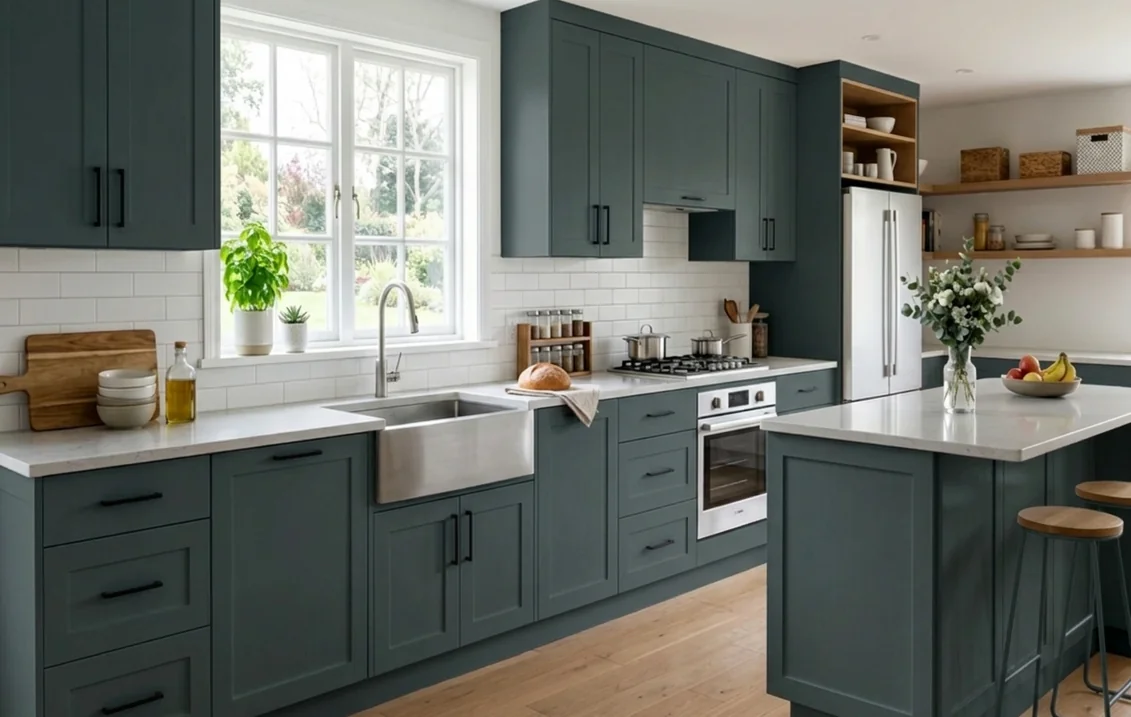
Salamander on kitchen cabinets and built-ins
Cabinets are among the projects Benjamin Moore's page data tags for this color. On cabinetry it works as a black with more depth: near-black beside a white counter, teal under the window or the pendant lights. Three combinations to preview (ours): the island only, with white perimeter cabinets; lower cabinets with white uppers; built-in shelves around a fireplace, with warm white walls. Our guide to green kitchen cabinet colors covers lighter and brighter options.
For the paint, Benjamin Moore's guide How to Paint Kitchen Cabinets recommends Advance Interior Paint over Fresh Start High-Hiding All-Purpose Primer, in nine steps. Its key points:
- Remove doors, drawers and hardware, degrease, then sand with 100- to 150-grit paper.
- Prime, wait at least 1 hour, then sand lightly with 220-grit paper. The guide warns: "Do not use a lacquer-based primer, as it can impede how Advance adheres to the surface of the cabinets."
- Apply two coats of Advance, sanding with 220-grit paper between them.
- Let the cabinets dry at least 24 hours before reassembly, and avoid heavy abrasion or cleaning for at least five to seven days.
The technical data sheet for Advance Semi-Gloss (793) adds the numbers: 400 to 500 square feet per gallon, 4 to 6 hours to touch and 16 hours to recoat at 77 °F and 50 percent relative humidity, and up to 30 days to reach optimum hardness and final sheen. Two of its lines matter for a color this dark. For best hiding, it says to tint the primer to the approximate shade of the finish coat, especially for a significant color change, as when white or oak cabinets go to Salamander. It also notes that certain custom colors require a deep color base primer: ask your retailer.
The 16-hour recoat time is the constraint: two coats on both faces of every door take several days. Our Benjamin Moore Advance cabinet paint review covers the product, and the step-by-step guide to painting kitchen cabinets covers the sequence.
Upload a photo of your kitchen and recolor the cabinets while the counters, backsplash and walls stay as they are.
Trim, interior doors and paneling
Salamander on trim reverses the usual scheme: light walls, dark woodwork. It suits a paneled study, a staircase or a single interior door. Benjamin Moore's guide How to Choose a Paint Finish says satin is ideal to highlight windows, shutters, trim and even interior doors, and its sheen chart lists semi-gloss for trim, doors, cabinets and wainscoting.
With a near-black, the sheen changes the color you see (our reading): a glossier finish reflects more of the window and the lamps, so the teal shows in the highlights, while a flatter one stays closer to black. The same guide sets the limit for high gloss: because a gloss finish can accentuate blemishes, avoid it on areas that are not completely smooth. On dented old doors, satin is safer. For door colors in general, see our page on interior door colors.
Walls: accent wall, dining room and powder room
On walls, an LRV under 6 means the surface returns very little light, so the lighting plan matters as much as the paint. The three uses below are our suggestions.
Accent wall. The lowest-risk way to use it. Choose a wall that daylight hits from the side, such as the one behind a bed or a sofa, so the teal shows. The wall that contains the window is backlit and will read black. Our guide to accent wall colors compares other dark options.
Dining room. A room used mostly in the evening is where a near-black is easiest to live with. Under warm bulbs Salamander goes green-black, which sits well with wood furniture and brass. The finish guide lists matte for dining rooms and credits it with excellent hide and depth of color. More ideas are in our green dining room paint ideas.
Powder room. A small room with no shower can take all four walls in one dark color. With no window, the bulb alone sets the result: check the sample under the actual fixture. For rooms exposed to more moisture, the finish guide points to Aura Bath & Spa, a matte paint designed for high-humidity environments. See also our powder room paint colors.
What colors go with Salamander: whites, brass and wood
The Salamander page shows four coordinating colors under "Color Combinations". The LRV values are Benjamin Moore's; the roles are ours.
| Color | LRV (Benjamin Moore) | Possible role (our suggestion) |
|---|---|---|
| White Dove OC-17 | 83.16 | Soft white for walls, trim or upper cabinets |
| Sebring White OC-137 | 78.5 | Cooler white for walls beside Salamander cabinets |
| Edgecomb Gray HC-173 | 63.09 | Warm light neutral for adjoining rooms |
| Silver Marlin 2139-50 | 55.99 | Mid-tone gray for walls with Salamander trim |
Whites. White Dove sits about 77 points above Salamander and Sebring White about 73, so either gives a strong contrast. Benjamin Moore describes Sebring White as "a sleek, refreshing white with cool green undertones", which echoes the green half of Salamander; White Dove is the warmer of the two. For a brighter trim than either, Simply White OC-117 (LRV 89.52) and Chantilly Lace OC-65 (90.04) are our additions, not colors listed on the page. The brand's four picks split into a cool pair (Sebring White and Silver Marlin, a gray with "a hint of blue-green") and a warm pair (White Dove and Edgecomb Gray). The White Dove OC-17 review and the Edgecomb Gray HC-173 review cover the warm pair in detail.
Brass and wood. Benjamin Moore publishes nothing on metals or wood for this color; this part is ours. Salamander is a cool color, and brass, oak and walnut are warm, so they stand out against it instead of blending in. Brass pulls read clearly on a Salamander drawer front where black hardware would vanish. An oak floor or walnut shelves do the same on a larger scale; chrome or nickel keeps the scheme cool. For wider palettes, see colors that go with dark green.
Sheen and Benjamin Moore product line
These are Benjamin Moore's own statements, not independent tests. The finish guide's chart lists matte for walls in living rooms, dining rooms and bedrooms, eggshell for high-traffic walls, and semi-gloss or high gloss for trim, doors and cabinets; it calls Advance Semi-Gloss one of the best paint finishes for kitchen cabinets. The Advance Interior Paint page lists three sheens, satin, semi-gloss and high gloss, and its data sheet calls the paint ideal for interior doors, trim and cabinets.
For walls, the Aura Interior page presents that line as the brand's highest-performing paint and states that it stands up to repeated washing with no color rub-off or loss of sheen. The finish guide adds a caution that applies to any low-sheen dark wall: stains are harder to remove from low-sheen paint, and constant rubbing can result in burnishing. Our page on semi-gloss paint for kitchen cabinets weighs satin against semi-gloss.
Whatever the product, ventilate. The Advance data sheet says to ensure fresh air entry during application and drying, and the U.S. Environmental Protection Agency advises increasing ventilation when using products that emit volatile organic compounds, a group in which it lists paints.
Preview Salamander in your own room
Your counters, floor and window decide whether you see green, blue or neither. Upload a photo to the interior paint visualizer and it shows 2050-10 on the walls or the cabinets, next to Essex Green or a plain black, before you order samples.
Sources and references
- Benjamin Moore, Salamander 2050-10 color page and the data it carries (description, LRV, collection, combinations, similar colors, shades, hex, RGB, tags). Read on November 15, 2026.
- Benjamin Moore color pages: Essex Green HC-188, Black Forest Green HC-187, Hunter Green 2041-10, Pacific Sea Teal 2049-10, Regent Green 2136-20, Black HC-190, Sebring White OC-137, White Dove OC-17
- Benjamin Moore guides: How to Paint Kitchen Cabinets, How to Choose a Paint Finish, The Color Handbook
- Benjamin Moore, Advance Semi-Gloss 793 technical data sheet, PDF, with the Advance and Aura Interior product pages
- Sherwin-Williams color pages: Cascades SW 7623, Rookwood Shutter Green SW 2809, Jasper SW 6216, Mount Etna SW 7625 (LRV, hex, RGB)
- U.S. Department of Energy, Purchasing Energy-Efficient Light Bulbs (color temperatures)
- U.S. Environmental Protection Agency, Volatile Organic Compounds' Impact on Indoor Air Quality (ventilation advice)
Frequently asked questions
What color is Salamander by Benjamin Moore?
What is the LRV of Benjamin Moore Salamander 2050-10?
Is Salamander green or blue?
What is the Sherwin-Williams equivalent of Benjamin Moore Salamander?
What is the difference between Essex Green and Salamander?
Is Salamander a good color for kitchen cabinets?
What white goes with Benjamin Moore Salamander?
What sheen should I use for Salamander?
Can Salamander be used on exteriors?
Trademarks mentioned (Sherwin-Williams, Benjamin Moore, Behr, Caparol, Brillux, Sto, Alpina, Valspar, PPG, Glidden, Dulux, Crown Trade, Sandtex, Farrow & Ball, Johnstone's, Leyland) are property of their respective owners. FacadeColorizer is independent and not affiliated with any of them. Nominative fair use under Lanham Act §1125.